


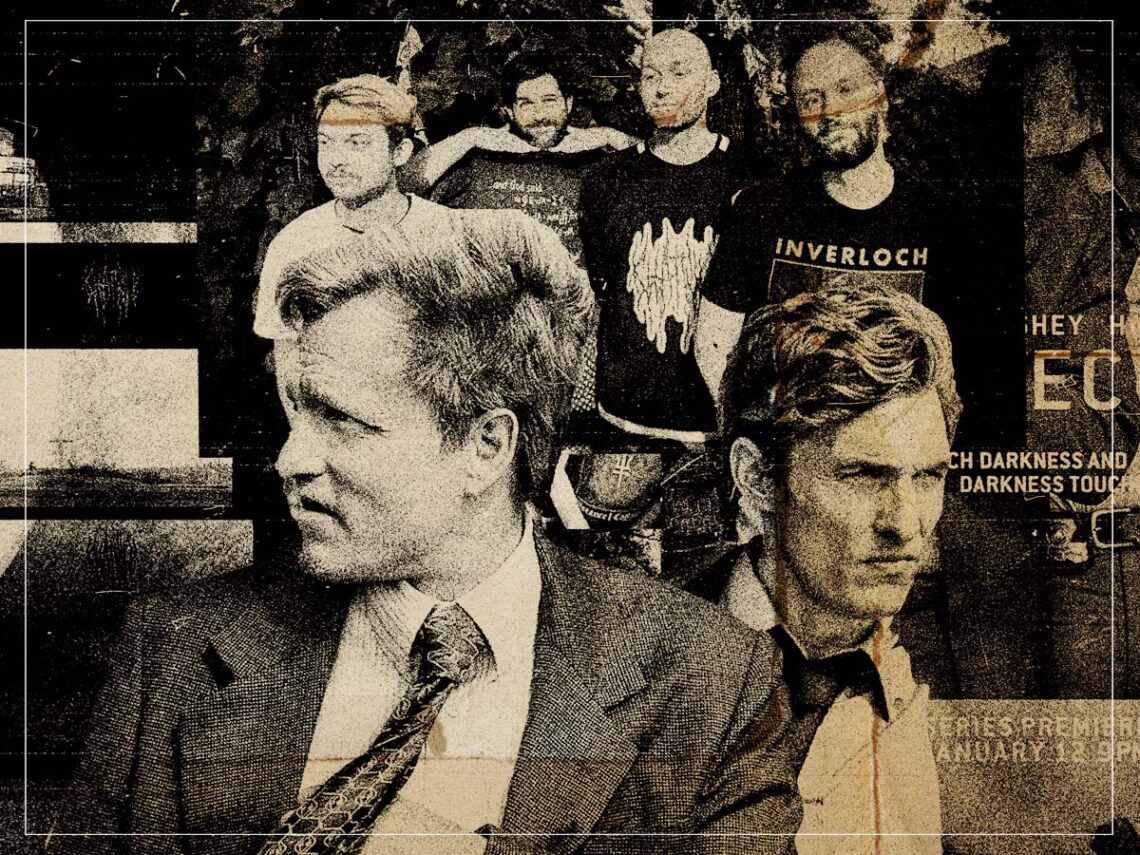
Cultural Connections: Chat Pile, ‘True Detective’, and the black heart of contemporary America

America is broken. Following years of political turmoil and the dire economic reality that many citizens face, making life a perilous struggle where basic human needs are not fulfilled, the name the United States has never seemed so ironic. The super-wealthy continue to line their coffers while most ordinary people struggle to put food on the table, as women and minorities toil against endemic discrimination, and the Conservative Christian right finds themselves in power once more. When you factor in continued post-industrialism, a looming environmental collapse, and a new Cold War, it makes you wonder how long the black heart of America will last before it bursts and the whole sickly structure tumbles headfirst into the asphalt of oblivion.
This stasis has made its way into an array of media. Yet, two of the most compelling conduits at conveying this sense of a broken American from deep within its bowls are 2014’s True Detective season one and Oklahoma City sludge/doom metal purveyors Chat Pile. While you might ordinarily think that there would be scarce similarities between a massively successful TV show starring Hollywood greats Matthew McConaughey and Woody Harrelson, brought to life by HBO, and one of the contemporary era’s finest heavy bands, there is a clear cultural connection.
Chat Pile have been open about the fact that they take inspiration from an array of sources, with horrific real-life tales feeding into their music, as well as Nick Cave’s Murder Ballads and a variety of films. Furthermore, their music presents an unsettling and frank depiction of the dire state of their country and native southern region. While they hail from the southwest, their rendering of an economically, politically and spiritually broken area presents a profoundly visual and sonic parallel to the nihilistic picture Nic Pizzolatto paints of the southeast in the first outing of True Detective. Interestingly, Pizzolatto carried this on in the third season, set in the Ozark region, a part of Chat Pile’s Oklahoma.
Chat Pile’s music and True Detective season one are immensely nihilistic and frame some of the most nightmarish snapshots of contemporary America. The fact that the band mix their immensely haunting, formidable sound – featuring de-tuned riffs and frontman Raygun Busch’s hellish deep drawl and occasional pained scream – with grim tales often based on the real-life state of nature that is America makes for an emphatic lesson. Just like life for droves in the country, it is severe. That’s precisely the point, and besides the evident aural hardness that would put many off, there’s real art at play.
Chat Pile’s aesthetic is a spiritual cousin to True Detective season one. It echoes the sagacious but utterly despondent philosophical ponderings of McConaughey’s Rust Cohle, the cigarette-smoking, bewitching, but incredibly troubled detective. It goes without saying that Cohle’s takes on the blackened heart of America are some of the most profound ever heard in visual media.

Ever the pessimist, Cohle refers to human beings as “sentient meat”, a topic duplicated in Chat Pile songs such as ‘I Am Dog Now’ and, perhaps more explicitly, ‘Slaughterhouse’. The latter, taken from their 2022 debut God’s Country, delves into real-life horror more deeply than in most of their other songs by describing a 2014 beheading at a slaughterhouse in Moore, Oklahoma. That shocking outburst of brutality, reportedly inspired by the Islamic terror group ISIS, provides Busch with a footing to parallel Cohle’s point in a perfectly grim setting. Just like the bovine we slaughter en masse, humans are meat, and our lives can be taken away in a horrific blink of an eye due to religion and the global economic order, both of which are major contributing factors to this laboured death of America.
Take the title and front cover of God’s Country as another example of this symbiosis. The dismal, post-industrial image of the Oklahoma County Detention Center—where 11 people died in 2022—not only aptly conveys the essence of the album’s contents but also looks like a setting straight out of True Detective. Furthermore, the name God’s Country serves as a perfect satire of how religious residents of these specific regions—and the country at large—believe they live in the best place on earth, thanks to God Almighty himself.
Then there’s the cover of 2024’s second album, Cool World—which takes its title from the unsettling 1992 film of the same name. With its barren post-industrial landscape and a cross hauntingly looming at the top of a hill, it seems to typify True Detective’s take on the Bible Belt in season one. Religion is money, and money is religion—and together, they’ve created a hollow husk of a society. Cohle’s following quotes are also crucial: “It’s all one ghetto, man. A giant gutter in outer space”.
“This place is like somebody’s memory of a town, and the memory is fading. It’s like there was never anything here but jungle.”
Rust Cohle
Once more, Chat Pile’s work brings these images to mind vividly.
A series of Rust Cohle’s postulations are echoed in Chat Pile’s work. As part of his concerted attack on Christian America, Cohle states: “If the only thing keeping a person decent is the expectation of divine reward, then, brother, that person is a piece of shit.”
He continues, “You gotta get together and tell yourself stories that violate every law of the universe just to get through the goddamn day? What’s that say about your reality?”
In ‘Shame’ from Cool World, Busch appears to troll this very subject. He references the brutality of modern war and its cynical motivations, with “all our fathers smiling” through it as it unfolds—all while God remains “silent”.
One of Cohle’s most potent takes is the following: “We are things that labour under the illusion of having a self; an accretion of sensory, experience and feeling, programmed with total assurance that we are each somebody, when in fact everybody is nobody. Maybe the honourable thing for our species to do is deny our programming, stop reproducing, walk hand in hand into extinction, one last midnight – brothers and sisters opting out of a raw deal.”
This heavily alludes to how humanity has surrendered its self-agency to religion and the neoliberal world order—something seen in droves across America and beyond, as people struggle against hegemonic institutions of their own making. Like Cohle, Busch and Chat Pile see this reality everywhere. In ‘I Am Dog Now’, the band explicitly addresses how man is being reduced to his animalistic self under these conditions. “You fucking take / I am dog now,” Busch sings at one point, and in another, “Veins full of garbage / I am dog now.”
In ‘Funny Man’ from Cool World, Busch also delivers some of his most brutal descriptions of reality. Examining the every-man-for-self nature of America and the world, he repeats, “Outside, there’s no mercy.” Other lines delve into how these forces are wreaking hellish havoc, such as, “If the horror don’t kill me, my rotten teeth will” and, perhaps most pointedly, “I help them to live, but why am I living?”
Rust Cohle’s underlying effect is that he is a frank commentator on the state of America and, by proxy, the world. Chat Pile also fit into this category. If there’s one quote that unites them closer than any, it is the following: “Death created time to grow the things that it would kill.” Both know that we are just pawns on the chessboard.
