


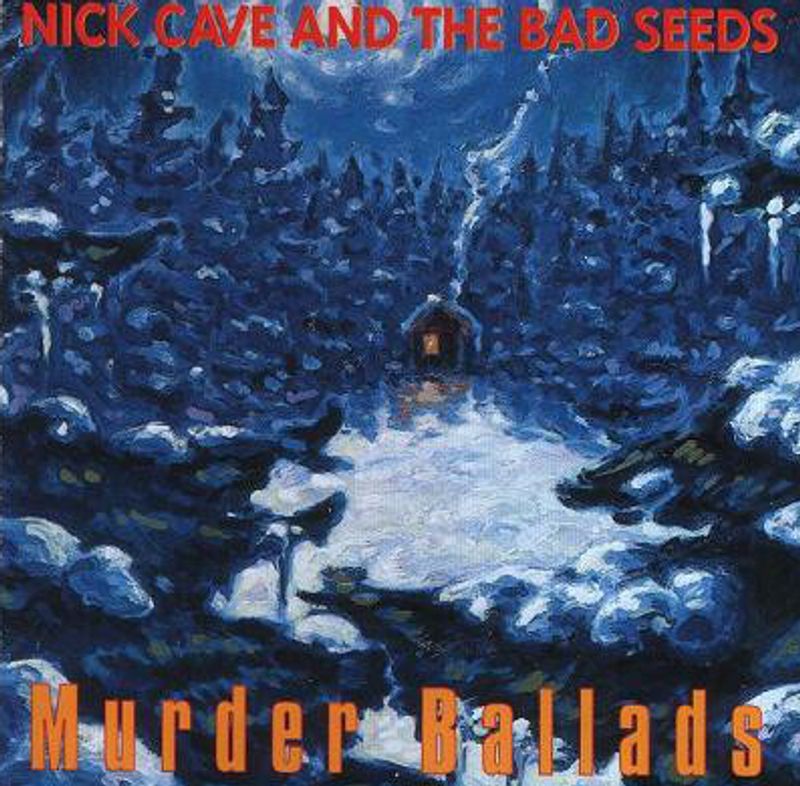
Nick Cave & The Bad Seeds – ‘Murder Ballads’

Edgar Allan Poe once wrote that “the death of a beautiful woman is, unquestionably, the most poetical topic in the world—and equally is it beyond doubt that the lips best suited for such a topic are those of a bereaved lover.” That is the pasture that Nick Cave & The Bad Seeds picnic upon with the gruesome Murder Ballads. Or at least the album opines that Poe was half right; not all bereaved lovers were created equal, and Cave and the gang take a macabre turn towards the extreme end of gothic that even went beyond the grasp of Poe’s dark, red right pale.
“I had no idea what happiness a little love could bring,” Cave growls in the opening track ‘Song of Joy’. Never has a greater misnomer been granted to a song, and that grisly act of unreliable dictation proves to be the perfect entry point for an album that joyously relishes in the dichotomous divide of love and evil, of beauty and ugliness, of murder and ballads.
As the frontman once said himself: “Do you want to know how to write a song? Songwriting is about counterpoint. Counterpoint is the key. Putting two disparate images beside each other and seeing which way the sparks fly. Like letting a small child in the same room as, I don’t know, a Mongolian psychopath or something, and just sitting back and seeing what happens. Then you send in a clown, say, on a tricycle and again you wait, and you watch. And if that doesn’t do it, you shoot the clown.”
Those are the words of a man who has no time for tentative art that trifles in self-conscious restrain. That creative disposition certainly comes to the fore in ‘Stagger Lee’. The title implies that it’s a blues song that you’ve heard before, but by the end, it becomes clear that it’s like nothing you’ve ever known. In a strange way, that almost makes it the perfect introductory track to Cave’s oeuvre.
The slutty song sees him so uncompromised that the perversion acts as a come hither to the curious mind. It’s stark, gruesome, rotten to the core, and entirely bad for you, but figuratively speaking, you just can’t take your eyes off it. It’s the sickening carcass that appears in the woods on what was supposed to be a pleasant jaunt through nature—appealing to the iniquitous human desire to be shocked and excited away from ourselves that ensures it’s simply more alluring than the splendour of nature alone.
That description is more visual than musical by design—the song unfurls more like a movie scene in the mind than a rock track. The same can be said for the bulk of the Murder Ballads. The colour of cacophony that preceded The Bad Seeds’ work on previous albums is traded for a more faithful sense of instrumental atmosphere that fit the songs without any thrills or fat. All the while, a sense of melody also punctuates the ballads helping to establish them as something akin to folklore fables from a rather horrible but very musically gifted town.
While that might sound like a squeamish affair, Cave saves it from becoming a monochrome world of monotony by utilising the most underrated zest in art: humour. Take, for instance, this pitch-black piece of comic poetry in the epic ‘O’Malley’s Bar’: “I jammed the barrel under her chin / and her face looked raw and vicious / her head it landed in the sink with all the dirty dishes.”
Nick Cave said himself, “Despite what people may think, I’m not interested in being dark all the time,” and despite what people may think, even at his most macabre, he very rarely is. It doesn’t get much darker than songs of the dearly dead but quips like this spear an assegai of vitality through the procession to make for a record that just about encapsulates why we find darkness so fascinating.
To complete the quote above, Cave went on to say, “I’m actually searching for some kind of light and I’m very happy when I achieve that.” Whether the light amidst the darkness is an injection of poetical hope or pithy humour, it always embellishes the song. When it comes to the jabs of his sniping whit, it elevates the track not just through counterpoint but because it establishes him as one of the few ‘serious songwriters’ who can genuinely prise a chuckle. In an album that deals in death, he has identified the importance of that, and he springs it throughout.
The result is a record with all the textured tones of the literary greats who helped to inspire it. In this regard, you can’t lose with the Murder Ballads; it has waltzes like ‘Henry Lee’ and ‘Where the Wild Roses Grow’ that are simply melodic masterpieces performed with poster-worthy sex appeal, but in the moments where melody abates, and things get less lovable in the manic ‘The Curse of Millhaven’, you’re still left with a captivating story that pulls the shutters closed on the outside world to allow for a few moments of escapism – the sort of escapism that rings true with another of Poe’s tenets: “There is no exquisite beauty… without some strangeness in the proportion”
