


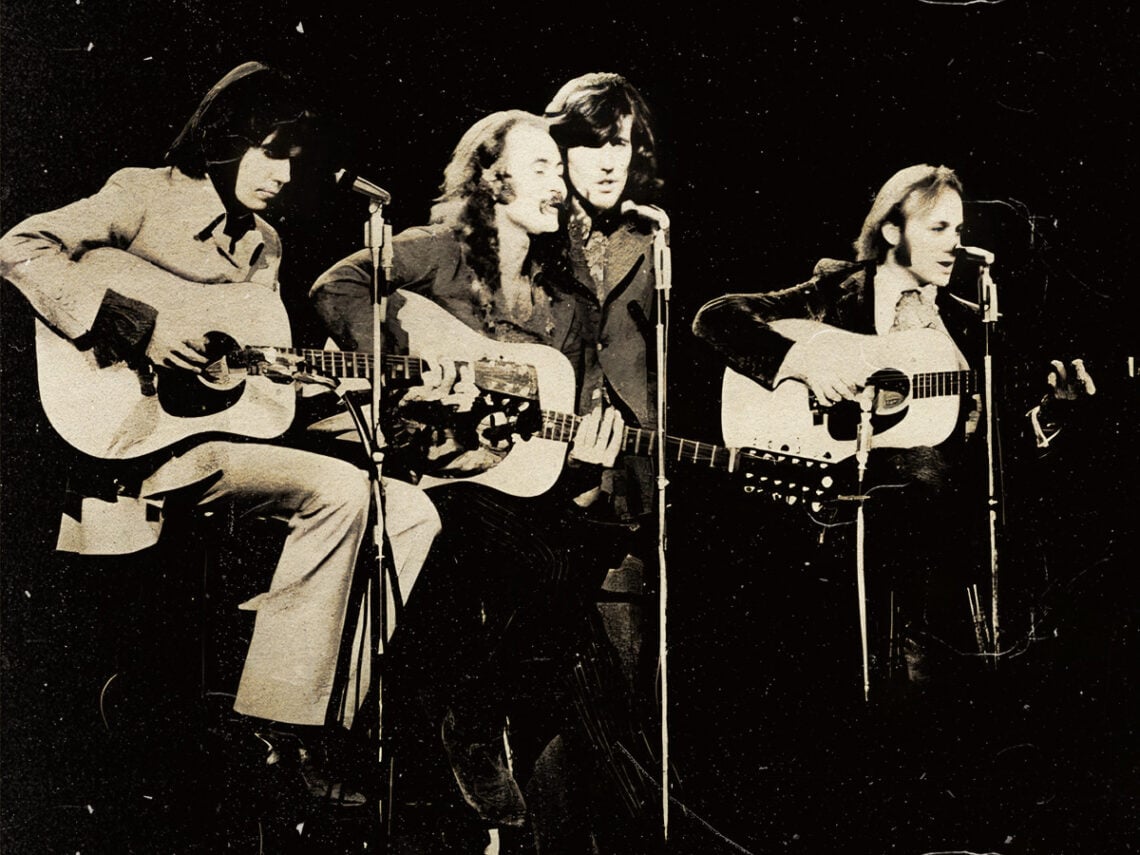
“Humanity was in great danger”: The CSNY song about the folly of war

‘Teach Your Children’ was a standout track for Crosby, Stills, Nash & Young on their seminal 1970 album, Déjà Vu. It peaked at number 16 on the Billboard Chart and continues to enjoy critical acclaim, but the highly poignant song began life two years earlier, during a particularly dark period in American history, the scars from which are yet to fully heal.
The song’s author, Graham Nash started writing ‘Teach Your Children’ in 1968, whilst still a member of The Hollies. The year before, the newly crowned World Heavyweight Champion, Muhammad Ali, had been threatened with prison and stripped of his title for refusing the draft. Over the following months, anti-Vietnam War sentiment had grown exponentially, particularly among the younger demographic. January 1968, saw the beginning of the Tet Offensive, a major escalation of the conflict. The American public were shocked by a call for 200,000 more US soldiers to be deployed.
The following month, American police clashed with civil rights demonstrators at a college campus in South Carolina. Three African American students were killed in what became known as the Orangeburg Massacre. On April 4th, civil rights leader Martin Luther King Jr. was shot dead at the Lorraine Motel in Memphis, Tennessee, sparking days of riots across the country. Eight weeks later, a lone gunman assassinated Robert F. Kennedy at the Ambassador Hotel in Los Angeles.
It must have seemed like the end times. A terrifying world full of never-ending war and horrifying violence. Great art often emerges from despair, and Nash funnelled the nation’s anxiety and desperate hopes for a better future into ‘Teach Your Children.’ As he explained in the liner notes for a 1991 box set: “The idea is that you write something so personal that every single person on the planet can relate to it.”
It was a visit to an art gallery which crystallized the essence of the song in Nash’s mind. He saw two photographs side by side, and their juxtaposition pierced his heart. He recalls: “…two images had been put together. One by a woman named Diane Arbus of a boy in Central Park with a hand grenade. And the other next to it was an image of Krupp, who was the German arms manufacturer for both World War I and World War II…”
The Arbus photograph perfectly summarises the uneasy relationship between childhood games and adult violence. The boy in question stands innocently beneath the shade of a spreading tree, clutching a replica toy grenade in one hand. The subject of the other photo, Friedrich Krupp, was one of many to have benefited from slave labour during World War II. Krupp and his company supported the Nazi Party and became Germany’s premier weapons manufacturer, producing battleships, U-boats, howitzers, tanks and thousands of guns for Hitler’s troops. The two images together, says Nash: “…made me realize that if we didn’t teach our children a better way of dealing with our fellow human beings, we were fucked.”
Déjà Vu marked the group’s first release as a quartet with Neil Young, although he reputedly did not contribute to the recording of ‘Teach Your Children.’ Long time friend of the band, Jerry Garcia, played pedal steel guitar on the track – a fair trade in exchange for lessons in singing harmony, which the Grateful Dead would put to good use on their albums, Workingman’s Dead and American Beauty. ‘Teach Your Children’ remains a stirring call for a world in which violence no longer plays a part in the solving of disputes. Five decades on from its release, Graham Nash’s peace anthem is as relevant as ever.
