


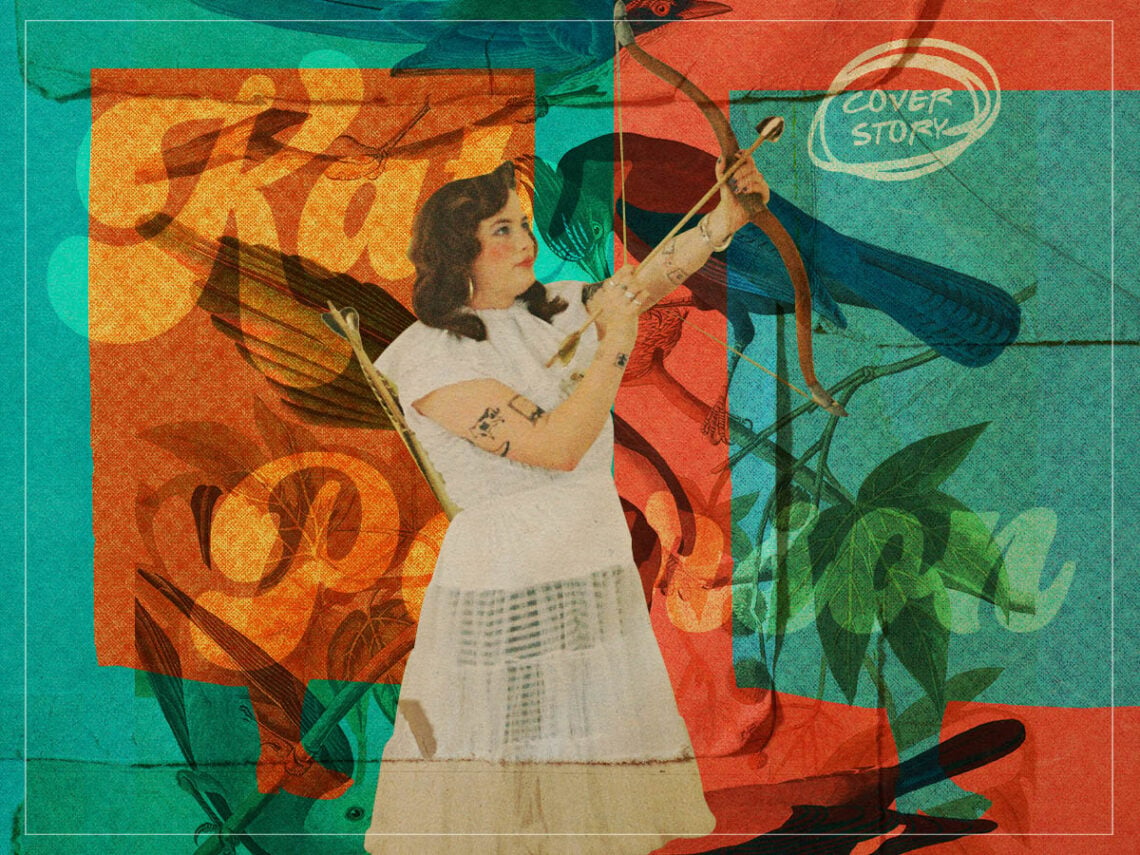
Katy J Pearson discusses hopes, fears and new music: “It feels like a classic”

On a balmy day in mid-August, I sat on a train from the south coast to the capital with the wind at my back. Outside my destination, a small bar on Little Portland Street, Katy J Pearson stood, waiting for the place to open. As the proprietor approached the door from inside, I exchanged greetings with the songbird of the West Country, who informed me that she had travelled from Bristol. After living in London for a couple of years, she recently moved back to more familiar territory in leafier climes.
The cordial hipster behind the bar handed us a couple of coffees to get us started: Pearson’s iced, mine hot. Given her characteristically stylish choice of bold, colourful clothing, this cross-table temperature gradient conformed to both meanings of the word “cool”. With stimulating drinks and conversation poised to combat dim lighting and a voracious leather booth, we started by discussing Pearson’s imminent third studio album, Someday, Now.
This third chapter in Pearson’s career follows two universally lauded records, Return and Sound of the Morning. She’s also fresh from a string of wonderful collaborations, including those with the Bristol-born art-punks Lice and, more recently, Yard Act. When Someday, Now arrives in late September, fans can expect a natural and nuanced development in Pearson’s established lyrical and musical identity.
“Everything overall just felt a lot more organised,” Pearson told me of the new studio project. “I think I had a lot more confidence in my choices, and it all felt a lot more thought through rather than rushed.” Working with Bullion mastermind Nathan Jenkins and a robust band of familiar names, Davey Newington (Boy Azooga), Huw Evans (H. Hawkline), and Joel Burton, she had total artistic agency and no shortage of constructive advice.
While Pearson enjoyed tracking her first two albums, the sessions were somewhat exacting as she worked under pressure to hone nascent ideas. As she says, “Albums are expensive. Studio time’s expensive. You haven’t got endless amounts of time to muck about.” By comparison, the Someday, Now sessions began with a more robust vision. It’s one of Britain’s most beloved young songwriters, and her most cohesive and considered product to date.

“Everything was just executed a lot better, and I had a much stronger sense of what I was trying to achieve with it,” Pearson added. “I also felt with the people I chose and working with Bullion, everything just felt very protected. I knew that it was going to be a good experience.”
Like her number-one idol, Kate Bush, Pearson set out on a plane of songwriting wisdom far beyond her years in 2020’s Return. Still, she believes Someday, Now contains some of her most accomplished material to date. “I think my favourite song on the album is ‘Constant’,” she revealed. “It feels, for me, like a really big step forward in my songwriting. It feels more mature and stronger lyrically and sonically. It feels like a classic song and a song that I’ve always wanted to write. It’s like an amalgamation of a lot of people I admire, but it’s still me.”
Indeed, Someday, Now is still very much a KJP album. There are no jarring sonic overhauls, and Pearson ensured the album still carries the flecks of rawness present in the first two records. “When I first started writing, I did a lot of the demos myself on Logic,” she said. “I showed a lot of those to Nathan because I felt like it would be good for him to get a sense of how I record sonically. So we took a bit of that rawness into the making of the album.”
Amid this crafted classic there is an unseen mass of influential artists who continue to shape her creative outlook. Ever-present are hints of Kate Bush and strands of Stevie Nicks, while more recent influences range from Broadcast to Beck. “I was listening to a lot of a band called Operating Theatre,” Pearson said of her listening habits. “On their album called Miss Mauger, there’s this particular song called ‘Blue Light & Alpha Waves’, which is a song that I kept going back to and referencing.”
Also on repeat during the creation of Someday, Now were the krautrock renaissance rhythms of Broadcast’s Tender Buttons and Beck’s signature song, ‘Loser’. At the moment, Pearson’s favourite Kate Bush song is ‘Hello Earth’. As she mentioned this classic Hounds of Love cut, my eyebrows remained at ease. When she listed one of my old favourites, The Stranglers’ ‘Hanging Around’, one rose just a tad.
“It was a song that influenced me in that I played it a lot in transit on my way to write. Obviously, none of the songs on my record sound like it, but it was helpful,” Pearson explained, sating my curiosity. We then briefly gushed over The Stranglers as I suggested Pearson listen to the superior Peel Sessions recording of ‘Hanging Around’, her effusive reaction reflective of how impassioned she is about music. Along those lines, she will also be pleased to know I have since done my homework as a latecomer to the Operating Theatre fan club.
Aside from sonics, as any writer should be, Pearson is an avid reader. Though Someday, Now contains no direct references to novels and authors on the level of Bush’s ‘Wuthering Heights’, Vashti Bunyan’s recent book Wayward had profound subconscious influences. “I’ve always found her to be such an inspiration to me,” Pearson said. “She’s a really good role model because she didn’t have success at the time she was writing; later in life, more success came. No one knows when something’s going to hit properly. All you can do is be present in your making. You can’t control when something’s going to be recognised.”

Thematically, Pearson’s new album scales the emotions, often juxtaposing upbeat rhythms and bright melodies with downcast, ruminative lyrics. She gravitates to music with either a touch or an abundance of melancholy. As an artist, a marriage of the two is her “thing”. “I always like to meld the two worlds together,” Pearson mused. “But I probably relate more to melancholic music because I think it’s obviously universal. People turn to music in all moods but I think listening to music when you aren’t doing well or you’re sad, you can use it to navigate that emotion. It’s an amazing tool.”
Just as one’s grandmother might use Abba’s ‘Dancing Queen’ and a few glasses of Tia Maria to loosen up at family functions, we like to lean on plaintive minor keys the morning after or while gazing through a rain-pocked window on the road to heartbreak hotel. Naturally, Pearson has many cathartic tear-jerkers in her toolbox, though none of them have been so helpful lately as Vaughan Williams’ classical piece, ‘The Lark Ascending’. “It’s just such a brilliant piece of music, and it’s a song that I always listen to in the morning,” she noted. “It’s one of the highest chosen songs on Desert Island Discs because it’s the best song ever.”
Notably, this fully orchestral piece dates back to the 1920s. Producing the ”best song ever” in the modern age, with an eye-watering cost attached to creating studio albums, is another matter entirely. Though the path from songbook to record sleeve has never been cheap, the modern climate is forcing artists into their bedrooms and onto social media. Why shell out for studios and traditional distributors when you can create a passable product on your laptop and farm a fanbase on TikTok?
As 1996 babies, Pearson and I waltz the hairline between the Millennials and Generation Z. Pearson told me she doesn’t feel a day over 20 in this world of lightning broadband and short attention spans, yet we both seem to fall on the far side of the generational divide, cautious of the social media age. “For a lot of young artists starting now, there’s a lot more pressure to overshare their lives,” she pondered. “People need to be careful because while it’s good to be vulnerable, it’s important not to give all yourself away. As artists, we’re already vulnerable sharing music.”
“It’s not easy to make money in this industry at the moment,” she pursued. “It’s a funny time. People like PinkPantheress are saying a song doesn’t need to be longer than two minutes, and there are a few artists I’ve noticed recently that aren’t releasing music in an album format. They’re doing mixtapes and dropping singles, which is cool, but I think people’s attention spans are withering away.”
Concluding her point, Pearson suggested that, while the industry was a stressful place for emerging artists when she set out at age 16, it is becoming increasingly competitive. “The younger people are expected to give so much more,” she said. “I’m so stubborn. My label are very nice to me because I don’t have TikTok, which is maybe detrimental, but I just can’t do it, and I won’t do it.”

On the hot topic of artificial intelligence, Pearson held a similarly cautious stance as she said, “To be honest, I just want it to fuck off. Can it just go away?” Maybe in medical sciences, it has a place, but “in terms of creativity, we don’t need it. It can’t create what the human soul, brain and heart can. Artists are suffering anyway. We don’t need another thing to compete against. I just wish people would stop mucking about and just leave that to one side.”
The problem with prose is its incapacity to convey the tone of delivery, hence the popularity of emojis in the modern day. While Pearson’s above opinions on the status quo may come across as fearful and incensed, her indelible smile never faltered; she chooses optimism in the face of such present and threatening issues. “I think these things are cyclical,” she said before opining that with vinyl on the rise, albums will never disappear, bestowing faith in mankind’s collective sense in the face of insidious technologies.
Pearson’s lyrics may paint the overcast landscapes of unfiltered experience, but her future looks bright and breezy. As Neil Young says, rust never sleeps. Fortunately, neither does creativity. Pearson has already begun to accumulate material that will one day constitute a fourth studio album. For now, she has an open road before her with a growing list of tour dates to promote Someday, Now.
Towards the end of our conversation, Pearson told me that she had a literal midsummer night’s dream not long before our meeting in which she encountered PJ Harvey. “We became friends, then she became my mentor, and then we did a collab album together,” she wistfully recollected. While wishing this dream into reality, she added an onstage collab with Beck, a couple of world tours and a Mercury Prize nomination to the bucket list.
With coffees drained and conversation at a conclusion, we headed our separate ways. I hope to see Pearson again in the not-too-distant future, tearing it up in a duet with PJ Harvey or collecting that Mercury Prize. Such aspirational objectives are imperative. Still, as an adherent to Vashti Bunyan’s ethic, Pearson is perfectly content to live in the moment and vows never to compromise on creativity. This failsafe formula for artistic integrity may or may not lead to headier climes of attention and acclaim. As always, the destination is of secondary importance.
Katy J Pearson will release her third studio album, Someday, Now, on September 20th via Heavenly Recordings, followed by a run of in-store performances. Head to her website for more information.

Never Miss A Beat
The Far Out New Music Newsletter
All the latest New Music from the independent voice of culture.
Straight to your inbox.