


“Things go better with coke”: the counterculture acts who sold out for commercials

The pernicious creep of commercial hijack can ensnare even the most lauded songbooks. Take The Beatles. Long enjoying a reputation for a songwriting oeuvre that’s doggedly avoided corporate besmirch, let alone rarely featuring in film or TV, a messy and protracted ownership of their Northern Songs publishing infamously found its way into the hands of Michael Jackson. Following mutual collaboration with Paul McCartney, Jackson’s purchase of ATV Music in 1985, the distributor who held The Beatles’ songs, resulted in the dispiriting use of ‘Revolution’ scoring an ’88 Nike advert. Unsurprisingly, the pair’s relationship cooled from then on.
Most bands aren’t The Beatles, and even the most deified icons of the music counterculture have dealt with the corporate devil for a quick buck, and who can blame them? It’s a perspective easily lost as a music fan holding our heroes up to unreasonable levels of moral elevation, now more than ever in an age where the economic climate for well-established artists, nevermind upcoming bands, is fraught with unremitting cost of living trudgery, guaranteed losses for live shows, and dismal streaming revenues. It’s easy to lambast John Lydon for his Country Life Butter commercials or turn your back on Iggy Pop for gyrating to Swiftcover insurance, but did you snap up tickets to following Public Image Ltd or Pop shows that their respective payouts probably helped bring about?
That queasy pang of disappointment is undeniably stirred, however. With all the class and socio-economic analysis in the world, of course, it sucks to see Tom Waits lend his gruff narration to a Butcher’s Blend dog food commercial in 1980, ironically later becoming the face of artistic integrity when suing Doritos for using his likeness, and an unavoidable shudder takes hold when considering the roll-call of artists who’ve slapped their endorsement to Coca-Cola and Pepsi, David Bowie, Tina Turner, Ray Charles, Aretha Franklin and Jack White all recording jingles for the soft drink giants, the financial necessity for such huge stars up for question.
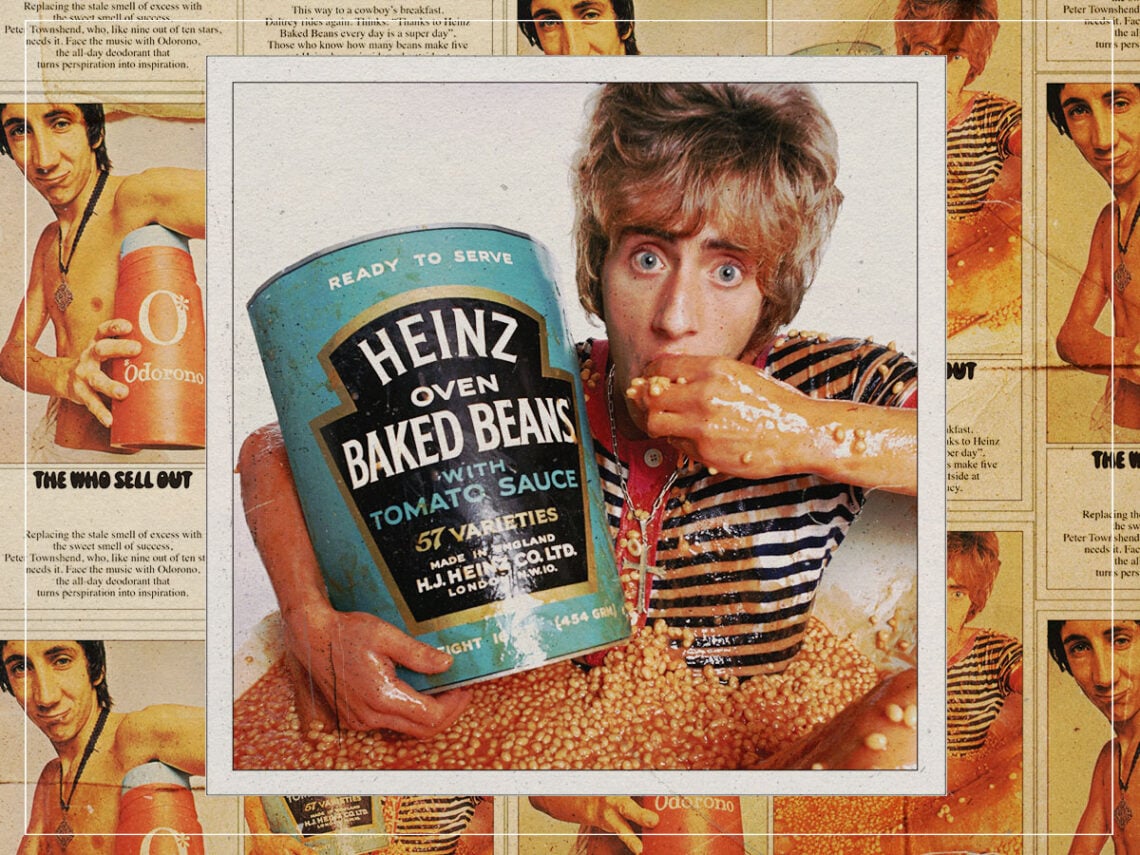
Sixties powerhouse The Who can count Coke as one of their clients too, cutting harmonic renditions of the ‘Things Go Better with Coke’ jingle and a later more hard-rock variation. This dallying with the advertising world inspired ’67’s The Who Sell Out, a quasi-concept album featuring interspersed commercials created by Texas station identification company PAMS Productions. On the face of it, their third LP could be received as a wry blast of self-deprecation refreshingly at odds with the era’s puritanical policing for authenticity, wrapped in an affectionate nod to pirate radio who they owed their early exposure.
The satirical merit of The Who Sell Out starts to lose credibility when considering that the products lampooned are real high-street brands. It’s not like they tried to hide it. Adorned on its memorable cover, frontman Roger Daltry is sitting in a tub of Heinz Baked Beans with a comically oversized can referencing the album’s second track, and Odorono, Medac, and the Charles Atlas work-out regime as modelled by the other three Whos all real goods and services of the day — it’s unclear whether Charles Atlas’ fitness programme came with a Tarzan suit and teddy bear though.
The Who’s countercultural credos are further mired by dallying with the American war machine. Long before Daltry’s American Express appearances, guitarist Pete Townsend agreed to a public service announcement while the public opposition to the Vietnam War was escalating, recording a piece for the Armed Forces while ‘Happy Jack’ plays in the background: “I just want to say that the United States Air Force is a great place to be. A great place to learn a space-age skill and serve your country too…see your United States Air Force recruiter.”
A charitable blind eye to an artist’s commercial flirt evaporates when in the service of American imperialism or institutes of political oppression, Stormzy’s self-debasement for McDonald’s as their Israeli franchisee showers the apartheid state’s IDF with free meals a stain he’ll never rub off. But in a more innocent sphere, even the financial whack of ‘needs must’ temptation struck some of the British Invasion’s biggest names when cutting their teeth, and even the holy icons of the Woodstock generation succumbed to the dark side. The Rolling Stones cut a Rice Krispies advert around the release of their debut album, The Yardbirds gifted a jingle for General Foods’ Great Shakes flavoured powder, Falstaff Beer was scored by Cream, and even head-feeding psych stalwarts Jefferson Airplane provided Levi’s jeans with a pretty far-out raga droned advert theme.
When the ‘Man in Black’ country legend Johnny Cash pens a ditty for Southern Maid Donuts, it begs the question: can an artist truly navigate the music world with an entirely spotless record of artistic integrity? It can happen: Fugazi’s Ian MacKaye eschews any press interview for a publication that features alcohol advertising in keeping with his straight-edge principles, but as The Beatles’ disastrous publishing legacy shows, artists can be devastated by dodgy deals, unscrupulous management, and the bleak economic contemporary we’re all navigating.
The tussle between credibility and financial viability will always be to and fro so long as there’s a music industry, but perhaps the spike of letdown we feel when, for whatever reason, the commercial temptation is too hard to resist, that displeasure should be directed at the rotten system that forces all of us by varying degrees to make those unethical concessions to the capitalist altar we’re all bludgeoned with.
