


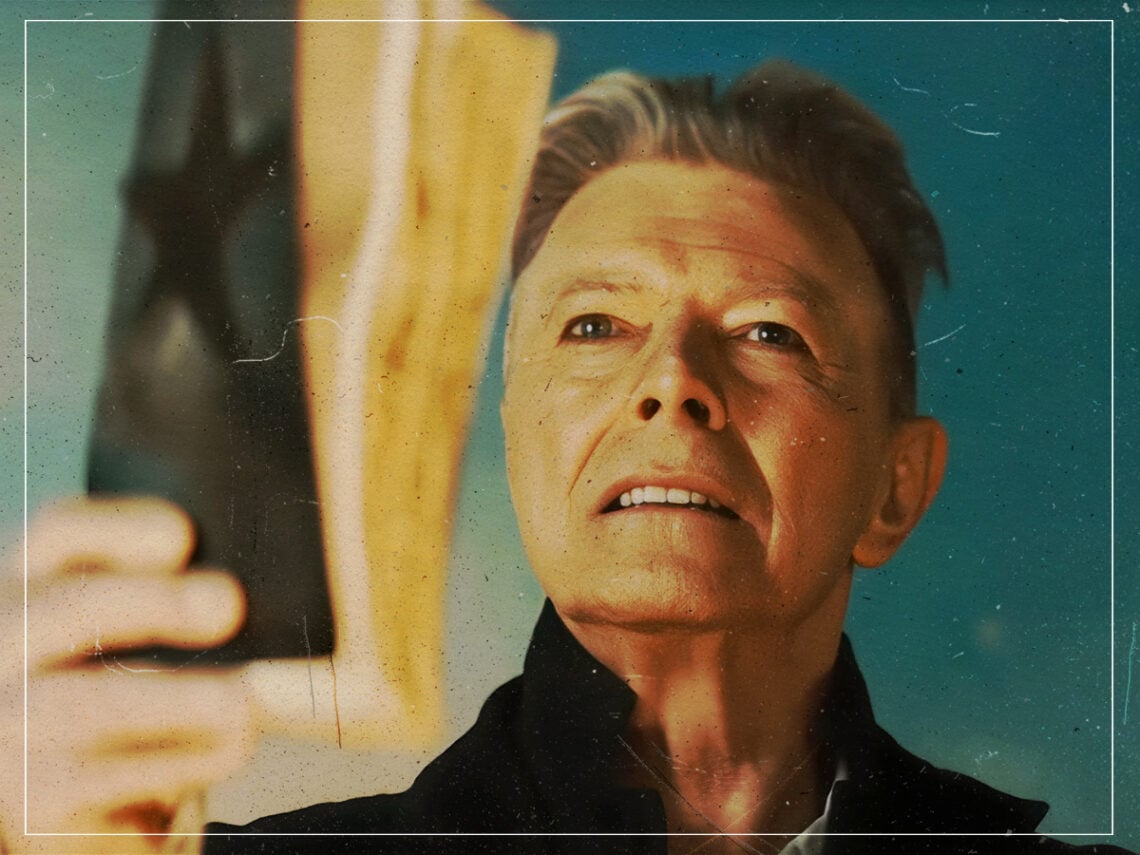
From Elvis Presley to the Occult: The conspiracies at the centre of David Bowie album ‘Blackstar’

Blackstar is kryptonite for conspiracy lovers – its overt references to death, the apocalypse, and even Elvis Presley continue to occupy the minds of those who have made it their life’s mission to decode the cryptic messages embedded in the final moments of David Bowie. In this realm, the Starman and the cosmic implications of a black star intertwine, creating a poignant exploration of mortality in the face of impending doom.
Released just two days before Bowie’s death was announced, you can’t ignore the darkness at the crux of Blackstar. Bowie embraces the macabre as you would expect of a dying man, whose final moments were brimming with existential lamentation and the implications of passing over into the next realm. In some ways, he was already there, flirting with the afterlife and tempted by the unknown.
“Look up here, I’m in heaven,” he sings, effectively telling us that death is not something transactional; it is as organic and natural as walking into a supermarket. In the title track, he references the “Villa of Ormen” as a way of reflecting death and chaos and potentially harking back to his obsession with occultist Alastair Crowley in the 1970s. The “Ormen” is a serpent, which, of course, occupies Satanic connotations as well as themes of illumination. Whichever way you look at it, the mention is intended to be provocative.
It becomes a stranger when one considers that “the Villa of Ormen” was a Tumblr name set up back in 2020, a day after the music video was released. Although fans could have been behind this – and probably were – there were hints towards the ‘Lazarus’ video on the page, despite it not being released for another six weeks. Theorists argue that Bowie was the mastermind behind this to generate hype, but the truth remains a mystery.
A lesser-known Elvis Presley song includes the lyrics: “When a man sees his black star, he knows his time has come”. Despite what some may say about this, the idea that the album symbolises a proverbial passing of the torch to another star seems a little out of reach. Bowie was a fan of the singer, and they shared the same birthday, but it’s difficult to agree with those who believe that Bowie and Presley were somehow cosmically connected.
The concept of the black star itself does come with various strands of thought, including the collapse of a black hole and a star, which figuratively reflects the implosive nature of death itself. Black stars can also be used as a scientific term meaning cancer lesion, which almost entirely aligns with Bowie’s cause of death. In fact, the realities of Bowie’s mental and physical decline seem to go hand-in-hand with the words he sings, more so than the idea that he was viscerally connected to the king of rock and roll.
While Bowie’s whole career lends itself to the thriving nature of conspiracy theories, Blackstar is a breeding ground for cryptic messages and suspicion. Of course, the album is packed with references to angels and the poetic yet melancholy reality of death; Bowie experiences it every day. That still didn’t stop the debate about his thoughts at the time and even his existence entirely – but perhaps that’s the point.
Blackstar is undeniably one of the most hard-hitting works of Memento Mori in all of history, and so its very existence invites you to fall down its carefully crafted abyss. Bowie, an innovator, could ultimately provoke and frustrate as much as inspire and uplift. His words resonated within the shadows he occupied, offering an endless journey of exploration through realms of emotion and mystery that may forever elude complete understanding.
