


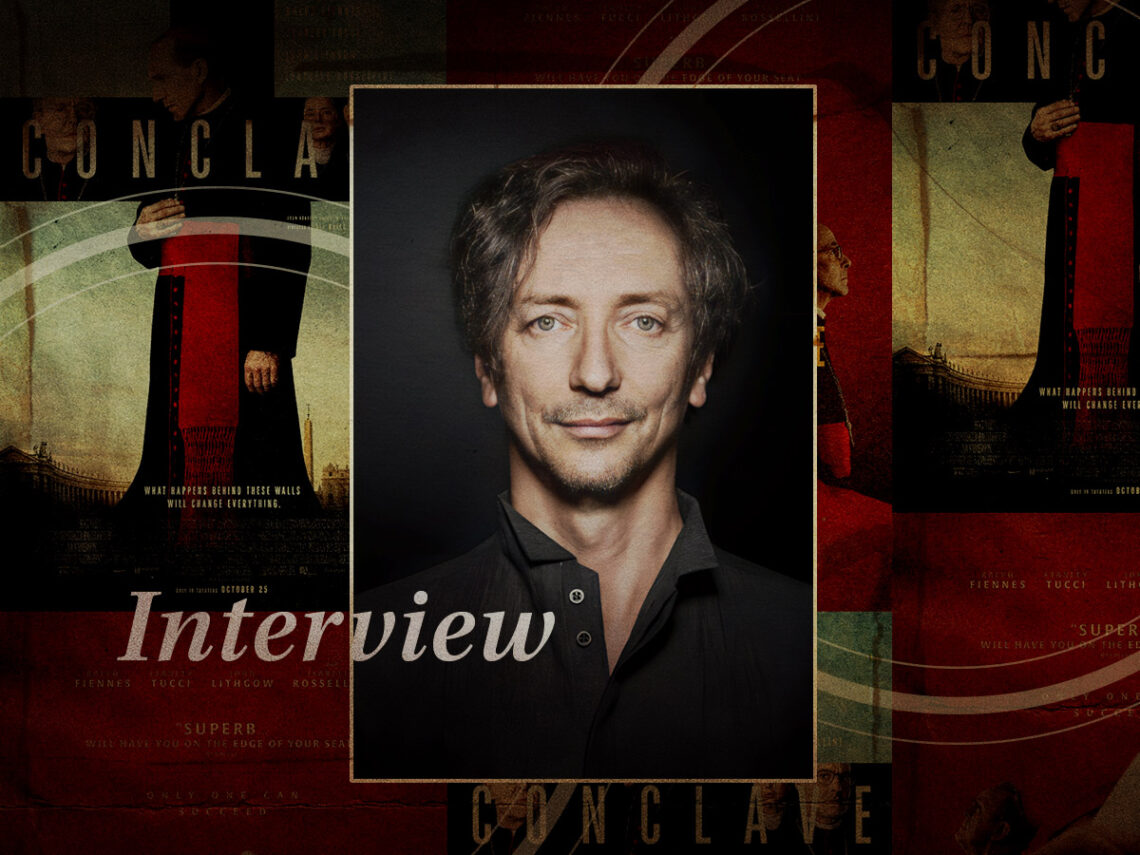
‘Conclave’ maestro, Volker Bertelmann on destroying the picture and the sound of silence

Many of us have become used to a feeling of constant precariousness in our lives, from the volatile political landscape, fragile climate and fleeting nature of our own human rights as they steadily evaporate for some. Our children and young people feel hopeless and resigned to the permanently pervasive narrative that the world is basically over. Resistance is ultimately futile because there is only a handful of people with the power actually to change our fate. It is why we attempt to use music, art and film as a way to share the universal messages in a personal way, direct to the eyeballs of those affected. Yet, the impending doom still has a habit of creeping up on us.
We wake up, check the news, promptly regret doing so and spend our days spiralling about the precariousness of it all… will we have the time to realise our goals? Is there any point in having children? What about owning property? Is there a good place to own property when the ground is on fire? And as the world only divides itself further, it becomes hard not to wonder how our leaders will ever resolve the matters most pressing and whether their hearts are in the right place to do so.
In recent years, many films have attempted to relay the urgency of these issues, but few have captured the contradictions and nuances of this in the same way as Conclave; a gripping tale about a group of religious leaders who are tasked with electing a new Pope after his sudden death. However, the prospect of power is something that corrupts many of us, and what ensues is a melting pot of manipulation and mind games as the priests slowly turn against each other in a bid for the top spot.
For a story that takes place in oppressively quiet rooms and suffocating spaces, the task of scoring the film is no small feat: a delicate balancing act of exaggerating the tension created through silence while making sure it doesn’t become stagnant, which is why I was so thrilled to speak to Volker Bertelmann about the masterfully unnerving and anxiety-fuelled score of Conclave.
You could imagine that one of the key challenges in a film like Conclave is simultaneously honouring tradition while also going against it; the push and pull between old and new creates the gritty tension within the score, with a drone-like cello that moans in the background while agitated-sounding strings click over the top.
“I didn’t want to lose the qualities of traditional music,” Bertelmann explained when directing how he balanced the clashing values within the movie on his auditory representation. “I played traditional old instrument where I maybe played chords that were Bach chords, but they were destroyed by a plastic piece of paper that was lying on the strings. I did a lot of stuff with cellos, but I used them in a way that they were just snapping, or rubbing. These moaning sounds from the cello and strings… I wanted to find a sound that is maybe a little bit of a yearning of a human, of a human moaning, where you just feel like somebody is in a room, and you just feel like you know somebody’s not comfortable.” The instruments on offer were not meant to compliment the visuals directly: “In a way, I used them more like a sound tool, so in a topic like that, it’s ideal because it handles all the traditions, which I think in the first place are great if they would honour what they are breaching”.

The score feels intentional yet restrained, something that mirrors the feeling of tradition, especially within a church. If you walk into any cathedral, they are objectively beautiful, but the silence of the space feels almost oppressive; you’re afraid to make a single sound in case it rings out and disturbs this fragile sense of peace, and idea that is particularly striking in the film as the priests have illicit conversations but are forced to contain it to hushed whispers and private corners.
Discovering a new instrument would be a breakthrough for the maestro as he attempted to bring the notions of silence and secrecy into the fold: “I wanted to find something that is somehow replacing the organ or the choir, but is not like a choir or organ and is something more modern. It needed something that is somehow touching. And so I looked at instruments, and I found an instrument from 1952 that was built by two French brothers called the Cristal Baschet. And it’s an instrument that is played with glass rods. So you have four octaves of glass rods, and you just rub them with water, and then they create these kind of… like your wet finger on a wine glass”. The glass ringing noise he describes sounds haunted and almost painful, a quiet voice that hangs over the clinking strings, with a distorted and yearning tone to it.
Bertelmann embeds this new instrument within the deliberate stillness of the score, explaining, “Pacing and silence is always important for music, because first of all, silence is important to actually make the next move. When you have films that are completely full of music, it’s very hard to feel music at all. You just feel like there’s a wallpaper. But when you place a piece of music in the right place where it can breathe, then it can also accept the silence”.
The idea of breathing life into the rigidity of these traditions is very moving, and there’s a surprising tone of hopefulness to the film that I found very refreshing, with many filmmakers grappling with similar issues in a way that feels hopeless and borderline misanthropic. But the emotional undercurrent of any film is shaped by the score, with some composers being asked to directly imitate the action on screen and the mood the director wants to create, but some composers are asked to not follow what is being visually conveyed.
It’s a fascinating facet of soundtracking. It lands the responsibility more firmly on the shoulders of the composer as they bring their own interpretation of the director’s movie to the audience, dominating one of the primary sense they use to understand it. Thankfully, Bertelmann confirms: “Edward is exactly on the same page. He just says, always, please destroy the pictures.”
It’s a liberating set of instructions for a composer, and allowed Bertelmann to work more intuitively after internal investigation: “I think obviously gives me a little bit of more freedom, but at the same time, when he says that I’m always like, what does that mean? Destroying the pictures? Should I put a flame on the celluloid? What I do a lot of the time, is I try to connect my music with something that continues, even though the scene is already over. But I try to find something internally that I can move onwards, because that that is, in a way, something that is not describing the scene. It’s much more an internal process. It needs a little bit of imagination, and some directors don’t want that”.
In many ways, this sentiment mirrors the film’s final note – that we can find freedom within destruction, and by infusing traditions of the past with values of the future, we can breathe life into a new world. Bertelmann’s score is one that beautifully incorporates these ideas and finds equal space for each musical voice, whether it be a cello or a modern instrument made of glass. Through the merging of the old and new in the soundscape, we can not only dare to imagine a union between the most divided voices, but one in which we are strengthened through these differences.

