


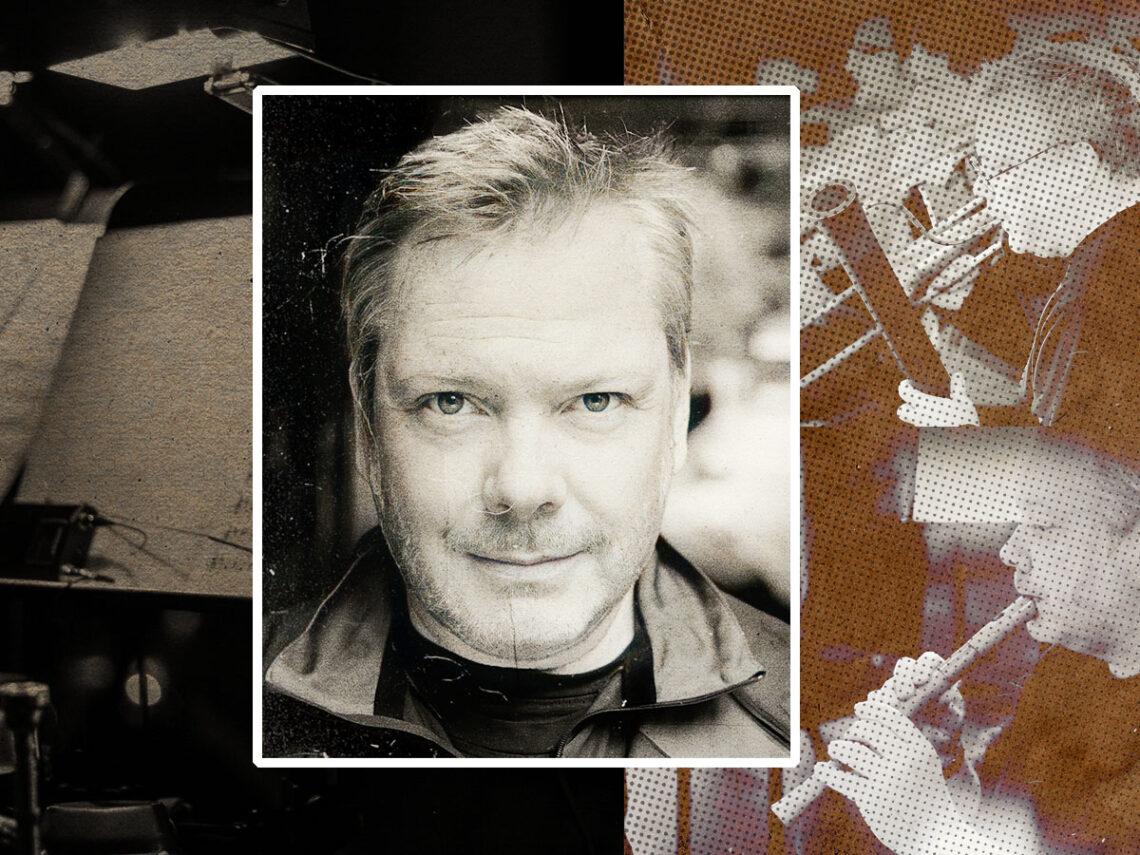
Composer Spotlight: William Lyons talks working with John Williams and the perils of the historical score

The historical score is a tricky thing to get right. Composers must all decide whether to dedicate themselves to historical authenticity or, in sacrificing this, seek to evoke the mood of an era. More often than not, Hollywood film composers opt for the latter. But for decades now, composer, arranger and historical advisor William Lyons has been relentlessly vouching for the former.
If you haven’t heard Lyons’ music for films like The Favourite and Elizabeth: The Golden Age, then you’ve almost certainly heard him plucking some intricately-strung lute or blowing a shawm in one of John William’s scores for the original Harry Potter films. When not researching, teaching or composing music for the stage and screen, Lyons provides expert historical advice to world-class film composers, helping them to create the most accurate and immersive score possible.
“For me, it goes right back to when I was at primary school,” Lyons says of his fascination with early music. He grew up playing that perennial and diabolical tool of primary school music classes, the recorder. But unlike most, he was blessed with a schoolmaster who viewed the instrument as more than a stopgap before ‘proper’ orchestral instruments. “He got everyone playing all sizes of recorder in recorder consorts,” Lyons continues. “A lot of the repertoire was Elizabethan and that sort of golden age of English music. So I wasn’t, you know, standing on my own in a corner playing ‘Hot Cross Buns’. We were playing Renaissance polyphony, Renaissance dance music, and I think it just sort of sunk in – it obviously resonated.”
Having explored the disparate strands of early English music, UK ska and American jazz, Lyons formed The Dufay collective – named after French medieval composer Guillaume Dufay – in 1987. The group have been at the vanguard of medieval and renaissance music interpretation ever since, touring the world and releasing a string of celebrated albums, including A L’Estampida – Medieval Dance Music and Miri It Is – Songs and Instrumentals from Medieval England. We had the chance to sit down with William to discuss his life in early music – from working under John Williams to the dangers of Jane Austen adaptations.
Far Out: Why are people still so fascinated with early music?
Bill: “I think for a lot of people, it’s something sort of other. In most people’s minds, the music of the Middle Ages and the Early Modern period sounds much closer to what they think of as traditional music making. And I think a lot of the people who came from that interesting folk music scene in the late 1960s – with Pentangle, Gryphon and Phaedo and all that – ended up fusing their ideas with that traditional music sound.
“I also think there’s a lot of interest in how the instruments work. There are a lot of amateur musicians taking them up, often not with the most successful results, but they love playing in groups together, just as I did when I was a kid. And I think it gives them a chance to progress a bit further without having to deal with the technical and physical demands of, say, a Beethoven symphony. It’s also far more communal. You know, it’s not about being the great virtuoso soloist, it’s about playing music in groups.”
Your work for film tends to revolve around composing historical music for key scenes. Are you seeking to accurately replicate historical pieces or simply evoke a medieval or baroque mood?
“It largely depends on what the relationship with the director is and on how invested they are in the accuracy of the historic atmosphere. In The Favourite, for instance, I was working a lot on finding the right sound world. The director Yorgos Lanthimos was very keen on the reality of the sound in the room, so a lot of the stuff we recorded was done live on set. He wanted to do everything live, and that’s how we did it. We got kids from the Purcell School to come in, and they were coached in historical instruments from the late 17th century, so he was very invested in the accuracy of it all.
“When it came to looking into the broader aspects of the score, I pushed a lot of music his way, some of which he rejected because he wasn’t working on a historical level; he was working on an emotional level. It was the same with Autumn de Wilde on [2020’s] Emma, though she was much more focused on the historical aspects. They were really keen on getting exactly the right pianos for that sort of 1810 to 1815 sound, so we had to look into all of that.
“When looking for the perfect music, you realise that film is always an imperfect medium for music, certainly for historical music, because there are always different ideas at play that might conflict with historical accuracy. So, for instance, Jane Austen’s own hand-copied music manuscripts include a lot of Mozart, a lot of contemporary English composers, some Scottish folk songs – things like that. But there’s no music by the new composers like Beethoven – he was a little too avant-garde. And yet we chose to put in the Apassionatta because it was perfect for conveying the emotions of one of the characters. You often get that with historical films. So many of them look period-perfect, right down to the cups and saucers, but when it comes to the music, there’s something else at play.”
You were the historical advisor to John Williams on The Prisoner of Azkaban. How was he to work with?
“He called me and said he’d heard my work with The Dufay Collective, who did a lot of medieval stuff. One of the recordings we’d done had this loud band of shawms on it, and he’d heard this record and had decided this sound world was perfect for The Prisoner Of Azkaban. So we had a long conversation, he sent me his ideas, and I did some idiomatic arrangements. I then sent those back, and he did his version of them. It went like that, back and forth, for a while, and then we got the players together and had this wonderful day in Abbey Road.
“A lot of people accuse John Williams of lifting his music form here and there, but what he actually does is take a style and work within that style very effectively. I worked with him as a musician on a couple of other Harry Potter films, and one of the things I noticed is that he knows the instruments he’s working with inside out. A lot of people use an arranger and an orchestrator to work out their demoed themes, but he knew exactly what he wanted. And he was really invested in the historic aspect of it in terms of the harmonies and the modal style of the music. A lot of the instruments I play are considered primitive. They’re proto-flutes or proto-bassoons or whatever. There are composers out there who think if it hasn’t got the full three-octave range of a flute, then it’s not a proper instrument. John Williams wasn’t like that. He was great and one of the very few composers who have been a joy to work with. Alexander Desplat is another”.
In 1995 The Dufay Collective released a collection of medieval songs and instrumentals called Miri It Is. What’s the story behind the perenially popular ‘Sumer Is Icumen In (Summer Is Come)’?
“It’s actually a remarkable piece in that it’s a canon, and not many of them survive. It’s written out in a very clear form in a small manuscript which is in the British library – you can go and have a look if you like. But it’s very interesting in that it has an English text, which is the one we sang, and another Latin text, which is based on an Easter theme. It’s a sort of double canon and very cleverly put together. It’s quite a well-known piece. A lot of people will have heard of it, but we wanted to get back to how it might actually have been performed, so we did it with voices and included a sort of instrumental jam over the ostinato in the middle.
“I tend to do all the research for the recordings, and the main challenge is setting the lyrics. You often find them in poetry and anthologies, and they’ll say stuff like, ‘This is a lyric, but no melody survives.’ So for me, it’s all about putting those lyrics back into the right context. And I think with the Dufays, that always happened: we always got to a point where the academic research was all very well, but we were a performing band made up of people. We were never just a siphon for old music”.
Thinking purely about the music, which historical period would you most like to have lived in?
“That’s a hard question because you’d have to be in a particular place. It’d be quite exciting to be in London in the 1960s, sort of Purcell’s time when there was a lot of musical development pushing towards the baroque style but still married to the music of the early 17th century. Instruments were developing too, so I’d like to have heard Purcell play the organ in all his pomp. But I’d also liked to have been in 14th-century Avingon, when this particular musical style emerged, blossomed and then was filtered away: It’s the music of the Ars Subtilior, or Mannerist music is another way of terming it. And it was a really complex, very avant-garde style using a notation that is still incredibly hard to decipher. It was taking notation and trying to play with all of these polyrhythms to create something that, to our ears, might sound a lot like contemporary avant-garde music. It took ideas of composition and notation that were still developing at the time and took them to the extreme. So that would have been very exciting. I’d also like to have been in New York to hear Charlie Parker”.
Finally, do you have a favourite period score?
“I’m going to say The Seventh Seal by Ingmar Bergman. That had an amazing score – in its darkness. it didn’t do much, but it conveyed the period really well. I’m struggling to think of another score that utilises historic music as an essential element. I mean, that’s what I’ve been trying to get people to do for a very long time. But there’s always a point at which they seem…I mean, even The Favourite, which I really enjoyed working on, ended up with some rather bizarre musical choices. When Mozart starts creeping in, that’s when I don’t quite understand the thought process because [Yorgos Lanthimos] could have got that same power from Handel, something much closer to the period”.
Thanks to William for talking to us. You can listen to some of his work with The Dufay Collective below.
