


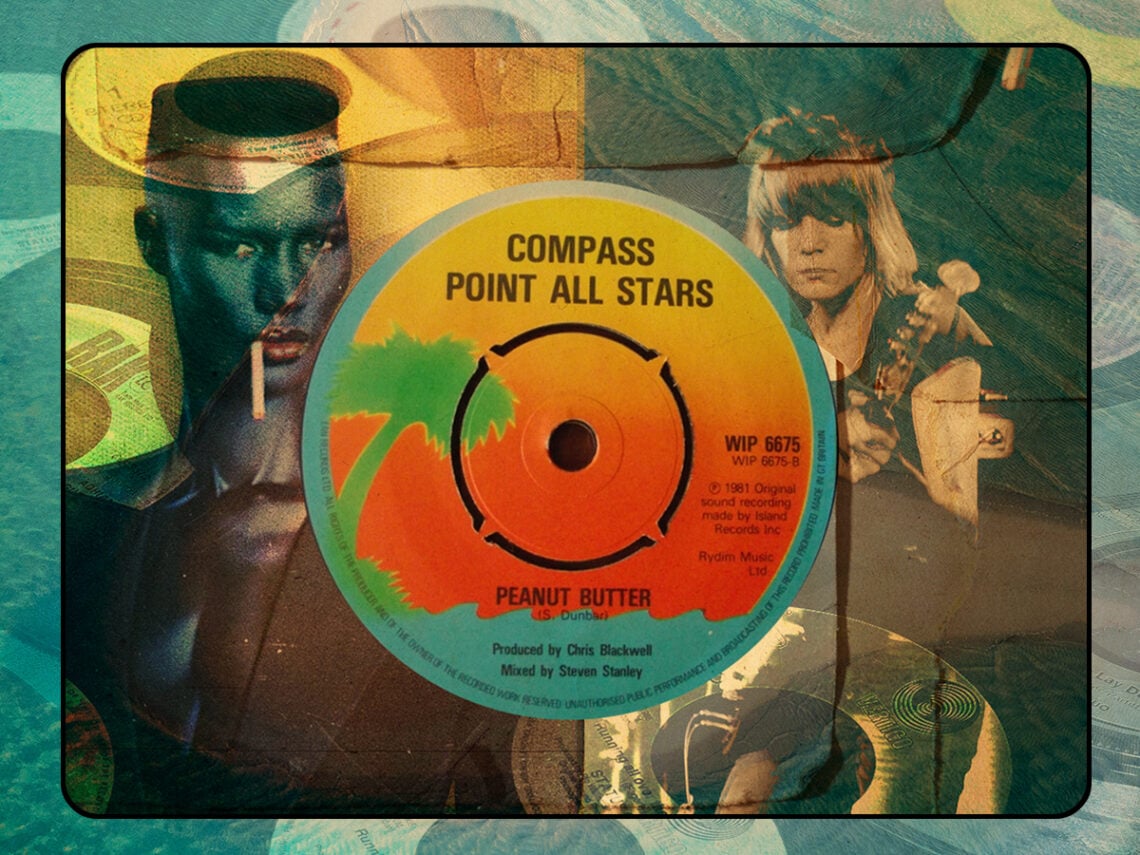
Compass Point All-Stars: The story of the Bahamas’ greatest session band

When we talk about the greatest session players or house bands, we tend to think of those who were the most prolific, or who played on the most hits, and collectives such as Motown’s Funk Brothers or The Wrecking Crew tend to be the first to receive acknowledgement.
However, just off the coast of the US, where both of these illustrious cabals were operating, was a group of session musicians working on records in the Bahamas, helping to produce some of the finest pop records of the late 1970s and ‘80s. The Compass Point All-Stars, named for the studio from which they operated, consisted of a host of talented musicians revolving around drum and bass combo Sly Dunbar and Robbie Shakespeare, better known together as Sly & Robbie, while making up the rest of the lineup were percussionist Uziah ‘Sticky’ Thompson, guitarists Barry Reynolds and Mikey Chung, and synth player Wally Badarou.
With many of the ensemble having played on others’ records and celebrated for their own contributions to popular music throughout the 1970s, the origins of the band are somewhat peculiar in the first place. Compass Point, a studio in the Bahamian capital of Nassau, had been opened by Island Records founder Chris Blackwell, who had visions of being able to rival the output of previous house bands like those mentioned before. And so, in an effort to forge an all-star group for the recording of Grace Jones’ fourth album, he assembled what he believed to be a group of unmatched talent.
Dunbar and Shakespeare recalled being contacted by Blackwell and his representatives in a 2008 Q&A for the Red Bull Music Academy, claiming that there was an air of mystery about the entire project from the offset. “The first time I met him was through a movie star named Esther Anderson,” Shakespeare claimed, explaining, “She came for me and said Chris Blackwell wants to meet me. I said, ‘Who’s Chris Blackwell?’ She said, ‘Bob Marley’s boss’. He wanted to know who the man who played bass on ‘Concrete Jungle’ was. ‘Oh, you played bass? Nice’. That was it.”
With little other information given at the time, they were corralled together with the rest of the band to work alongside Jones on what would become Warm Leatherette, something that confused some of the members due to the disparate backgrounds they all came from. “It was a cultural experience taking all these people and putting it together,” Dunbar added, believing that he was being ushered in to work on a reggae record not unlike the others he was used to working on.
However, while they believed they were set to work on just this album, that’s far from how things turned out. Their proficiency meant that they were done with recording in a matter of days, and they had essentially passed the test that Blackwell had set for them. They clearly had the ability to become one of the greatest house bands to be assembled, and so when they ended up cutting half of Jones’ fifth record during the same session, he was proven right in his estimations. If they could work this well together, then why not get them to work on more?

Badarou revealed in a 2009 interview that this slight ruse that Blackwell had run on them ended up being more than he’d ever bargained for. “I landed in Nassau in early 1980 for what was to be just an album session initially,” he recalled, “And ended up being a near-12-year experience”. Reynolds was similarly unimpressed with how he’d been dragged from his home in the UK to work somewhere where he had zero intention of being long-term.
“It’s such a dull island,” the guitarist bemoaned. “The sea is beautiful, you can go swimming, but there’s really nothing to do”.
This was partially the point, as far as Blackwell was concerned. If the musicians were bored, but were working on the very island that offered them little else to do, then the only thing they could realistically put their minds to was making music, thus increasing their productivity. This might sound laborious, but when it helped produce some of the best pop music of the early ‘80s, then surely there was no reason to complain.
Despite the initial flurry of activity that spawned from the initial sessions, with Warm Leatherette and half of Nightclubbing done in a matter of days, there are only a handful of other records that the entirety of the Compass Point All-Stars can lay claim to having contributed to. One further Grace Jones record, Joe Cocker’s Sheffield Steel, the first two Tom Tom Club records, two Gwen Guthrie albums, and an album apiece for Black Uhuru, Junior Tucker and Sly & Robbie themselves was the full extent of what they managed to do as the full ensemble.
11 albums doesn’t feel like an awful lot, but when you consider that they did all of this in just three years while working on other projects at the same time, and given how successful some of them turned out to be, it’s hard to look at the group and think of them as anything other than a miracle. However, aside from the official sextet’s collective output, there are numerous records that feature members of the All-Stars, and anything created at the studio with residents, or anything they contributed to outside of Nassau, would begin to get attributed to the name.
Because of the unique sound of the two Grace Jones records they produced early on in their time together, anything that involved the two in-house producers, Alex Sadkin and Steven Stanley, would then be considered as part of the wider CPAS catalogue. Tyrone Downie, formerly of The Wailers, was officially part of the All-Stars after a while, as were Chris Frantz and Tina Weymouth of Talking Heads and Tom Tom Club, and also Robert Palmer, who had played a significant role in the sessions with Cocker in 1982. Things were expanding, and more artists were flocking to the studio to work with the musicians and producers there.

Despite selected members working with the likes of Mick Jagger, Ian Dury, Lizzy Mercier Descloux and Gregory Isaacs, things were slowly spiralling out of the control of the residents. One might argue that they’d had little control over affairs in the first place, and that this expansion was only the act of a puppet-master who had been driven by financial motives.
Badarou would later reflect on Blackwell’s domineering role as an impresario who made everything on the island happen, and seemed to feel like this questionable leadership and management of the musicians was ultimately what led to their downfall. “He immediately thought of it as a ‘band’,” the synth player confessed, adding, “I was quick to observe that a real ‘band’ needed to stem out of a co-opting process, shaped around a clear leader. As it turned out, he was the Compass Point All-Stars sole leader, which inevitably implied, in the long run, that things would not survive his complicated business life.”
In essence, Badarou was proven to be right in his fears that something else would eventually drive Blackwell away, and his decision to begin focusing his mind on ventures within the film industry, combined with the sudden and unfortunate loss of Sadkin in a car accident in 1987, meant that activity came to an abrupt halt.
Chung would reflect on the sudden demise of the band in a 2019 interview with United Reggae, where he spoke about how the motivation to persevere was no longer there after these two events, and that it pained him to ever bring this chapter to a close. “I’m just sorry that it didn’t really happen, but we were supposed to do a Compass Point All-Stars solo album, but it never got finished,” he revealed, noting, “Also I think because Alex passed away. Just two or three weeks ago, Chris Blackwell was saying that he’s still blown away by that, and Alex was a great brethren. I don’t know if that caused him to kind of lose interest with all of the ideas.”
Whether or not the group could have continued without the guidance and backing of Blackwell, or without the masterful production of Sadkin, the records that the Compass Point All-Stars contributed to in a seven-year period still remain some of the most inventive and influential records of the era. It remains a shame that this couldn’t have lasted longer, and that their legacy isn’t spoken about as much as the fruitful discographies of some of the other great house bands, but against the odds, this mishmash of global musicians who were forged together in Nassau for one album ended up being legends.
