


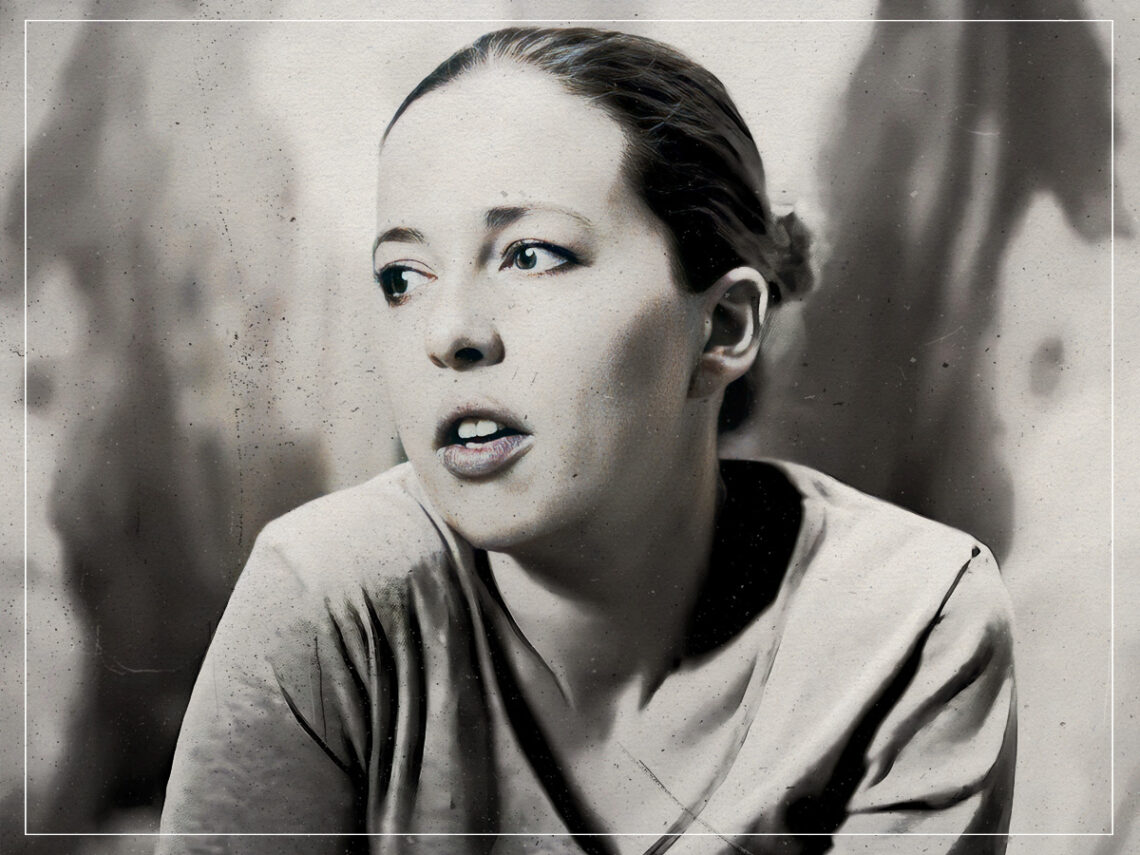
A collection of Jenny Saville’s favourite songs

When Jenny Saville was working on Voice of the Shuttle (Philomela), she listened to one song on endless repeat. Inspired by the tragic myth of Philomela, she found only Franz Schubert’s seven-minute odyssey, ‘4 Impromptus Op.90, D.899: No.4 in Ab Major’, would do. For Saville, music is crucial in constructing her fleshy paintings, but she never sticks to one genre. She can flit from classical to alternative indie, often choosing one song to soundtrack an entire painting. While her art rarely strays from her preoccupation with the body, her selection is widely eclectic.
Sometimes, her art and playlist merge completely. One of her staple tracks is the Manic Street Preachers’ ‘4st 7lb’, a horrifying vision of a woman in the throes of anorexia which appeared on Holy Bible. That album used her infamous triptych of an obese woman, South Face/Front Face/North Face, on its cover. Nicky Wire described the moment he first saw her work as a vivid memory. He and Richey Edwards each bought a newspaper featuring her work and instantly phoned each other to talk about it.
“[We said:] ‘Those paintings are amazing.’ It was a sort of psychic thing that me and him had”. Soon, Saville was talking to Edwards on the phone herself and being faxed lyrics. “They were so profound; the lyrics of that whole album are just amazing,” she told the Art Newspaper. “That’s what prompted me to do it.”
In addition to the Manic Street Preachers, she’s fond of Jay-Z, Nirvana, and Philip Glass – but only when she’s mixing colours. “It’s very annoying,” she says of her tendency to play songs on repeat for hours. “If anybody were in my studio, they would just be going completely crazy because I can listen to one single piece of music for the whole duration of an artwork or even for a show.”
Radiohead’s ‘Weird Fishes/Arpeggi’ was a perfect candidate for constant repetition. While making the Mother and Child drawings, the In Rainbows track rang out until she was finished. “You may or may not think that that goes together, but actually, the repetitions of sounds and the layerings were a good companion for me at that time,” she explained. “And there’s an urgency in the music that I liked.”
Saville has consistently depicted the human body with unflinching honesty, which was celebrated in the art world but frowned upon when she crossed over with the album covers. Her Holy Bible cover was censored, with albums being issued in plain sleeves. But her work was the visual answer to the arresting lyrics. Her work is provocative and shocking but ultimately concerned with one subject, and her studio soundtrack seems to be a window into these themes and a sonic escape from the repetitive brushstrokes – albeit in a confusingly repetitious way.
