


Colin Farrell: Incredible actor, awful action hero

Any actor that bursts onto the scene finds themselves inundated with offers to appear in broad, studio-backed crowd-pleasers, something Colin Farrell was far from immune from when he first rose to stardom around the turn of the millennium.
In fact, he was off to the races from almost the second he initially turned heads in Joel Schumacher’s Tigerland, embarking on an impressive box office winning streak that saw Minority Report, Phone Booth, The Recruit, Daredevil, and S.W.A.T. give him five consecutive films that opened at number one in the United States, where he played a lead role in three of them and took top billing in two.
However, while nobody’s going to deny that Farrell is an immensely talented actor – as displayed by the two Golden Globes and Academy Award nominations he’s got under his belt – and one that’s evolved into a phenomenal character actor blessed with leading man looks, the worst side-line of his impressive career has come when he’s tried his hand at being an action hero.
He’s a wet blanket dwarfed by Al Pacino’s scenery-inhaling in The Recruit, his Jim Street in S.W.A.T. is as bland as action movie protagonists come, and it’s no coincidence that he steals the show in Ben Affleck’s maligned Daredevil as an over-the-top secondary villain that’s encouraged to pitch their performance as outlandishly as possible.
Comparing his understated, immersive, and attention-grabbing work in the likes of In Bruges, The New World, The Banshees of Inisherin, The Lobster, and The Way Back to his workmanlike, formulaic, and charisma-free returns in anything that requires him to either pick up a gun or battle an army, and it’s like watching two completely different performers.
Farrell thrives when he’s given material he can sink his teeth into and wrap his nuances around, which is why his smarmy suit in Minority Report and put-upon everyman in Phone Booth are among his finest turns in heightened genre fare. In the former, he isn’t shouldering the burden, and in the latter, it’s the immediacy of the concept that allows him to flourish, but plastering his face front and centre yields the worst results.
Look no further than Oliver Stone’s Alexander for the costliest example, both personally and professionally. “I felt so much shame. I found myself in a place where with everyone I met I wanted to say, ‘Have you seen Alexander? If you have, I’m really sorry,'” he told The Hollywood Reporter. “I’m not even joking. I wasn’t going to give them their $20 million back, but…”
The best historical epics require powerhouse performances to lead the line, and Farrell’s was completely absent. He was less than thrilled with Michael Mann’s thriller Miami Vice, too, although he did “accept a good bit of the responsibility” for a commercial failure he admitted was “style over substance.”
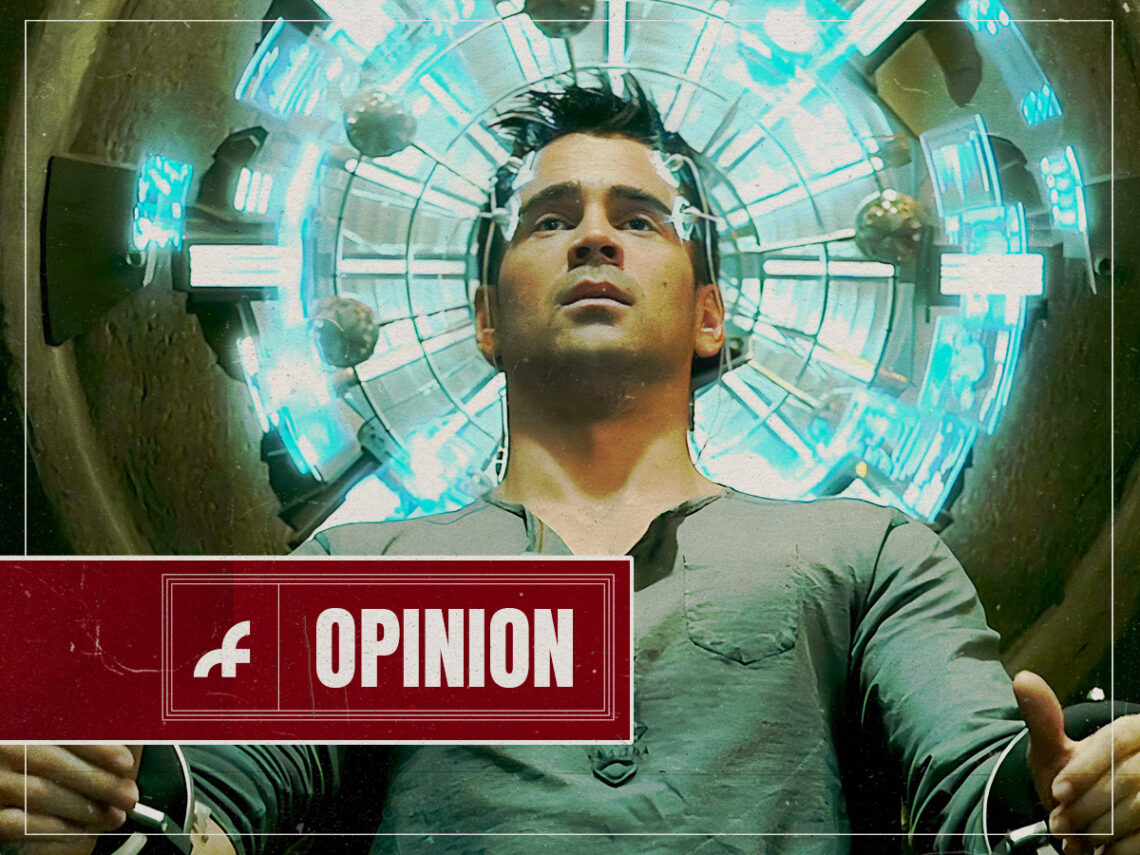
Len Wiseman’s Total Recall remake was yet another star vehicle for Farrell that continued underlining how ill-suited he is to being the face of an explosive action-packed epic regardless of its narrative parameters, never mind the juxtaposition of his prosthetic-laden turn in The Batman and well-received supporting role in Fantastic Beasts and Where to Find Them suggesting that he’s hardly allergic to delivering the goods under those circumstances, but he just can’t seem to do it when the focus is entirely on him.
Based on nothing but history, the least appealing thing Farrell can do at this stage of his career is dip his toes back into the water of running and gunning as an above-the-title marquee name. It’s far and away the least interesting and convincing tool in his cinematic bag of tricks, made all the stranger by a litany of credits covering drama, mystery, thrillers, and comedy that have spent two decades consistently displaying that he’s wonderful at what he does in virtually any other setting.
