


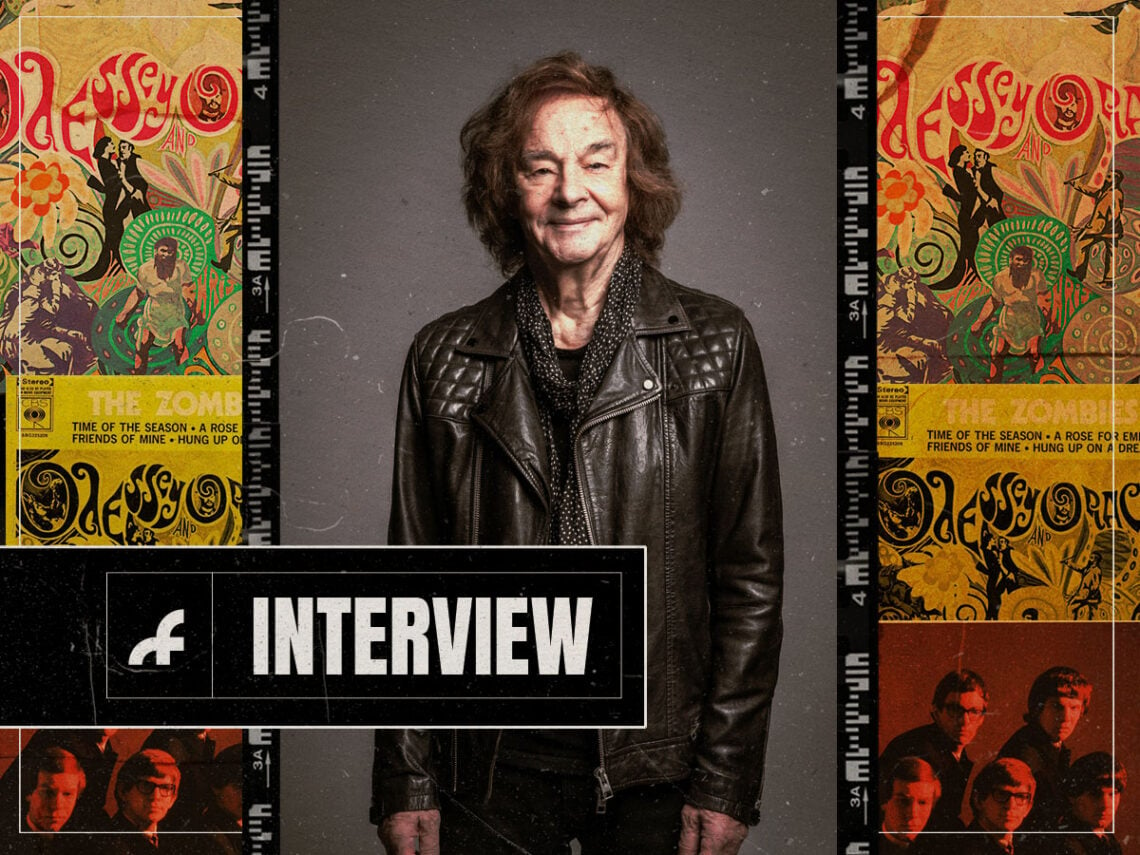
Colin Blunstone discusses The Zombies, Paul Weller and new music

“The Zombies first got together over 50 years ago and, as with all bands, have been through many ups and many downs, but being here with you all tonight on this wonderful occasion is an absolute joy and, of course, makes it all so very worthwhile,” frontman Colin Blunstone said during his speech at the Rock and Roll Hall of Fame in 2019.
One of the significant “downs” the iconic British invasion voice referred to here was The Zombies’ initial disbandment in 1967. Lodged somewhere between the splinters of Pete Townshend’s guitar and Dave Davies’ distorted amp, The Zombies found their footing in 1964 after releasing their hit debut single ‘She’s Not There’.
The single’s parent album, Begin Here, arrived in 1965 with a modest scattering of original compositions fleshed out by R&B covers. In a follow-up, they sought pure originality, both in writing and style; the result was Odessey and Oracle, a titanic yet cripplingly overlooked contribution to the psychedelic rock movement.
Odessey and Oracle, chiefly its best-known single, ‘Time of the Season’, formed the basis of my pleasant conversation with Blunstone last week. “Rolling Stone named it as one of the top 100 albums of all time,” he beamed, conceding, “And yet, when it came out in the UK in 1967 – it was a bit later in America – there wasn’t much of a reaction to it.”
After being dropped by Decca Records in 1966, The Zombies financed their studio sessions independently, with high hopes for the first singles, ‘Friends of Mine’ and ‘Care of Cell 44’. Sadly, they failed to garner much attention on either side of the Atlantic. “That was part of the reason why the Zombies finished,” Blunstone said. “I think we all felt that that album was the best we could possibly do.”
Bizarrely enough, The Zombies broke up just before Odessey and Oracle hit the shelves. Blunstone reflected that, since it was very much a “singles market” at the time, the underwhelming reaction to ‘Care of Cell 44’ alienated the band members to “try new projects and move on”.
“I look back, and I think that it is a little bit strange that we broke up before the album was released,” he admitted. “But I can tell you, the only DJ that supported The Zombies at that time was Kenny Everett; he loved Odessey and Oracle and played it. So it was noticed but by a select few.”
In a sour dose of sod’s law, ‘Time of the Season’ arrived as a single in March 1968 and went on to become the band’s most successful hit by a lofty margin. By this time, The Zombies were prospecting new pastures in various collaborations and solo projects, but the song’s powerful message of love caught the imagination of the US countercultural movement.

‘Time of the Season’ reached number three on the US Billboard Top 100, drawing attention to the album itself, which sold handsomely against the backdrop of the Vietnam War. “Strangely enough, the album nearly wasn’t released in America altogether,” Blunstone reflected. In a twist of fortune, however, Al Kooper brought the album to the attention of CBS executive Clive Davis.
“Al Kooper went into his office and said, ‘I’ve just got back from London. I’ve brought 200 albums with me, and one album really stands out: Odessey and Oracle. We have to get this album whatever it costs!’ Clive Davis said to him, ‘CBS already has this album, but we weren’t even going to release it.’ It’s only because of Al Kooper that the album was released in America,” Blunstone said with an air of relief.
When they noticed the impact of ‘Time of the Season’, The Zombies had been defunct for the best part of a year. “I think I would have been open to reforming the band to promote the album and the single, but everyone else, and even myself, I was really committed to another project. Everyone felt they had moved on. It was never even mentioned, even when huge sums of money were offered for the band to reform.”
Blunstone admitted that he was keen to promote Odessey and Oracle but was also “very curious as to what we might do next”. Although we sadly never heard an immediate follow-up to The Zombies’ second album, Blunstone feels the answer lies in the band’s ensuing solo endeavours. “Rod Argent and Chris White were involved in the first Argent album [eponymous], and they produced my first solo album, One Year. There are similarities between the albums, but they are also quite different. So maybe if you put a line down the middle of those two albums, that might give you a clue.”
Among The Zombies’ many famed disciples is Paul Weller, the co-founding frontman of The Jam. He once described Odessey and Oracle as his all-time favourite record and remembered, “The first time I heard it was in the mid-1970s, and it just blew my mind.”
Blunstone first met Weller in 2008 following a concert at the Shepherds Bush Empire for the 40th anniversary of Odessey and Oracle. “He came backstage afterwards, and he was really enthusiastic and just a great bloke, you know, a really, really good bloke,” Blunstone recalled.
If Weller was chuffed to meet one of his favourite bands in 2008, he was undoubtedly ecstatic to confirm a date to share the stage with Blunstone and Argent later this year. The so-called Modfather is scheduled to join The Zombies on the penultimate evening of their 2024 tour on June 7th at the Barbican Centre, London.
Blunstone was naturally touched to hear Weller’s popular cover of ‘Time of the Season’ recorded live on BBC radio in 2010. On the topic of covers, I was intrigued to find out whether the Zombies’ frontman had heard any other good covers of his band’s material.
“Cher has just done a Christmas album [Christmas, 2023], and she recorded ‘This Will Be Our Year’ from Odessey and Oracle. She’s done a great version of it,” he pondered. Adding, “Santana did a great version of ‘She’s Not There’, too.”
At this point, I referred Blunstone to Elliott Smith’s 1998 cover of ‘Care of Cell 44’. “You know, I was a fan of Elliott Smith,” he replied with an inflexion of surprise, “but I’m not sure I knew that he covered a Zombies song. Perhaps I just momentarily forgot… because I was always a big fan of his.”
Although Blunstone enjoyed Elliott Smith’s solo work throughout the 1990s up to his tragic death in 2003, his music taste is predominantly nostalgic. “I’m not saying this is true, but my theory is that you tend to listen to music you listened to in your formative years – say from about 15 to 25,” Blunstone proposed. “The music that I listened to then, singer-songwriters like Joni Mitchell, James Taylor and Jackson Browne, are the people that I listen to now.”
“I think I kind of feel safe listening to people that I know,” he explained. “There’s a UK singer-songwriter, sadly no longer with us, who I knew quite well called Duncan Brown, and I listen to his albums all the time. He’s so underrated. I don’t listen to a lot of radio, to be honest.”

Casting our thoughts to the vast uncertainty that is the music industry’s future, Blunstone admitted that he doesn’t hold a particularly attentive finger to the pulse. Despite his anxieties at the “advent of streaming”, he’s been reassured in recent years by “the renewed interest in vinyl… It does seem to be a more healthy situation than I thought it was,” he added.
Blunstone continued, lamenting the spiralling financial stature of grassroots venues. “I’ve got a solo band, and we last toured in 2019 just before the lockdown,” he said. “I was looking back over the dates quite recently, and I realised that quite a lot of the places I played in 2019 don’t exist anymore because obviously Covid stopped all live performances, and venues just go under.”
Troughs of underappreciation and zeniths of belated veneration evidently teach lessons of humbleness and gratitude. Over the past six decades, scores of artists, established and emerging, have admired Blunstone’s charisma and creative output. Therefore, it seemed wise to glean a final word of advice for any fans and aspiring artists among our readers.
“What I would suggest is to set many achievable aims so you don’t get too despondent if things don’t work out quite how you thought,” Blunstone ventured pensively. “Set your aims day by day – don’t forget your long-term aim; you should still keep that in the back of your mind. If you achieve some small gains, there will be options in your life that you wouldn’t have known about when you started off on your journey. You have to go through a few doors before you can find your path because before you go through those doors, you don’t know what options you’ve got.”
If The Zombies’ initial disbandment in 1967 was a mistake, they appear extremely unlikely to repeat the offence any time soon. Having released their acclaimed seventh studio album, Different Game, in March 2023, they hope to return to the studio before long. “I’m sure we’ll start recording again quite soon,” Blunstone told me in parting, “because albums take a long time to write and record, and it’s nearly a year since our last album. Rod Argent’s got a fantastic studio in his house, and it’s there just for The Zombies, so I’m sure in the next couple of months we will start that process again. I’m really looking forward to it – I love recording!”
Don’t forget to catch the band on tour this year in the US and UK. You can see a full rundown of the scheduled concerts on The Zombies’ website here.
Listen to ‘Different Game’, the title track from The Zombies’ 2023 album, below.
