


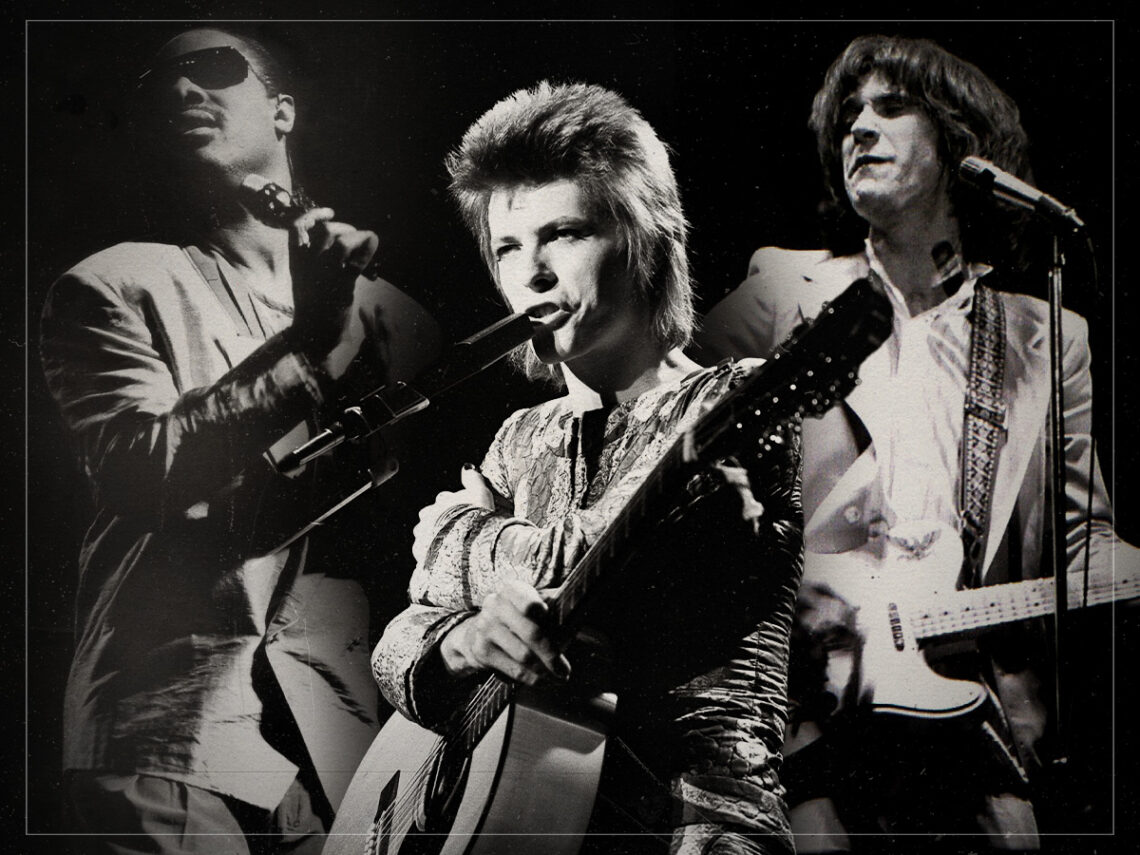
The curious chord that unites David Bowie, Ray Davies and Stevie Wonder

Pick any great instrumental, and an unspoken genius is conjured in the recording studio. Musicians can trace which chord was the magic touch, or which drum fill brought a song together, but often, the most memorable notes come from experimenting and a fearlessness in doing so.
One of the “unsung heroes”, if you will, of innovative instrumental technique is the third inversion chord, employed by some of rock history’s most virtuosic musicians. Inversion chords – or, “slash” chords, as they are commonly referred to as – change the lowest note from something other than the root. A third inversion chord, in particular, is where a dominant (or flat) seventh is added to a triad/chord and moved to the bottom, noted as a “slash”, as explained by Guitar World.
But it can have any arrangement of the root, third and fifth above that, including doubled notes, compound intervals and more. In other words, the third inversion chords are going beyond convention, experimenting with alternative notes and chord extensions.
One of the most famous uses of a third inversion chord is on David Bowie’s ‘Starman’, heard in the song’s chorus. Released in April 1972, ‘Starman’ employs a 12-string acoustic guitar, playing a “subdominant” chord followed by “the major 7th of the root” across both channels, as analysed by Michael Doggett in his book, The Man Who Sold the World: David Bowie and the 1970s. A six-string electric strums at various points across the song, before both guitars merge. The inversion gives the effect that something is missing, as though the chords are trailing off into an unknown space, though in the end, they find their place.
An earlier example of this technique came before Bowie’s Ziggy Stardust landed on Earth, heard in the British invasion stylings of The Kinks. Their 1966 hit ‘Sunny Afternoon’ features a third inversion shape, creating a descending progression. Frontman Ray Davies wrote the familiar melodic opening while stuck at home, ill, having not written for a long time.
“I’d bought a whit upright piano,” he recalled to Songfacts. “My one-year-old daughter was crawling on the floor, and I wrote the opening riff. I remember it vividly.” This particular third inversion chord is heard similarly on songs like ‘Holiday’ by the Scorpions and ‘Dear Diary’ by The Moody Blues, among many other interpretations, creating a common theme that crafts a tune that is off-centre but catchy.
A proficient scholar of the third inversion chord is Stevie Wonder. To attempt to define the various chord progressions Wonder has used across his discography is a near-impossible feat, and his virtuosity is perhaps only fully understood by the genius himself. Still, we can hear how he often employs the technique of placing the seventh in the bass to create a flowing texture in his songs.
Listening to a song like ‘As’, his hit single from 1976’s Songs in the Key of Life, the chorus hears a dominant seventh chord, a distinct use of third inversion. With this, the chords weave seamlessly together, a spiralling continuation of the melodies.
While spotting a third chord inversion does not come naturally, its influence in music is undisputed, bringing together some of the greatest musicians in a shared spirit for reinvention.
