


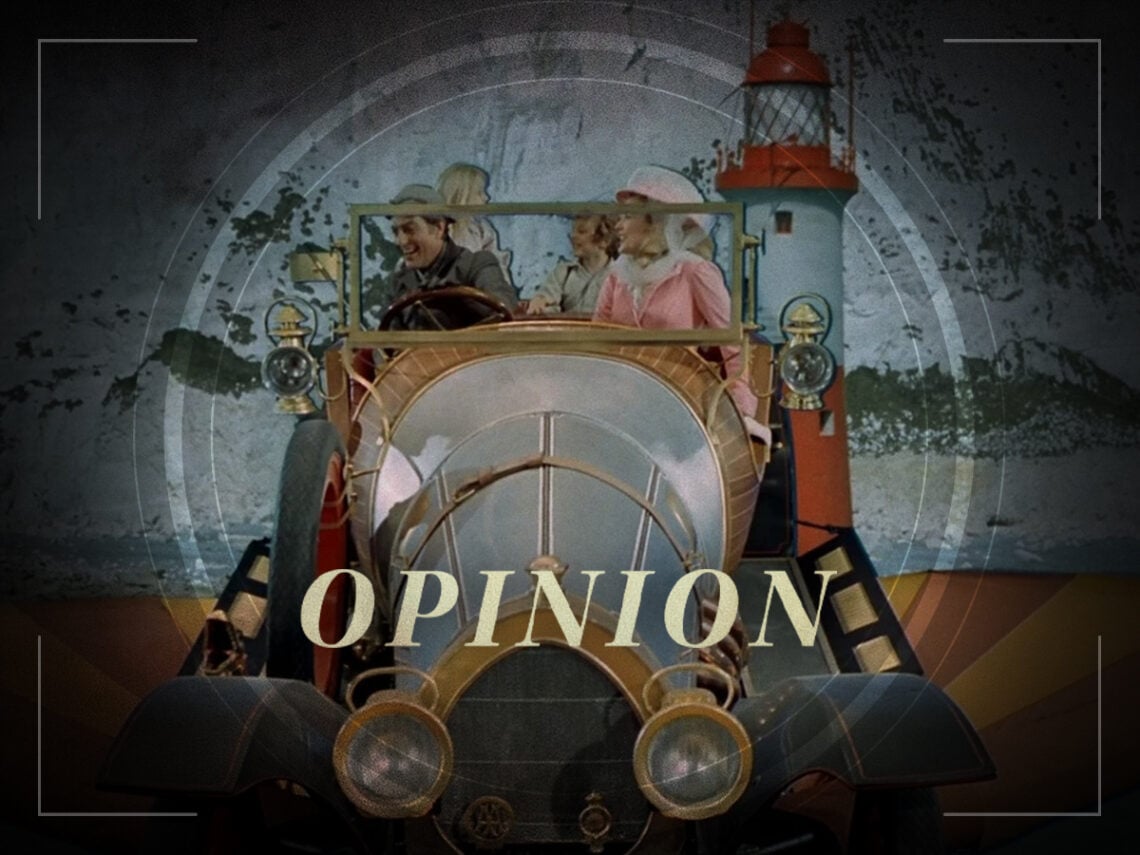
Hear Me Out: ‘Chitty Chitty Bang Bang’ is the strangest kids movie ever made

When I was young, I was fascinated by a little toy car replica of Chitty Chitty Bang Bang that my dad had owned since he was a small boy. The paint was chipped but the wheels still spun round as well as I imagined they did back in the late 1960s, and I pictured my dad racing the delicate Corgi toy across the floor, careful not to snap the wings off the sides of the car.
I don’t remember the first time I watched Chitty Chitty Bang Bang, whether it was before or after I discovered this strangely-shaped mini car, but I remember my mum preparing a costume for one of my dance shows, which would see me dancing to ‘Toot Sweets’. Eventually, the movie became a staple childhood movie of mine, and I would fling myself in front of the telly as Dick Van Dyke and Sally Ann Howes swung on food carts, or I’d use the broom to perform an electrifying rendition of ‘Me Ol’ Bam-Boo’. My poor parents.
After seeing the musical live on stage, there came a time when I stopped dancing around the living room to Chitty Chitty Bang Bang, and I outgrew my eight-year-old self’s passion for musicals. However, I still come back to chunks of the film every Christmas, and I’m always reminded of how strange, and sometimes terrifying, it actually is. I’ve even found myself down various Chitty Chitty Bang Bang rabbit holes before, deep diving into everything from the anti-Semitism theories to the much more lighthearted (but mind-boggling) fact that Lionel Jeffries, who played Dick Van Dyke’s father in the film, was actually six months younger than the lead actor (and only 42).
Yet, every time I think about the film, I’m instantly reminded of the terrors of the Child Catcher, one of the most bizarre and nightmare-inducing characters for any child to witness on screen. I have a memory that is permanently lodged in the back of my brain of my mum showing me a clip of the Child Catcher scene to prepare me for seeing it live, but something glitched as the video started to play, and she couldn’t turn the volume down. I was petrified. The sheer loudness of the Child Catcher ringing his bell and luring children with lollipops haunted me, and you have to wonder what was going through the filmmakers’ minds.
The movie is based on Ian Fleming’s book of the same name, but the terrifying character was actually conjured up specifically for the film, although whether sole credit goes to Ken Hughes or co-screenwriter Roald Dahl is still debated. Yes, that Roald Dahl, the raging anti-Semite, potentially had a hand in creating this character loaded with evil Jewish stereotypes. The Child Catcher has a long prosthetic nose and sports a top hat and a long coat, all of which were features typically used in Nazi propaganda to portray a Jewish person. Yet, the film has the Child Catcher take on a Nazi-like role, rounding up blonde children in his cage and searching for them in houses much like the SS did.

You have to ask why a sudden allusion to Nazi Germany was added to the script of a kids film, turning the charming musical into a surreal horror film for a decent part of the runtime. The atmosphere that pervades over the audience during this part of the movie is dramatically different to when Dick Van Dyke is jumping around or the children are admiring their potential new mum, Truly Scrumptious, at the beach.
Of course, as a child, I couldn’t see the strange Nazi parallels in the fantasy part of the movie, nor did I likely understand that the main chunk of the film is just a story that Caractacus tells his children. Looking back, it’s easy to see why a child would become strangely enamoured by this cinematic fever-dream, where cars can fly and children are at risk of being kidnapped. It balanced fantasy and reality in a way that both enticed and scared me, and I’m sure many young viewers felt the same.
Looking back, my taste in movies as a kid – I was also a huge fan of Tim Burton’s Charlie and the Chocolate Factory (this was my favourite scene) and The Cat in the Hat – was the perfect primer for my adult taste in the likes of John Waters and David Lynch. Chitty Chitty Bang Bang didn’t set out to be a surrealist epic or a deep exploration into the fine line between reality and fantasy, but it can certainly be experienced that way.
I’m not sure if children still regularly sit down to watch Chitty Chitty Bang Bang, after all, it’s two-and-a-half hours in length. It’s also rather nonsensical when you think about it, with most of the movie acting as a story-within-a-story, with a plot regarding Caractacus and Truly potentially getting together sandwiched between. He even turns her down at the end, only returning to confess his love when her father funds his Toot Sweet invention (although he must market it as a dog treat). Is he anything more than a simple gold-digger?
It feels like a rite of passage to be terrified by the Child Catcher when you’re little, though, and for many children, it’s the first time you must reckon with a character so threatening you might get nightmares about him luring you in and locking you in a cage. What went through the minds of Dahl, Fleming, and Hughes is certainly questionable, but what it did give us was one of the strangest yet most compelling children’s movies ever made.
