


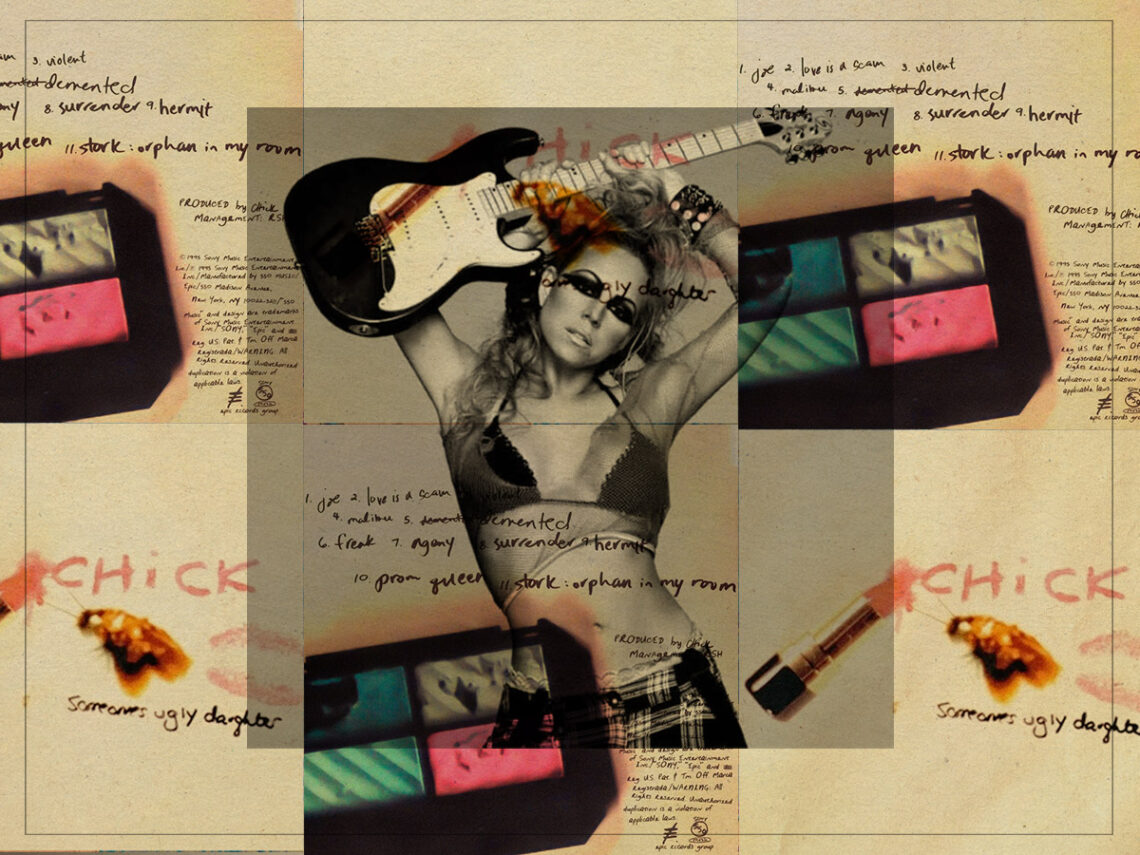
Chick: the strange tale of Mariah Carey’s grunge alter ego

Lots of people might try to argue that the 1990s were the last decade in which there were distinct musical scenes and identities, and that since then, things have either looked to the past so much or become homogenised to the point that there’s always an overlap in an attempt to blur boundaries between audiences. While the decade may be known for having birthed grunge and Britpop, it was also a time when the biggest stars were emerging with a brand of pop that was so pristine in its presentation, and leading the charge with this was Mariah Carey.
Sure, lots of people love Carey’s records, and there are plenty of people who get excited when Christmas comes around and they have a decent excuse to wheel out that song once again. To others, the singer-songwriter represents a mutation of pop music that is too formulaic; one that feels as though it was immaculately conceived in a lab in an effort to make the most inoffensive and appeasing style of music possible. There’s clearly plenty of talent there with Carey, but it’s hotly debated as to whether that has always been put to good use.
However, her dalliances with overpolished pop were hardly her fault. Greedy music executives knew they could market Carey in such a way that they’d be able to rake in mountains of cash from selling her records, provided she stuck to the formula and wrote these radio-friendly songs. A large amount of this external pressure in the mid-1990s was coming from her then-husband, Tommy Mottola, who happened to be the CEO of Sony Music, and because there was this demand for her to sell as many records as possible and not to pursue her creative ambitions, she began to feel frustrated.
Since she had become ensnared in this vicious ploy to make her write pop music that she didn’t feel passionate about, Carey decided that she’d have to find another outlet where she could truly express herself in a way that wouldn’t have been accepted by her existing audience. However, she chose to do so in disguise, so as to not jeopardise her career trajectory in any way, and this ruse remained in place for almost 25 years.
Chick was a short-lived alt-rock and grunge group led by Clarissa Dane-Davidson, who released their sole studio album, Someone’s Ugly Daughter, in 1995. Alongside Dane-Davidson were a handful of other members who assisted with instrumental backing and earned themselves co-songwriting credits, but the fact that none of these other members had first names was peculiar for an album that seemed so no-nonsense in its approach. Their deliberately obscure names, D Sue, W Vlad and W Chester, added an air of mystery to the entire album – one that Carey would eventually reveal all on.
What happened with Someone’s Ugly Daughter was that she had written and sung a number of songs alongside her regular collaborators, Walter Afanasieff and Gary Cirimelli, in an alternative rock style, but when it was presented to Sony, they immediately rejected it on the grounds that it would tank her career. Desperate to release the album, she enlisted the help of Dane-Davidson, a friend of hers, to sing over the top of the songs while leaving in her backing vocals, and released the record under a pseudonym.
It came out at the same time as her fifth studio album, Daydream, and because it was released in such close proximity to the album, and frankly, so far out of character for Carey to have done, very few suspected her of having been a significant part of the record. It’s a raw and raucous release that takes cues from contemporaries such as Garbage, Hole and Sleater-Kinney, and one that Carey is proud of to this day for having done regardless of how muted the reception was.
In her 2020 memoir, she revealed that after sessions for Daydream, she would work on her secret album. “I was playing with the style of the breezy-grunge, punk-light white female singers who were popular at the time. They could be angry, angsty, and messy, with old shoes, wrinkled slips, and unruly eyebrows, while every move I made was so calculated and manicured.”
As for whether others remember it fondly, she doesn’t seem to mind that much – her own memories of making the record were some of the happiest of her career, where she could expel all of her pent-up frustrations. Carey concluded, “I made the sarcastic hardcore head-banging record no one was ever going to allow me to make. My assistant and I used to blast it in the car, singing at the top of our lungs, giving me a brief moment to be outwardly angry, irreverent, and free.”
