


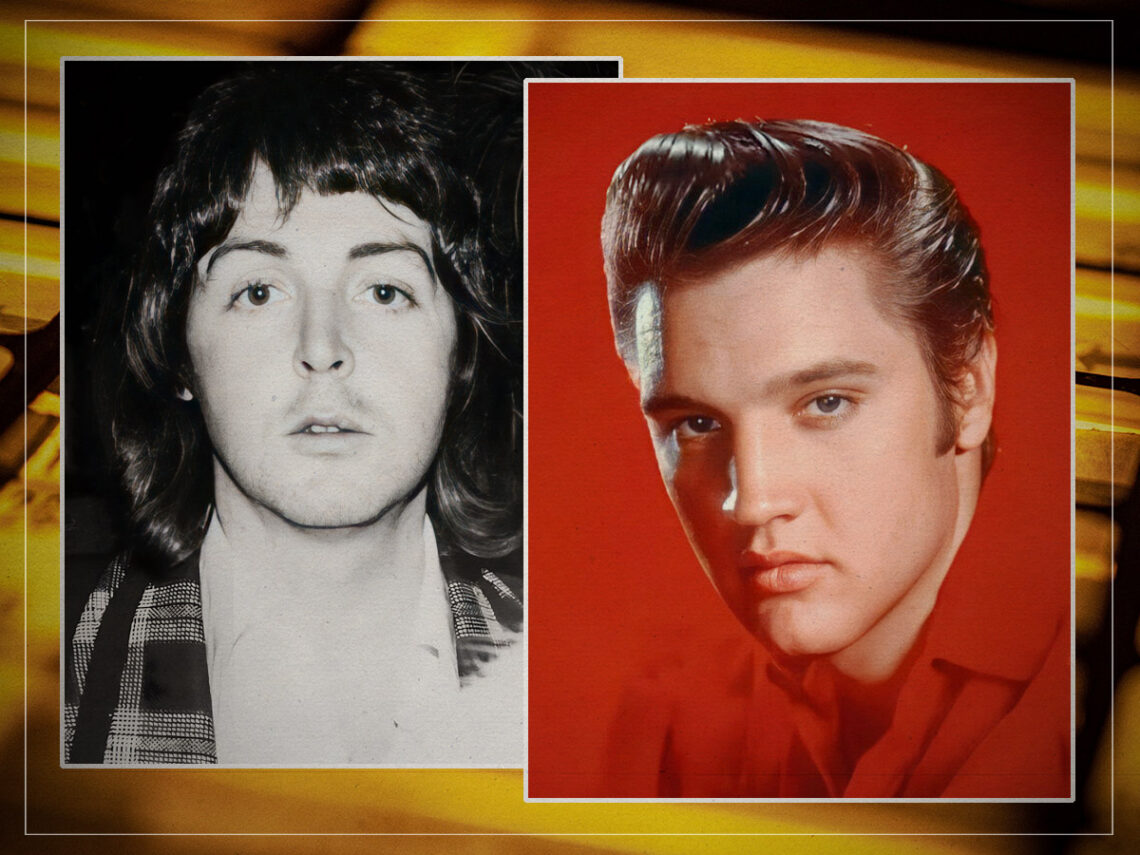
Who won in the first chart battle between Elvis Presley and The Beatles?

In the world of music and popular culture, it is tricky to find any names bigger than Elvis Presley and The Beatles. Respective rock revolutionaries, Elvis typified the first age of rock and roll during the late 1950s, while The Beatles took that inherent sound into bold and unexplored territories during the 1960s. Given the fact that both artists existed in distinct eras of music and culture, it can often be difficult to remember that the performers co-existed for a time. At one point, Presley and the ‘Mop Tops’ even came face to face in a battle to reach the top of the pop charts.
Elvis Presley was always an incredible force for commercial success. From his earliest recordings, the gyrating rock and roll star became a regular feature of the American singles charts, culminating in his reputation as the harbinger of this rebellious new generation. His shocking qualities and obvious musical talent allowed him to stay relevant for much longer than many of his rock contemporaries, and he quickly became a worldwide phenomenon. Elvis was particularly popular in the United Kingdom, where a young band named The Quarrymen would often sit around listening to his records.
For the uninitiated few among you, The Quarrymen eventually morphed into The Beatles. Particularly during the band’s early period, the Fab Four were always keen to pay homage to their 1950s rockabilly influences. For instance, the group would often include covers of Chuck Berry or Little Richard within their live shows – ‘Roll Over Beethoven’ even made it to the tracklisting of sophomore record With The Beatles.
Meanwhile, the early 1960s were a pretty strange time for Elvis Presley. Towards the back end of the 1950s, the rock star was drafted into the US Army, which put his musical career on temporary hold. Even when he returned to the States in Spring 1960, his focus appeared to be on films rather than music. Although many of them were fairly successful and have since developed cult followings, Elvis’ film appearances weren’t all that memorable. As the decade progressed, the global star was at risk of losing relevancy.
Ironically, The Beatles were partly responsible for that declining relevancy. After all, the Liverpool group represented an inventive new age for rock, ushering in the British Invasion and embracing the psychedelic counterculture age. They had largely moved away from paying homage to old rockabilly stars by the time Elvis made his famous comeback in 1968, but that did not stop Presley from recapturing the interest of the American audience.
Following his famous ‘comeback special’ in 1968, the singer released the triumphant comeback album From Elvis In Memphis. Even though musical audiences had largely moved on from the primitive rockabilly of ‘All Shook Up’, the album was a colossal success, cementing the singer’s legendary reputation and lasting success. One of the most notable tracks on that album was ‘In the Ghetto’, which reached number two in the UK charts and three in the Billboard Hot 100.
There is no doubt that Elvis, along with RCA Victor Records and everybody else connected to his career, was hoping that the comeback single would top the charts. However, the song was kept off the top spot on both sides of the Atlantic by Paul McCartney’s magnum opus track ‘Get Back’. One of The Beatles’ most beloved compositions, the song signalled the beginning of the end for the legendary band, but its success reflected the unparalleled position of the band by the time the 1960s was drawing to a close.
Elvis Presley, despite the success of his comeback, still represented the old school for many music fans. Young people at that time craved modernity and innovation, so it is no surprise that The Beatles managed to come out on top of the chart battle. Seemingly, though, Presley did not hold a grudge against the band. During his performances in Las Vegas in 1970, he even performed portions of ‘Get Back’ as a part of a medley, interspersed with parts of ‘Little Sister’. Even Elvis could not deny the genius of Paul McCartney.

Never Miss A Beat
The Far Out Beatles Newsletter
All the latest stories about The Beatles from the independent voice of culture.
Straight to your inbox.