


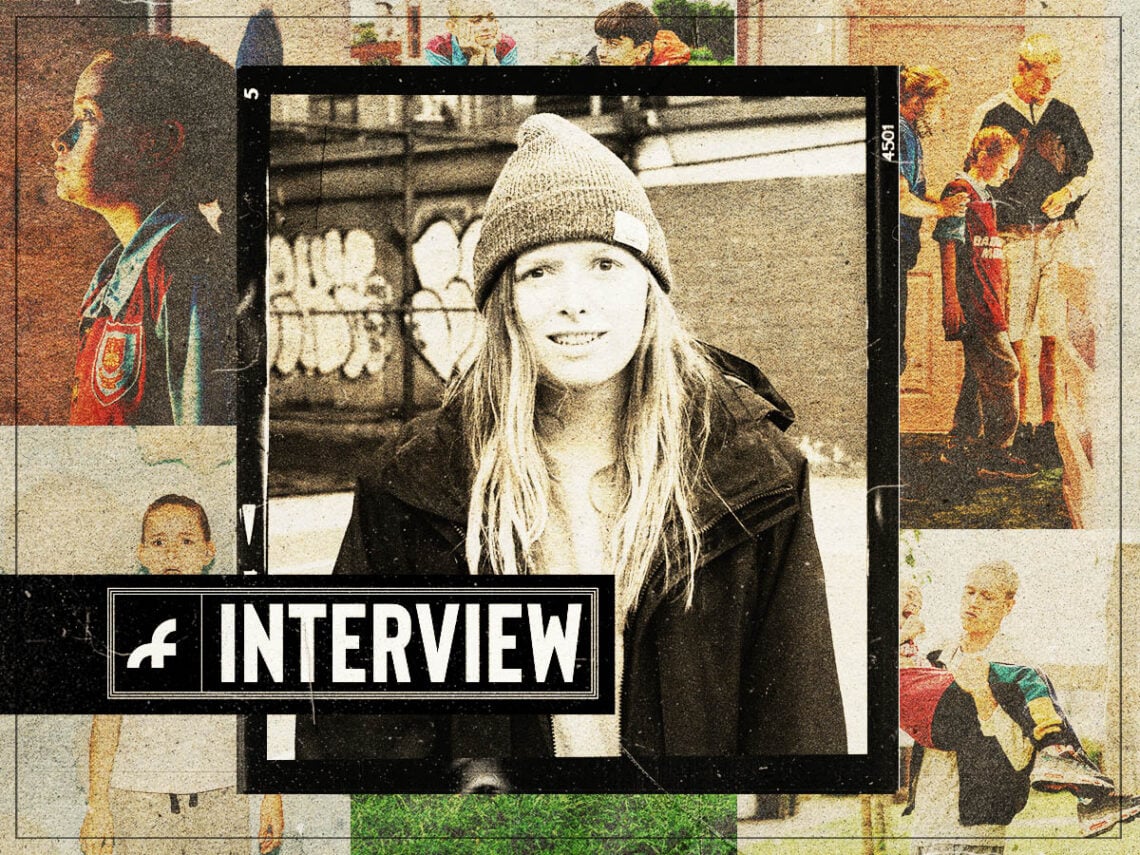
Charlotte Regan discusses ‘Scrapper’ and the vibrancy of British cinema

Whilst blockbuster filmmaking flounders in Hollywood, causing studio executives to pace their boardroom and throw a dart at a number of long-expired franchises to see what pointless adaptation to do next, across the pond, independent cinema continues to thrive. The British film industry has already seen a number of impressive debut features, with Charlotte Regan’s Sundance hit Scrapper joining the likes of Georgia Oakley’s Blue Jean and Connor O’Hara’s Kindling.
Arriving with a great deal of expectation following its ‘Grand Jury Prize’ at the Sundance Film Festival, Regan’s debut comes after a great number of short projects that each explore the reality of coming-of-age for the British youth. Scrapper feels very much like the culmination of her career efforts, featuring the Triangle of Sadness star Harris Dickinson as an immature father who returns to his neglected daughter, played by the charming debutant Lola Campbell.
Capturing the same vibrant aesthetic as Raine Allen Miller achieved with Rye Lane earlier this year, Scrapper pulses with frenetic spontaneity, as if the direct viewpoint of the young protagonist. It’s certainly a refreshing perspective of British cinema, particularly of the working class experience, with Regan taking her characters to unexpected places using a range of idiosyncratic techniques.
We talked to Charlotte about her spectacular debut feature and her impression on the current landscape of British cinema below.
Far Out: Looking back at your filmography, it’s clear that you have a love for stories about young people coming through hardship. I was just wondering what it is that draws you specifically to that subject.
Charlotte Regan: “There’s something about the slight magical perspective and outlook that young people have on everything. I’m interested in how formative and impactful those years are; the experiences you go through and the effect they have on you as an adult.”
What were the films or stories that came to mind when writing Scrapper?
“The films of Taika Waititi, his oldest stuff like Boy and Hunt for the Wilderpeople, other films like Paper Moon and like Paris, Texas, with the father-daughter moments, and I love like Shane [Meadows’] older stuff, where it feels like he’s almost documenting those young people just existing. His casting was always so incredible, and it felt like you were just really watching people exist, instead of like words being put in people’s mouths.”
Considering this is your first feature undertaking, what would you say that the biggest challenge was compared to short filmmaking?
“The edit was mad long! It was super boring to edit, just sitting somewhere every single day, it made me go a bit mad. That was probably the worst part, the edit, the stamina and having to keep finding a fresh perspective on this film that you’ve watched like hundreds of times, that was quite hard. Having to keep finding the energy to go back to the edit and solve another problem without ruining the film, it’s hard to keep having clarity on stuff like that.”
“The shoots always feel the easiest because you’re just running off like a mad adrenaline and every problem has to be solved instantly.”

You mentioned before about the kind of filmmakers like Taika Waititi that inspired this project, I also got Shaun Baker vibes – was this someone you looked at, particularly for cinematic inspiration?
“I love The Florida Project, that was a massive visual reference, and I love how the drama is almost secondary to the kids’ joy, you know. Things are happening that you’re not given exposition, I love the way he kind of does plot and drama, it’s incredible.”
The colourful housing estate that features heavily in the film seemed to take specific inspiration from this. Was that intentional?
“Yeah, that was intentional. We painted them all in order to not be like a classic desaturated working-class film, but we knew that if it poured down for the whole shot, which obviously can happen in a British summer, there’s only so much we can do with lenses to make it look bright. As well as the mad beautiful American sunlight that they get, the hotel is the character in The Florida Project, so that was for sure a massive inspiration.”
That’s true. A lot of British films bathe in how gloomy and kind of depressing they are. But, with your film and Raine Allen Miller’s Rye Lane, it’s nice to see that colour coming back to British cinema because it’s not all doom and gloom, even though it sometimes seems like it.
“Yeah, I love Rye Lane. It’s proper beautifully shot.”
In terms of performances, what was it like handing someone like Harris Dickinson, who’s a massive up-and-coming talent, and then completely fresh debutants like Alin Uzun and Lola Campbell at the same time?
“I never really saw it as any different, which is probably a testament to Harris’ character as a human being. He’s very selfless and egoless and comes there with the same energy that everyone else does. He just wants to make the best thing possible, and maybe that is also a benefit of making low-budget indie features. If someone like Harris decides to do it, it’s probably because he’s interested in the story, so you don’t have to spend weeks battling him. He very much wants to understand the character, wants to take ownership of it, and he was incredible with Lola and Alin.”
“And then they [Lola and Alin] were just mad, that is the joy of casting debuting young people. Every day you’re doing something they haven’t experienced before, so they’re finding it all super exciting, and it reminds everyone on set of what a great job it is, you know, it reminds us all to take a step back and appreciate what we’re doing.”
It was definitely nice to see a British film exploring working-class characters and relatable stories. I was wondering how you see the current landscape of British cinema.
“It feels like it’s been like an incredible year for like debuts in particular, you know, or two years even. We have Georgia Oakley’s Blue Jean, Aftersun is incredible, Rye Lane, Polite Society, Molly Manning Walker’s How to Have Sex is an incredible film, and it feels like there’s a real shift in British films and what it means to be a British first film.”
Scrapper is a really exciting debut to be announced onto the British film stage too! What’s next for you?
“I don’t really think about it too much. I’m not like a big planner, so, who knows, I’ll write something and hope I don’t totally fuck it up, and after then make something eventually.”
Then, finally, away from British cinema, what are your favourite films at the moment?
[Quickly accesses her Letterboxd account] “Arrival, The Wicker Man, Manchester by the Sea and Monos!”
