


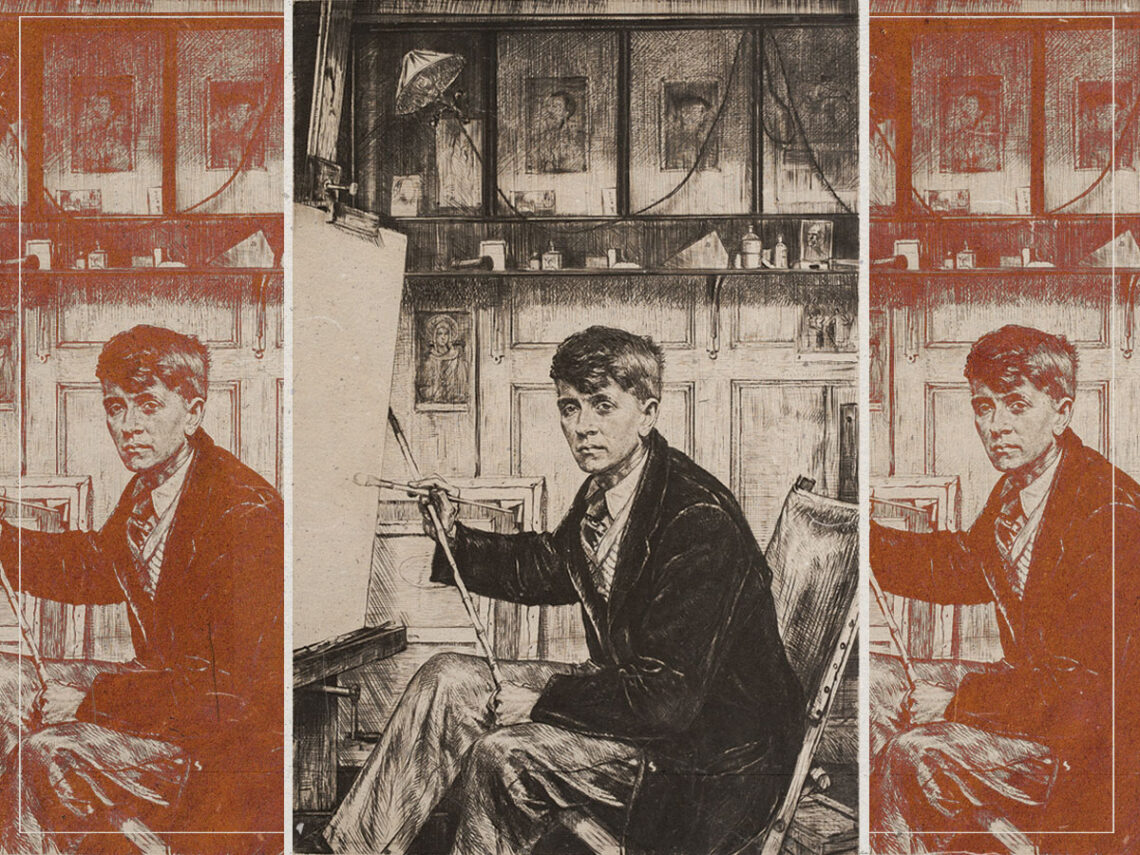
Charles Ernest Cundall and the horrors of war

When the War Artists Scheme was set up, it was argued that “the camera cannot interpret a war so epic in its scope by land, sea and air, and so detailed and complex in its mechanism”. Instead, it was thought that the atrocities required “interpreting” by artists, as well as photographic recording. Although it’s a clumsy phrase in the face of mass violence and death, when we look at “iconic” wartime images, like the Pulitzer-prize winning Vietnam photography by Eddie Adams and Nick Ut, it’s so horrific, it’s almost clinically devoid of emotion. It’s presented as fact: this happened, and this is how it looked. When it came to the commissioned wartime art from Charles Ernest Cundall, the visual interpretation of war took a different approach.
Only a few short years after gaining a scholarship to the Royal College of Art, Cundall was serving with the Royal Fusiliers in the First World War. His right arm was badly injured, but he lived, forever changed mentally and physically, as were an incomprehensible amount of men. Before returning to the college, he needed to learn to paint with his left hand. That his life was changed by war is a crucial window into understanding his approach to capturing it when the Second World War broke out.
When it did, he worked on a few brief contracts for the War Artists’ Advisory Committee (WAAC), then as an Admiralty artist working alongside the Merchant Navy. After spending time on the Thames, he suddenly found himself assigned to the Air Ministry in 1941. He spent the first chunk of 1942 in Northern Ireland, painting the American troops.
His best-known work to come out of the war had been completed a year earlier. The Withdrawal from Dunkirk, June 1940, is one of his most devasting. It’s a glimpse into the devastation on the sand dunes, with huge plumes of smoke completely dwarfing the people, which seem secondary to the chaos as the aircraft plummets. Despite the fact three artists from the WAAC were eyewitnesses at the retreat from the evacuation from Dunkirk, Cundall, who wasn’t, was called upon to capture Operation Dynamo – otherwise dubbed ‘The Miracle of Dunkirk’.
Fellow artist Richard Eurich joined him, and the two attempted to conjure a fitting artwork based solely on photographs, published reports, and largely, their imagination. The works they created were debuted, side-by-side, at the National Gallery in August 1940. Kenneth Clark, an art critic who’d previously been involved in an exhibition linked to Benito Mussolini, criticised Cundall’s take for its lack of detail, which contemporary revisits more accurately agree adds to the sense of overwhelm and chaos.
While Clark and the Royal Navy preferred Eurich’s painting, photography from the Ministry of Information would later crop up in newspapers depicting two servicemen looking at Cundall’s piece, seemingly recognising parts of the scene he’d painted.
Working solely from vague eyewitness accounts and his own lived experience, Cundall somehow created an artwork that spoke to the horrors of war as piercingly accurately as possible.
