


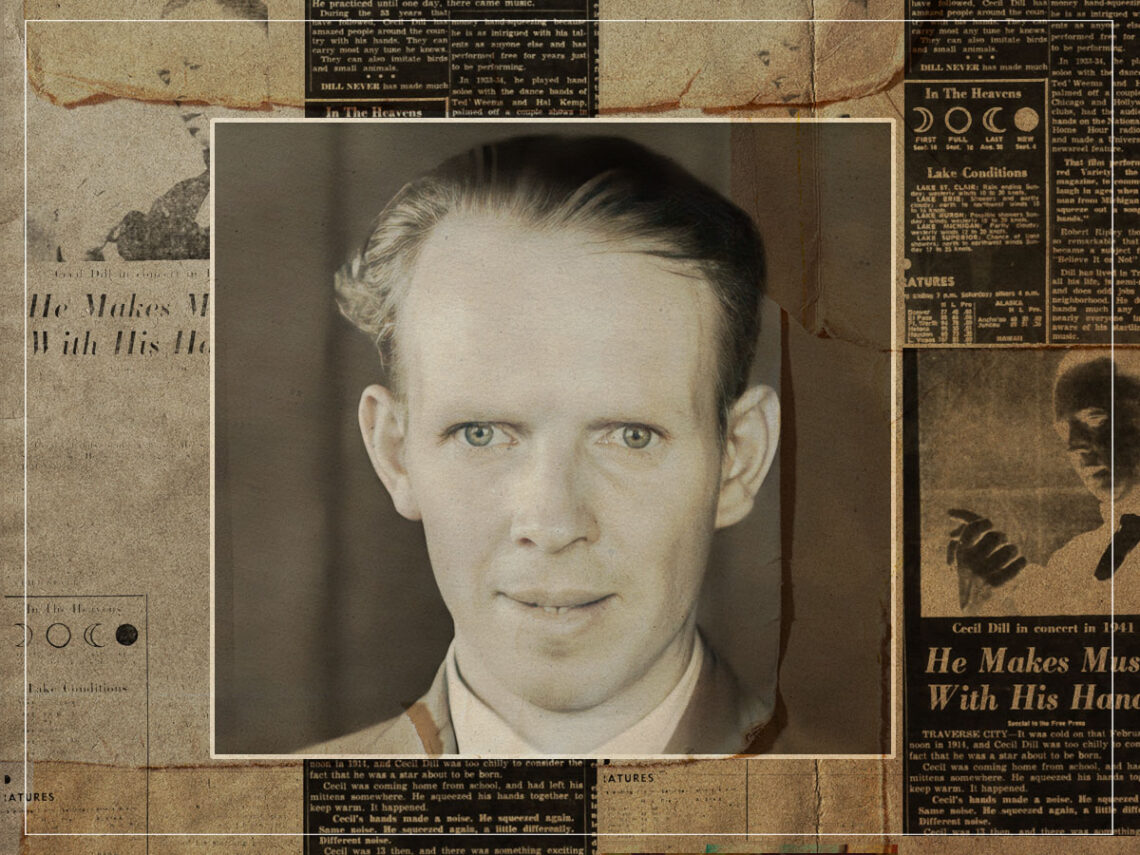
Cecil Dill: the dairy farmer whose hands could sing

Whether or not you possess a single musical bone in your body, there are undoubtedly two parts of your human frame that you will have used in a musically expressive way at some point in your life. Most obviously, the mouth and all of its attached apparatus can be used for singing along with music, and even if you’re tone-deaf, I’m sure that your harsh tones have graced the airways for others to hear. Similarly, we’ve all used our hands to make music before, with clapping and slapping along to the beat of a song being the traditional way in which we make use of these appendages.
So, singing with the voice and clapping with the hands – sounds simple enough, right? But what about singing with your hands? Considering your hands don’t have a mouth to speak through, this sounds implausible, but for a young dairy farmer in Michigan, his singing hands were the key to his brief notoriety during the 1930s.
Cecil Dill remembers clearly when he first discovered that his hands possessed a talent like no other. In February 1914, as a young boy walking home from school in the bitter cold, Dill noticed that when he clasped his mittenless hands together, they produced a variety of different sounds rather than just the same monotonous squeak. Upon discovering this, as most bored adolescents might, he decided to see if he could consistently pitch these different sounds and play tunes, and by the end of the year, he’d mastered the art of playing ‘Yankee Doodle’.
Of course, his hands were not exactly ‘playing’ the song, and nor did they have the same clarity in tone that a tuned instrument like a piano or violin might have. What was, in fact, happening was that Dill had been trapping pockets of air between his palms and squeezing them out of the small gaps at the top and bottom to create different notes and pitched them by applying different pressure. We’re all familiar with armpit farts and their comically flatulent sound – this isn’t that different.
Dill practised his skill daily and, within the next three years, had managed to perfect ‘Marching Through Georgia’ and ‘Trail of the Lonesome Pine’. However, he was bothered by people regularly asking how he could do his party trick and decided to quit practising his instrument for six years, instead applying himself on the local dairy farm. When he met up with a showman he’d previously known in his hometown of Traverse City, he was curious to see whether Dill still had the skill in him, and when he demonstrated that he could, this was when people began to take note for a second time.
He would make his recorded debut in 1933 as part of a brief Universal Studios newsreel and perform his famed rendition of ‘Yankee Doodle’ with piano accompaniment before telling his story of how he discovered his talent to the cameras. In addition to this, there are documents of Dill performing other traditional songs as part of different newsreels, such as a rendition of ‘Let Me Call You Sweetheart’ roughly two years later. There isn’t much other documentation of whether Dill hung up his hands or continued to entertain with his art form after this, but the two newsreels are a fascinating insight into his unique talent.
From a musical standpoint, there’s little to shout about when it comes to Dill’s flatulent palms, but as far as being a pioneer and a one-of-a-kind performer who managed to master a skill that so few people can even begin to learn, Dill was extraordinary. Others have since gained notoriety for having similar skills, and the practice has become more widely referred to as ‘manualism’, but Dill remains the earliest documented example of a competent manualist.
Dill remained on the farm all while honing his craft, maintaining his job tending to the cattle. When people asked him how he used to keep up with his skill, his response was simple: “Just by milking ten cows morning and night, I could keep my musical instrument in practice and also keep it nice and limber.” If there are any dairy farmers out there looking for a career change, just think; you could be the next Cecil Dill.
