


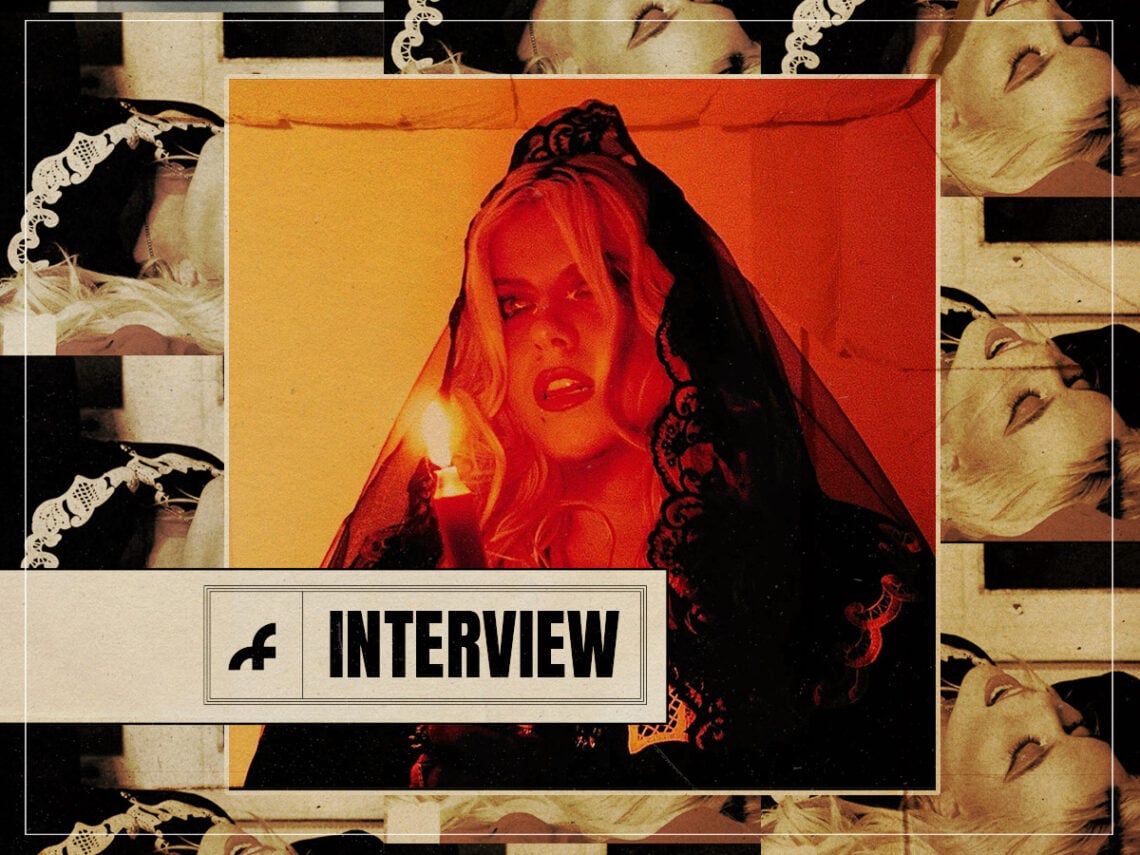
“Believe in yourself to a delusional degree”: how a voice note landed Catty the support slot for Stevie Nicks

Performing on a festival stage is any musician’s dream—but supporting Stevie Nicks? Well, that’s a different beast entirely. Nicks might have made a name for herself as an integral part of the fiery Fleetwood Mac, but in today’s pop-rock resurgence, she’s more relevant than ever.
For Catty, the Welsh-born singer-songwriter currently leading the charge in the high-energy pop resurgence, supporting her rock idol wasn’t just a dream; it was something she felt destined to do. So, with all the confidence and sparkle she could muster, she did what anyone would do: she told Nicks’ agent on Instagram…in a voice note.
Catty appeared at Nicks’ BST Hyde Park show, but the build-up required what seemed like blood, sweat, and tears, and a mammoth amount of faith—without a debut album and a name far from being the biggest on the stage by any measure, the singer got her team to email anybody they could find to make the case for her appearing on stage in the coveted spot alongside her hero. No one replied.
Alongside her musical dream, Catty works as a waitress, but her effort to perform on the all-female lineup made her realise some hard truths about her own self-belief. Thankfully, it was all positive. “I really struggled with backing myself for the longest time,” she explains to Far Out. “But for some reason, in the last two, three years, I feel like I’ve really come into my own.” This confidence—and all of it is justified; Catty is an incredible writer and performer—is what led her to put on her most persuasive hat and take the sought-after Nicks spot for all it was worth.
“When they announced Stevie Nicks, it was the first time ever that I’ve been like, ‘No, I have to do this, and I’m good enough to do this’. It was the first time that I’ve ever done that. Even my manager was like, ‘Huh, what?’ So, I was like, ‘We have to email everybody that we can. We have to just go for it, like, full throttle.'” The inevitable silence befell her hopeful dream.
Most musicians would have likely taken no for an answer, but Catty isn’t just anybody, and she knows it, too. “Everyone was all hands on deck trying to get this done, and no one was replying,” she says. “So we found the booking agent on Instagram, and I sent her a voice note like, ‘Girl, listen, I am the biggest Stevie Nicks fan. This is so embarrassing, but I just really think that I should be on that lineup.'” When she listened to the recording, the fight wasn’t over yet—she said that, unfortunately, all spaces were filled.

However, after sending the agent an enticing email that they couldn’t refuse, the rest, as they say, is history. Beautiful, long overdue, cathartic history. “They told me [the news] when I was on Beth McCarthy’s tour, who is literally one of my best friends in the entire world. [They told me] before I went on stage, and I literally just fell to the floor. I fell to the floor. I was, like, crying my eyes out.”
Catty joins a growing list of popular musicians reinstating pop music’s importance in today’s landscape, along with the likes of Charli XCX, Chappell Roan, Billie Eilish and more, injecting messy, real, tongue-in-cheek, glitzy, authentic female experiences into a genre that had long since given itself over to shallow commercialism.
Albums like Roan’s The Rise and Fall of a Midwest Princess aren’t just elegant, sugary pop brilliance; they’re the signifier of a queer resurgence. No, a lesbian one. And Catty is thrilled to be a part of it. “Pop-rock is having a moment, but lesbians? I’m like, finally!” she laughs. “This is what I am, and even when those things aren’t ‘popular’, I’m still going to be those things,” she adds. On the excitement that surrounds the current pop-rock moment, she continues: “I have been waiting for guitars to come back into music for a time, but even when it goes again, it will still be my music.”
Growing up, the singer remembers struggling to find musicians to relate to. As Catty reflects: “I’ve struggled to find people to look up to for the longest time, especially because I was growing up like, ten years ago. I can’t remember seeing an out-lesbian. We had Ellen [DeGeneres], and that was it”.
Until now, the landscape has been lacking when it comes to confident lesbian musicians, which is good, of course, even if it’s a little late. “I remember being in such dire need for it,” Catty says. “I don’t think I would have been in the closet as long as I had, so I think an artist like that is so important to me.”
On other influences, Catty doesn’t shy away from those she enjoys, which is completely characteristic of embracing queer culture in and of itself—an artist loved by many doesn’t have to be quintessentially queer, but if it’s campy, real, and honest, all wrapped in one, it could be coded as part of the community that embraces such notions, regardless of who was the creator.
“I’m really into CMAT and Self Esteem at the moment,” she shares. “I think they are so incredible and so completely themselves. I’m just obsessed with them. I obviously love Chappell and Gaga. But also, should I say this? Is it embarrassing? I love Nickelback so much. I don’t think that’s embarrassing. I actually love it. I think they’re so incredible.” Everyone also remembers the first artist they ever fell in love with, so it’s no surprise when Catty also reveals hers as ABBA.

However, when it comes to crafting her own artistry, she might lean into certain aspects of her cherished favourites, but ultimately, everything comes from within. To her, music is personal, and that’s when it can truly shine. “I’m just writing about what is happening to me,” she explains. “I had such a strange year in my personal life last year. I booked this wedding in Vegas and then cancelled it and had a terrible, terrible breakup.”
Explaining how she reframed a bad situation into a good one, Catty continues, “But in terms of music and rock and roll, I was like, ‘Hold on, I cancelled a Vegas wedding, that’s kind of good,’ which is a fucked up way to look at it. But I was like, ‘I can write about this.'” In the early days, however, she encountered a complexity that many queer artists will come across at least once in their careers: the option to build a vision and reputation first before coming out and being honest about your identity.
Naturally, Catty shunned the entire idea, feeling it hugely misaligned with her authentic ethos. “When I started, I remember everyone being like, ‘Why don’t you establish yourself as an artist first and then say you’re a lesbian?’ And I was like, ‘I’m not gonna lie.’ If I write about a man, then everyone in my life is gonna be like, ‘Well, that didn’t fucking happen’,” she quips.
Ultimately, being yourself—no matter what that might look and feel like and how many seem to be opposed—is the key to success in the most honest manner. Catty knew she had something when she approached Nicks from all angles, and now she’s looking to the future, excited about all of the seemingly endless possibilities coming her way. Her one piece of advice to anyone looking to do the same? “Believe in yourself to a delusional degree.”
As women, having self-confidence or believing in yourself has historically been linked to misogynistic views about delusion. A woman being brave enough to view her talent as important or worthy of attention is usually viewed with disdain, because female musicians should be modest and humble, unlike their male counterparts. But the queer pop-rock resurgence has nothing to do with that—because, well, in Catty’s words, “If you’re not yourself, it’s not going to happen.”
