


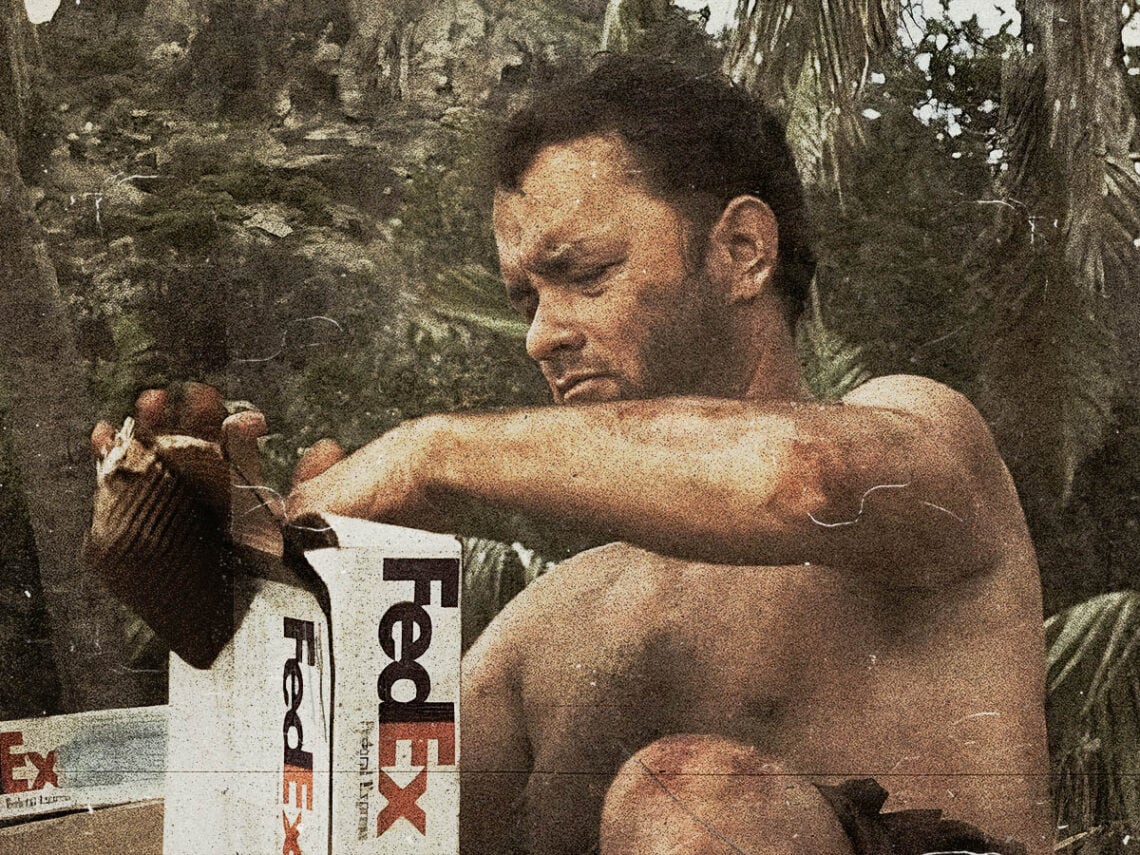
‘Cast Away’ at 25: how a movie accidentally created a 21st-century small screen phenomenon

It takes a special kind of movie to turn an inanimate object into a cultural icon, and it speaks volumes about how well Tom Hanks and Robert Zemeckis pulled it off in Cast Away that there was barely a dry eye in the house when the former’s Chuck Noland became forcibly separated from his best friend and volleyball, Wilson.
In the aftermath of the film’s release on December 22nd, 2000, you could barely go anywhere without hearing somebody screaming, “WILSON!!!” at the top of their lungs, with the manufacturers ingeniously capitalising on the hype by releasing a set of volleyballs with a blood-stained handprint on them to cash in. In fact, to underline the enduring popularity of the ‘character’, an original Wilson prop sold in a 2024 auction for over $162,000.
Cast Away may not have been entirely beneficial for Hanks’ health in the long run, but he thoroughly deserved his Academy Award nomination for ‘Best Actor’ for anchoring one of modern cinema’s greatest survival stories. Zemeckis even used the downtime during his leading man’s period of drastic weight loss for the island scenes to shoot What Lies Beneath, which is an impressive way to keep yourself busy.
The way the movie business usually works is that when a premise proves hugely popular, a string of thinly veiled imitators will begin emerging from the woodwork. Would anyone have been surprised had the star-driven survival flick become the latest fad? Not in the slightest. Did it happen? No. Instead, Cast Away accidentally gave rise to one of the century’s foremost small-screen phenomena.
Towards the end of the year, the television network ABC had gathered its executives for their annual retreat, where they brainstormed and pitched potential ideas for the next wave of original TV shows. Then-chairman Lloyd Braun’s favourite film of 2000 was Cast Away, and he suggested that it be used as a jumping-off point.
“A lot of people sort of laughed at the idea,” former senior vice president Thom Sherman admitted to Chicago Magazine. Still, because he was the boss, it started gaining traction. “Thom said to me, ‘We want to do Cast Away: The Series,” producer Ted Gold recalled. “That’s the only line that was ever pitched.”
Fast forward to 2003, and Jeffrey Lieber was pitching an idea tentatively titled Nowhere. “I won’t be so presumptuous as to say it was one of the best pitches ever,” Gold said. “I will say it was one of the more well-thought-out pitches I’ve been in. Thom called me, and he told me, quote-unquote, ‘The best project of the year’. He greenlights it enthusiastically.”
While Lieber’s initial concept was heavily altered, it nonetheless made it to the small screen by September 2004. It was handed over to a young creative named JJ Abrams, who, together with Damon Lindelof, reworked it into Lost. When the show premiered, it was an instant cultural sensation, one of TV’s ultimate water cooler talking points, and one of the most-watched, discussed, and dissected shows of all time.
Lieber retained a co-creator credit alongside Abrams and Lindelof, and he was no doubt compensated well for his efforts, but he still wasn’t thrilled about it. “I was angry and depressed and confused,” he confessed. “It’s the flip between ‘We love it’ to ‘There’s a problem’ that I’ve never really gotten over.”
Lost seized the zeitgeist and wouldn’t let go until the over-complicated story started careening off the rails, but it never would have existed in the first place if it wasn’t for Cast Away.
