


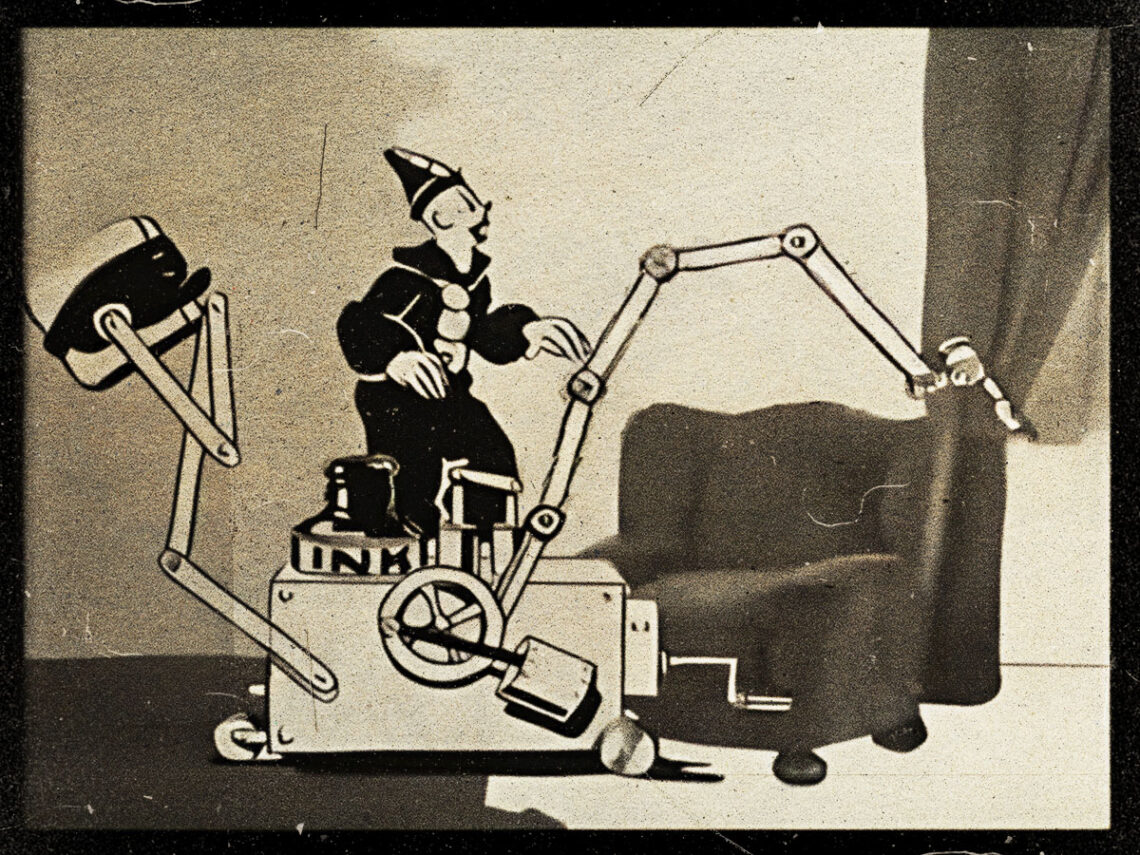
‘Cartoon Factory’: self-aware animation from 1924

Since the early days of cinema, animation has played an important role in expanding the creative liberties of the filmmaker. Constantly creating new perceptions of reality and artistic frameworks that facilitate multiplicities, animators have not just influenced their own medium but also changed live-action filmmaking forever. One of the best examples of this is a 1924 masterpiece called Cartoon Factory from the iconic Fleischer Studios.
Founded by the pioneering brothers Dave and Max Fleischer, Fleischer Studios created several memorable characters and even managed to put up a respectable resistance to Disney’s domination in the 1930s. While both Disney and Fleischer used anthropomorphism in their animated world, the latter deviated from Disney’s approach and explored surreal, dark and psychologically intense premises, which managed to stand out.
Cartoon Factory represents the apotheosis of the studio’s creative sensibilities, featuring a meta-exploration of the creative process. Starring Max Fleischer himself, it presents a scenario where Fleischer’s creation Koko the Clown, becomes sentient and starts rebelling against the limitations set by his maker. The film examines complex subjects like automation and the future of creativity at a time when cinema was still in its nascent stages.
Anticipating the postmodern philosophical foundations of Chuck Jones’ Duck Amuck, Cartoon Factory draws from Biblical allegories about the ‘Creator vs. Creation’ struggle while making the theme more modern through its unique depiction of technology. One of the early segments where Fleischer tries to control Koko the Clown’s character through a control panel will inevitably make contemporary audiences think of video games and how games have explored these meta-conflicts in similar ways.
Shifting between different registers of reality, Koko the Clown uses the animated apparatuses in his world to launch an attack against Fleischer’s version of reality and his tyranny. Despite moving from the two-dimensional animated spaces to the three-dimensional live-action segments, the brilliant filmmakers manage to maintain the momentum and the flow, which ends up uniting two incompatible versions of the external world.
In the 21st century, the rebellion portrayed in Cartoon Factory is much more than just the whimsical pranks of a naughty clown. It can also be read as a text that foreshadows the fundamental philosophical problems posed by the rise of artificial intelligence, especially at a time when AI is becoming an integral part of modern society. In the film, the sentient Koko jumps into Fleischer’s inkwell and dissolves into nothingness when he realises that an independent existence is too stressful. If AI becomes sentient, will it come to the same conclusion or put up a stronger fight against our own tyranny? Maybe it’s already too late for it to return to the inkwell.
Watch the film below.
