


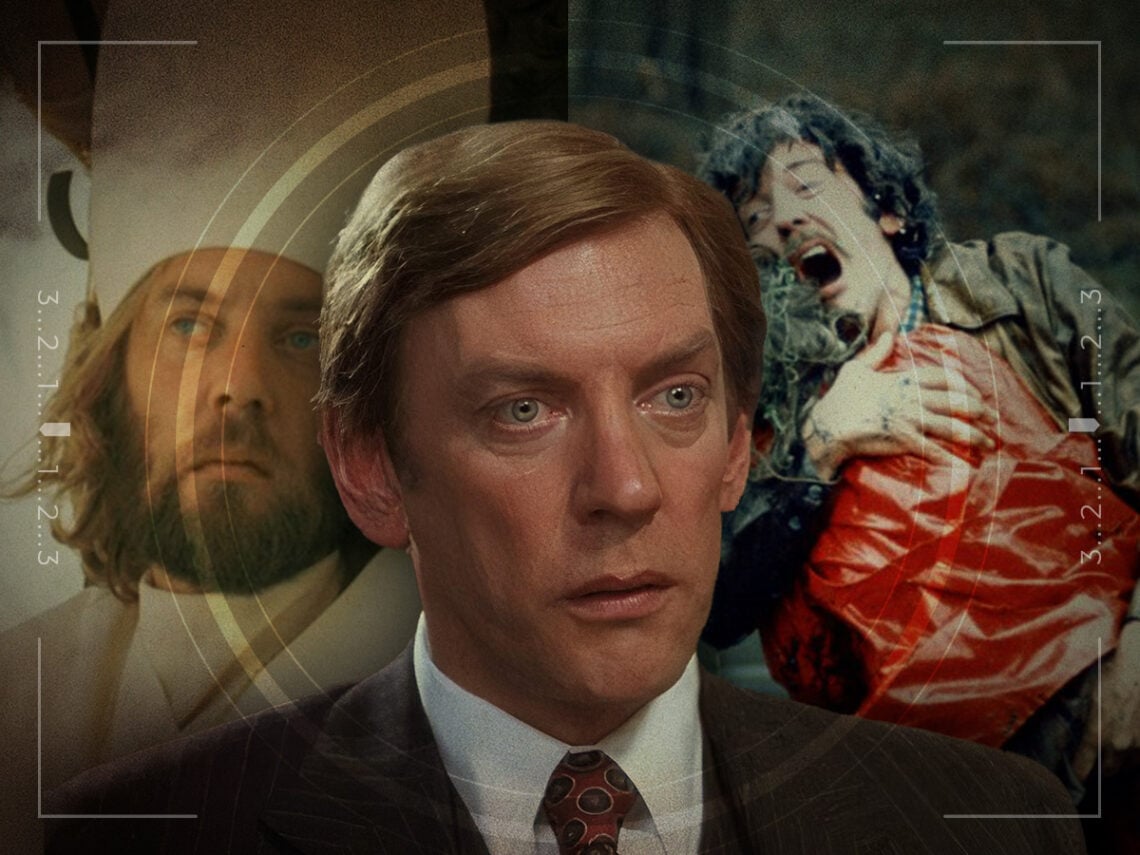
A career in three acts: Donald Sutherland

There was a sensitivity and spark to Donald Sutherland that truly marked him as one of the all-time greats, with a gleam behind his eyes and a sense of curiosity infusing each of his performances. From his arresting monologue in Oliver Stone’s JFK to his paternal warmth in Pride and Prejudice and star-making appearance in Klute, Sutherland’s filmography is overflowing with a quintessential sense of life. His innate wisdom and thoughtful, creative instincts led him to disappear into his roles as though he were simply playing an extension of himself.
The actor rose to fame towards the beginning of the 1970s, suddenly emerging as a star through his performance in MASH, working with the rebellious Robert Altman on his career-defining masterpiece about the staff of a Korean War field hospital who struggled through everyday horrors using humour to maintain their sanity. From this point onwards, he captivated audiences with his naturalistic and gregarious screen presence, adding colour to supporting roles in films such as Casanova, Klute, Invasion of the Body Snatchers and Animal House.
After his death last year, many of his former co-stars and colleagues cited the effervescent quality of his work, adding depth and vibrancy to every performance, with an innate emotional intelligence that allowed him to find the authenticity in any story.
But with a body of work as sprawling and eclectic as Sutherland, there are an overwhelming number of stories to start with, but here are three that capture his unstoppable vitality, compassion and curiosity.
Donald Sutherland’s career in three acts:
‘Alex in Wonderland’ – Paul Mazursky (1970)

Despite being one of the lesser-known additions to his filmography, his collaboration with Paul Mazursky should not be forgotten. Known for his pioneering work at the beginning of the 1970s and ringing in the era of sexual enlightenment through his 1968 film Bob & Carole & Ted & Alice, Mazursky emerged as one of the hottest directors, which made it perfectly fitting that he would want to work with Sutherland for his elusive cautionary tale about Hollywood’s disillusionment and corruption.
Alex in Wonderland follows a director called Alex before the release of his first feature film, living in anticipation of dizzying success and trying to figure out his next career move when faced with an overwhelming number of newfound opportunities. Mazursky critiques the destructive nature of Hollywood and the way creative integrity can be corrupted by a growing ego. Sutherland ingeniously captures his slow escalation from a humble filmmaker to a broodingly manic man, destroyed by the promise of endless fame and success. The film teeters between moments of realism and surrealist dream sequences, with the actor beautifully capturing the precariousness of his mental state and ability to switch from loving father to fevered lunatic, desperately clutching at straws as he tries to find purpose on the edge of being given everything he didn’t know he wanted.
‘Don’t Look Now’ – Nicolas Roeg (1973)

The release of Don’t Look Now was accompanied by a wave of outrage at the sex scene that takes place between the two lead characters, played by Sutherland and Julie Christie. Roeg’s slow-burning horror is a masterful portrait of a grief-stricken couple who are trying to process the death of their child, strangely finding themselves being visited by two mysterious sisters with a message from the afterlife.
Sutherland captures someone who is plagued by uncertainty and a fear of the unknown, desperately searching for answers that only plunge him further into the depths of insanity. What is more terrifying than the evasive figure that haunts him on the streets of Venice is the lack of explanation as to what is happening, leading the characters to distrust themselves as they embrace the darkness of their subconscious delusions and desires.
However, there is one scene that truly captures the inherent desperation of his performance, which is the sex scene between his character and Christie. It captures two people completely engorged by all-consuming denial and increasing insanity as they retreat to each other in an attempt to latch onto something real, clawing at meaning and trying to alleviate their growing sense of alienation and loneliness. It’s a gripping tale of paranoia that remains one of the greatest horror films of all time, with Sutherland’s frenzied glances and haunted expressions adding new meaning to a well-trodden genre.
‘Ordinary People'<em> </em>- Robert Redford (1980)

Ordinary People shocked not only by the fact that it was Robert Redford’s directorial debut, but with the chilling central performances by Mary Tyler Moore, Timothy Hutton and Donald Sutherland. While Hutton was awarded the Academy Award for his portrayal of Conrad—a troubled teenage boy who grapples with guilt over the death of his older brother—Sutherland is sensational as a grieving father caught in the middle between his wife and son, confronted by the devastating truth that his wife is no longer the person she used to be and struggling to keep the peace as they differ in their ways of dealing with trauma.
In the aftermath of an awful incident, people react in myriad ways, with each character in the film clashing over their vastly different coping mechanisms. While Conrad needs to talk about what happened, his mother cannot even look him in the eye or acknowledge it. On the other hand, Sutherland’s character desperately toes the line between both and tries to hold the family unit together, with every unsaid thing adding newfound strain to their tentative peace.
There is one truly heartbreaking scene as he sits at the kitchen table in the middle of the night, with the frailty of his marriage suddenly dawning on him, realising that there is no longer anything but pain between them. His wife quietly enters the kitchen, her dressing gown pulled tightly around her, and he voices the thought he has avoided for the entirety of the film, finally addressing the irreparable chasm between them. Sutherland is crushing in the role, both empathetic and conflicted as he tries to hold his family together, despite the fact that it has already fallen apart.
