


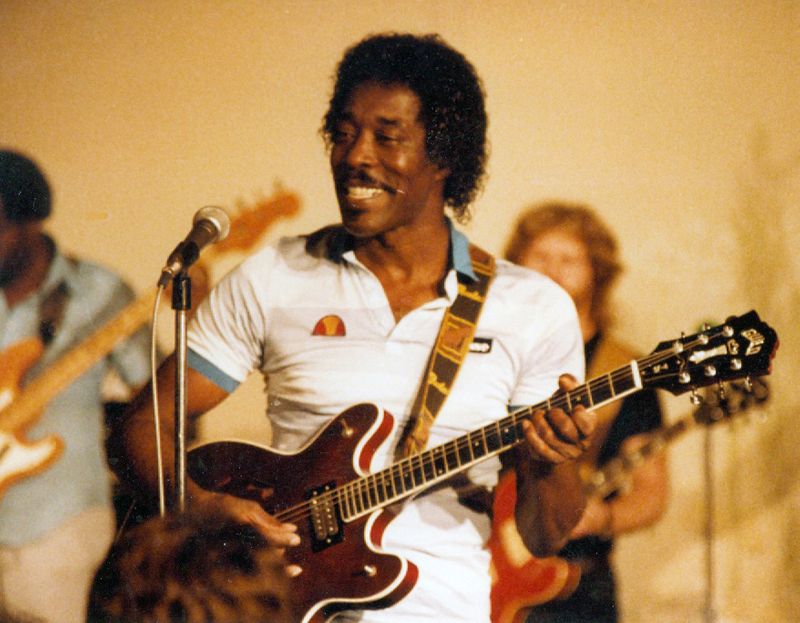
Explore the career of Buddy Guy through his guitars

The original wave of Chicago blues musicians ended with Buddy Guy. Originally a product of the delta blues explosion around his home state of Louisiana, Guy made his way up to Illinois in 1957 and never looked back. After finding inspiration in Muddy Waters’ electric crossover, Guy began wielding the electric guitar in ways that no blues musician ever had.
Reaching for the highest possible notes on the fretboard, Guy was also a pioneer in the use of distortion and feedback. He was so talented with the guitar that his initial role at Chess Records was as a session musician. Over a decade, Guy recorded guitar parts with Waters, Howlin’ Wolf, Sonny Boy Williamson, and just about anybody who walked into the studio. It wasn’t until Guy was already 30 that he got to record his own debut LP.
As most of the musicians from the blues scene have since passed on, Guy remains an integral voice in preserving the history and stories of the blues. While sitting down with Reverb, Guy detailed his history with guitars. Starting in his youngest days as a teenager in Louisiana playing a two-string axe and going through his first run-ins with what would become his signature instrument, the Fender Stratocaster, Guy has tried on quite a few different six-strings in his time trying to write some of his classic songs.
By the time he made it up to Chicago, Guy had finally gotten his hands on a high-quality guitar: a 1950s Gibson Les Paul. According to Guy, he was “in a club at 43rd and Drexel in Chicago, and they took a break. I wasn’t drinking or doing nothing. I was eating a banana.” When Guy asked a “valet” to go in and retrieve his Les Paul from the stage, both the guitar and the valet disappeared into the night, never to be seen again.
The proprietor of Theresa’s Lounge in Chicago put up the money to get Guy his first Stratocaster. “Man, that guitar: you could hit a note on that guitar and hold it until next week,” Guy enthused about his first Strat. “People look at you and ask, ‘Is that you still playing?’ Because it still looks like it’s holding that sound too long.”
Guy also shares stories about how he inspired players like Eric Clapton and Jimmy Page to treat the Strat like something other than a country and western guitar. “They said they didn’t know a Strat could do that,” Guy added. “Eric and them laugh now every time I get in the room, saying, ‘Man, we didn’t know a Strat could play the blues until we saw how you did it.’”
Trace Buddy Guy’s history through some of his classic guitars down below.
