


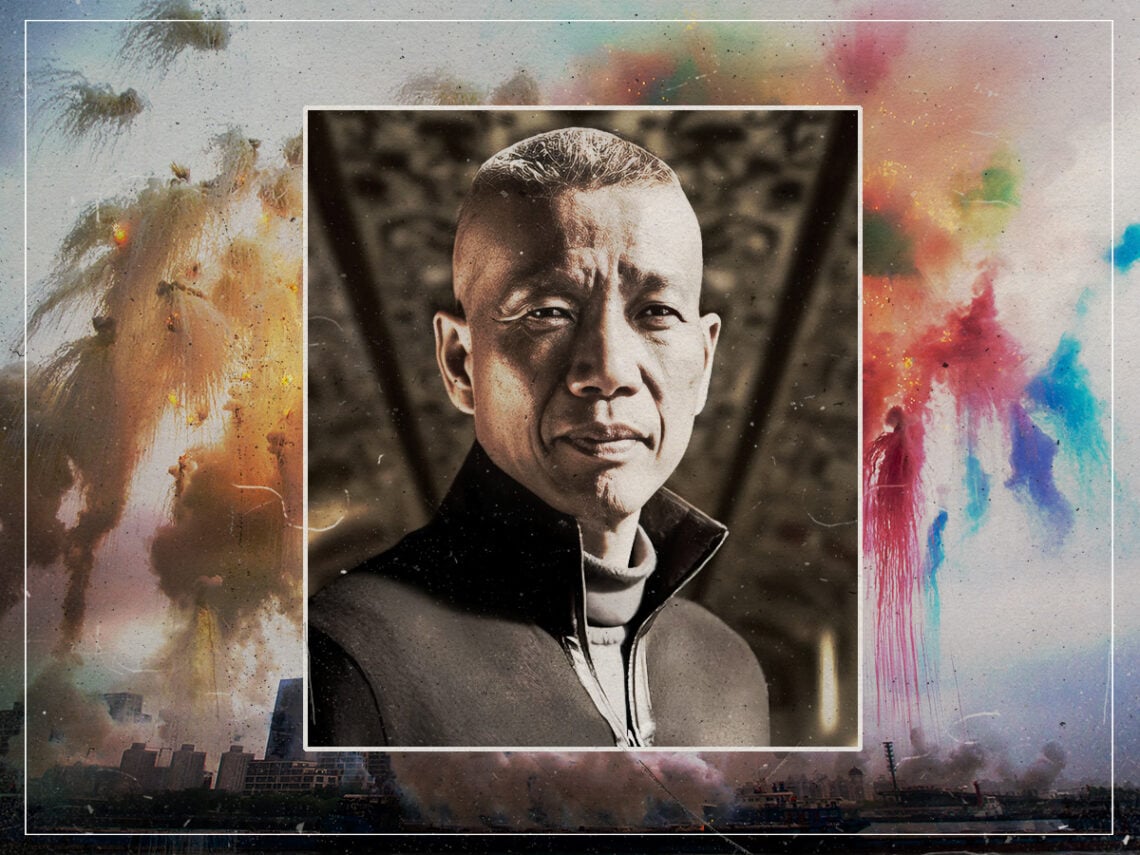
Cai-Guo Qiang: Using fireworks to talk to aliens

When Cai-Guo Qiang was a child, he often looked up at the sky, wondering what lay beyond the stars. As he moved through boyhood, that curiosity was replaced by the more immediate light of explosions. Qiang grew up as the Chinese Cultural Revolution took hold, where explosions – either from the seismic blast of canons or the celebratory boom of fireworks – were all around. Witnessing that was crucial to the tone of his later art with gunpowder because he saw firsthand how it could be used for good and evil: “Destruction and reconstruction”.
In a literal sense, space preoccupied him almost as much as visions of the starry sky. He studied stage design at the Shanghai Theatre Academy, and just as the explosions did, it aided the sense of spatial awareness he went on to explore in his artwork. In 1990, he started work on Projects for Extraterrestrials, a love letter to the great unknown.
Qiang used huge trails of gunpowder and fireworks across massive plains of land and buildings. The idea followed a move to Japan in 1986, where he said he broke through the binary “East-West dichotomy”. He told ArtNet it was there he was able to observe “humankind from the perspective of the cosmos”.
With a fresh perspective on the cosmic world, he began the series of controlled explosions seen in Projects for Extraterrestrials, which mimicked the death of stars and the kaleidoscopic brilliance of the Milky Way. “Back then, I already believed that there existed extraterrestrials and superpowers – and that there is the unseen world behind our world,” he said. “So I very much hoped these elements could be incorporated in my art and that my artistic methodology and philosophy would have a spiritual dimension.”
Other works echoed that theme, such as Encounter with the Unknown and Project to Extend the Great Wall of China by 10,000 Meters: Project for Extraterrestrials No. 10, both chimed with his childhood curiosity. Although his art is heavily associated with the possibility of alien life, it’s touched by distinctly human qualities.
The want to branch into space is an inherently human desire, which Qiang compares to shifting ideas around space throughout history. “The work weaves together humanity’s desire to defy gravity and embrace the cosmos shared across civilisations,” he says, citing early beliefs that the earth was flat.
The involvement of gunpowder is also a brilliant way of interrogating the unknown. It’s man-made but uncontrollable. While we’re at a curious point in history where space travel seems almost in our grasp, technology fails and burns just as quickly as it advances.
“Gunpowder has a life of its own,” Qiang agrees. “The question has always been: how can I fully present its vitality and the charisma of its spirit? The uncontrollability does not just lie in the material itself – gunpowder brings out the uncontrollable side in me! If I don’t lose control, neither will gunpowder.”
