


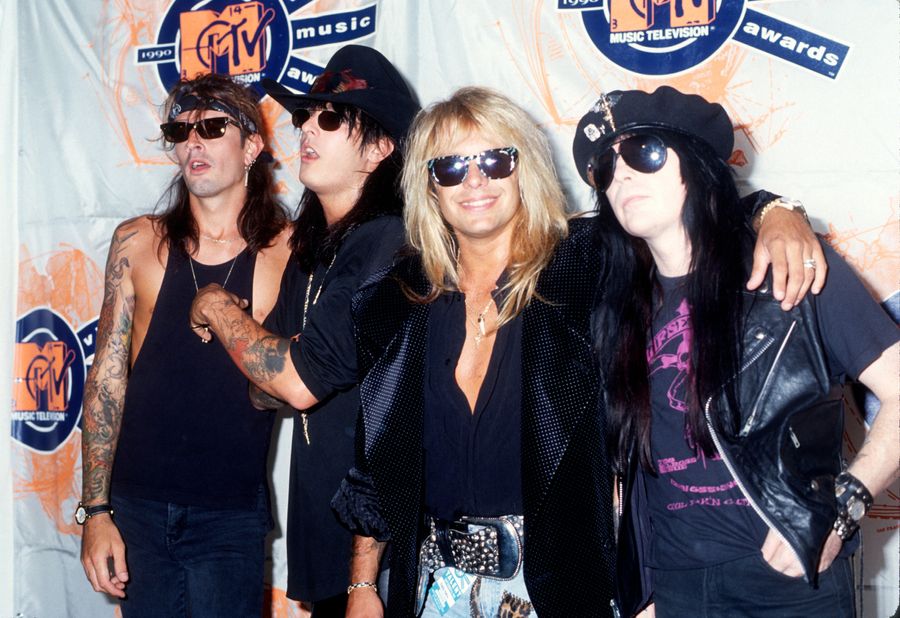
Busting the imposter myth surrounding Nikki Sixx of Mötley Crüe

Mythology is a crucial component of rock ‘n’ roll, and it’s always much sexier than the truth. For decades, one particular rumour surrounded Mötley Crüe’s Nikki Sixx, who some believed had died and was replaced by a man named Matthew John Trippe.
Trippe came forward with his bold claims in 1988, and for a while, part of the public ate up his lies. It seemed so outlandish that nobody could have made it up — therefore, some people decided to believe Trippe’s lies because it was too insane to be fiction. He told his story to the British publication Kerrang, and the tale started to spread around the rock community.
His story began when he left Pennsylvania in the early 1980s with a starry-eyed dream of Los Angeles. In his imagination, California was the only place to be if he wanted to become a rockstar, and at 19, Trippe caught a greyhound bus to make this a reality.
Once he arrived in Los Angeles, things didn’t fall into place as quickly as he had hoped. Trippe would waste afternoons in bars on the sunset trip, hoping to meet somebody who could transform his fortunes, but he had no such luck. However, he claimed all changed when he met Mötley Crüe member Mick Mars.
Trippe said Mars approached him and revealed Nikki Sixx had been injured in a car accident. Mötley Crüe had only recently signed a contract with Elektra Records and needed somebody to pretend to be the bassist, or else they’ll risk being dropped by the label.
In 2012, he told podcast host Ryan Barton: “[They said], ‘We’re gonna take a chance on you’. I was in front of contracts, and crap like that [was] thrown down. I didn’t have time to read it, I went to sign my name, they says, ‘No, we’re gonna give you a stage name, you’re now ‘Nikki Sixx’ and you just sign it here, there’s no need to read it.'”
He even brazenly claimed to have contributed the tracks’ Knock ‘Em Dead, Kid’ and ‘Looks That Kill’ for their 1983 album, Shout At The Devil. Trippe also said he performed with the group during their support slots with KISS and Ozzy Osbourne.
However, in 1984, Trippe claimed he was told he was no longer needed to perform or write with the group, and the real Nikki Sixx would be returning to the fold. After this moment, his life took a dark turn, and he was charged with a count of armed robbery.
Speaking to the Pittsburgh Post-Gazette in 1988, Trippe explained: “It was like I was rubbed out, When I tried to form bands, I’d tell people I used to be Nikki Sixx, and they’d say, ‘No way.’ I thought, ‘How can [Mötley Crüe] make it seem like I don’t exist?’ But unfortunately they did a good job.”
Trippe filed a lawsuit on January 29th, 1988, for “civil theft and other relief” of several Mötley Crüe songs, and strangely, it took until 1993 for the case to end. Additionally, all of the files in the case were destroyed during the Rules of Judicial Administration in August 2005.
Following Trippe’s death in 2014, Sixx finally discussed the matter in detail on his radio show, Sixx Sense, and told listeners: “I didn’t take it serious, but it actually started picking up steam. There was pictures in Kerrang! magazine of this guy and me, and they were actually the most ludicrous things I’ve ever seen. They compared our belly buttons. They were like, ‘Which belly button belonged to Nikki Sixx pre-1984 …’ I mean, it was so stupid. And this guy had my tattoos … but he had got them on the wrong arm. They were backwards. He must’ve looked … I don’t know how he did it.”
He added: “This is the most insane part. The guy actually filed a lawsuit against me. All he said he wanted was all of his songwriting royalties. Which, you know, he basically just wanted my life and my financial life and he wanted to be me – he didn’t want to be in the band anymore. That got thrown out of court and everything, and we started doing the research on this guy and he had been in a mental institution in Erie, Penn. At that time, I remember it freaking me out so much that I had a .357 and I used to go to the shooting range, and I started carrying it in my car, ’cause I just had this weird feeling that this guy could just pop up at any point. I didn’t know if my life was in danger.”
Although Trippe made a case which convinced many, there was glaring photographic evidence which suggested he was never part of the band, and it was all in his head. Furthermore, he also suffered severe mental health problems, and it was immoral for his story to be published in 1988 without being verified.
