


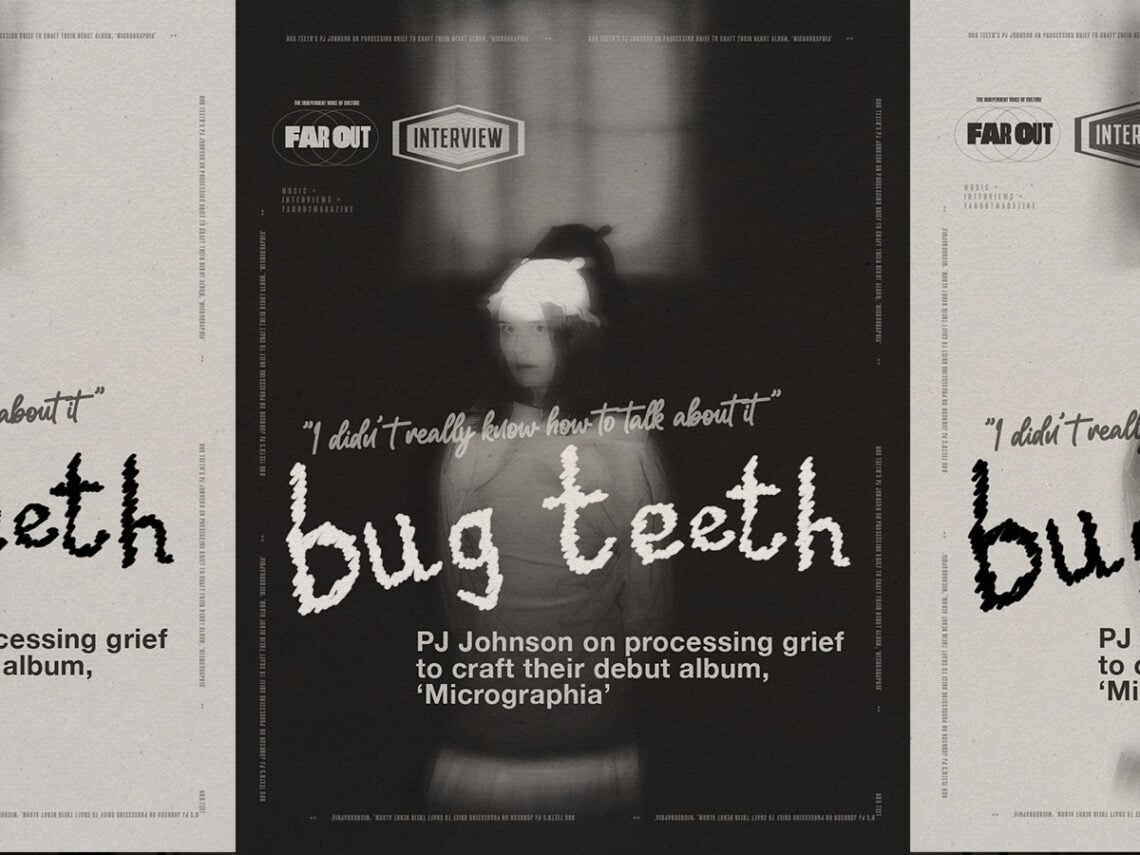
Bug Teeth’s PJ Johnson on processing grief to craft their debut album, ‘Micrographia’: “I didn’t really know how to talk about it”

When I meet PJ Johnson, Bug Teeth’s ethereal leader, at Leeds’ Brudenell Social Club, every room is crammed full of gig-goers and students. They’ve found a small table for us in the pool room, and as we begin chatting over our pints, the threat of being prodded by the ends of pool cues becomes unavoidable.
We move into the cold outside by the temperamental heat lamps, wrapped up in our coats, to discuss the release of the band’s debut album, Micrographia, which will be accompanied by a headline show in one of the gig rooms mere metres away. It won’t be the first time Bug Teeth have played Brudenell, arguably one of the best venues in the country, but this will be a massive moment nonetheless, gathered among friends to perform a record that has been years in the making.
Bug Teeth began as a solo project for Johnson while studying in Norwich, but eventually they found themselves in Leeds, where they’re now joined by George Orton, Sonny Mitchell, Adam Bentham, and Alex Calder, who round out the full band. “When they first joined, I didn’t quite know what I wanted the project to sound like,” Johnson tells me. “A pandemic hit pretty much as soon as they joined, but it took that to work out what I wanted us to sound like, and what I wanted the guys to bring to the project. It did take work in that sense, but I think the album is the perfect measure of all of our individual tastes.”
While everyone brings something different to Bug Teeth, Johnson cites the biggest influences at the core of the band as Broadcast, Cocteau Twins, Stereolab, Melody’s Echo Chamber (with whom they got to play with in London back in 2023), and ambient artists like Brian Eno. You can certainly trace a line between Johnson and the late Trish Keenan, their lineage intertwined by both singers’ abilities to pierce through spectral voids just as well as they can project themselves, loudly and without restraint. “I have to satiate myself just by watching old videos of Broadcast live,” Johnson admits.
This haunted sensibility that often defines Johnson’s vocal performances, like when they deliver a moving lament on ‘Crunch Went the Snow’, aligns with their interest in media that is completely unnerving, forcing audiences to reckon with themes like mortality and fear. Johnson loves folk horror, citing The Wicker Man as a favourite. “I want there to be a twist. I want it to be surreal. I want to see weird creatures, and I guess that’s what I’m looking for in music as well. I want something really unsettling, and I want dreamy, and I want a weird experience.”

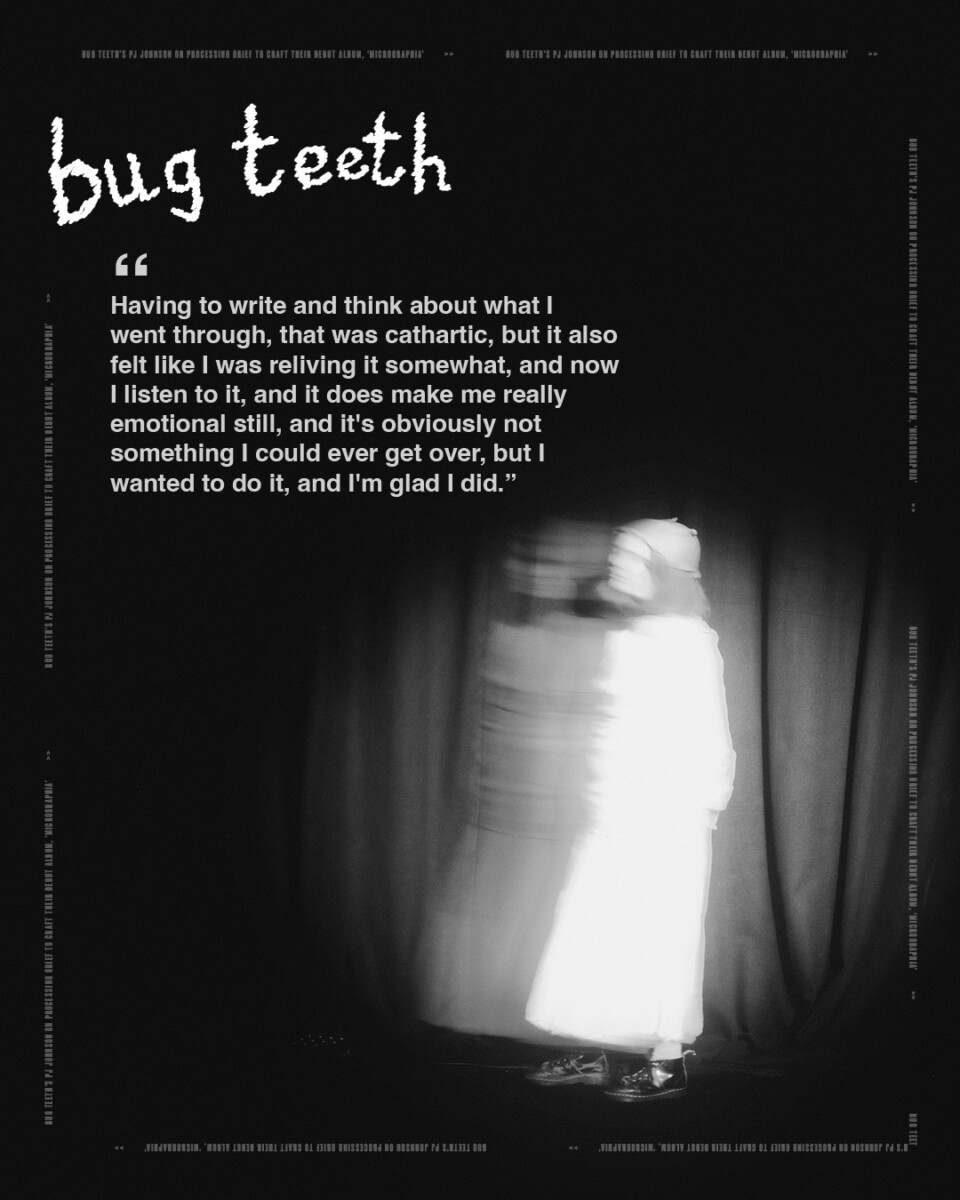
This weirdness aligns with the album’s central theme of grief (Johnson lost their mother a few years ago), which is such an intangible and confusing experience that is so eloquently brought to life on Micrographia. “Having to write and think about what I went through, that was cathartic, but it also felt like I was reliving it somewhat, and now I listen to it, and it does make me really emotional still, and it’s obviously not something I could ever get over, but I wanted to do it, and I’m glad I did.”
It might have been “more difficult than soothing,” but the discomfort it brought ultimately served a purpose, allowing Johnson to sit with feelings they didn’t necessarily know how to process. “There were a lot of things, especially lyrically, that came up when I was writing, and I was like, I didn’t even mean for that to come up and be a part of the song, but it is, and that makes it really special.”
Memory is at the core of the album, reflecting both the light and the dark of the grieving process, the shadow of loss often colouring once-pleasant memories. You can hear this in songs like ‘Ammonite’, a beautifully layered track which builds up with ferocious guitars, Johnson’s voice projecting over the instruments before everything mellows out again. “I can’t really think about my childhood with her without thinking about the way that she died and how traumatised I was, so the album wouldn’t be true and it wouldn’t be authentic to my experience if it wasn’t both dark and difficult and beautiful and lovely,” they explain.
Micrographia is a vulnerable record, and Johnson has learned the value of using art as an opportunity to communicate with listeners about the kinds of things we often consider taboo.
“As a culture, especially in the UK, we just do not talk about grief. And I know that before I lost my mum, it was something that I was quite uncomfortable with – I didn’t really know how to talk about it. But I guess what I would want to tell people about grief, or what I’d want people to know is, like, fucking talk about it, it’s awful, because it feels like you lose people twice. Someone dies and then you feel like everyone forgets. Having made an album for multiple years at this point, it’s nice that it can continue, and I can still talk about my mum.”
It’s certainly a special record, with Johnson emphasising the importance of the collaborative process. Members of Bug Teeth can also be found performing in other Leeds bands like Volk Soup, Fuzz Lightyear, and Gladboy, and it’s this community that the scene has fostered that has allowed Bug Teeth to flourish. Johnson has found it “such a privilege to be in a band with people that I really, really love,” and this has provided an invaluable level of confidence when it comes to both making music and performing. “We’re there to support each other, and if I fuck up on stage, it doesn’t matter anymore, whereas when I was on my own it would send me into a fucking crisis.”
The songs that form Micrographia have emerged from various forms of writing, whether that be someone bringing an idea to the group and taking it from there, while “some of it was completely improvised at the start.” In the case of ‘Thin Circle’, one of the album’s singles – a glitching, repetitive number that feels akin to watching tiny insects dance about beneath a microscope – an idea brought forward by Calder evolved into one of Johnson’s favourite moments on the record.
“That was never going to be on the album because it was written literally a week before we went to record, but then it just made so much sense,” Johnson explained. “But that was just us two, and then when we went to the studio and George added some guitar, and Joel [Anthony Patchett; producer] helped to do the final mix. But it was mostly just Alex and then me with vocals and structural ideas that made the song. That was a really easy way to work. We did it in a matter of hours.”
After years of writing, recording, and gigging, Micrographia is an album to be proud of, a multitudinous encapsulation of both the beauty and pain that forms the cycle of life and death. It’s never going to be easy to write about such difficult themes, but on Bug Teeth’s debut album, they prove that sometimes artistic creation is the only way through such rocky terrain.
