


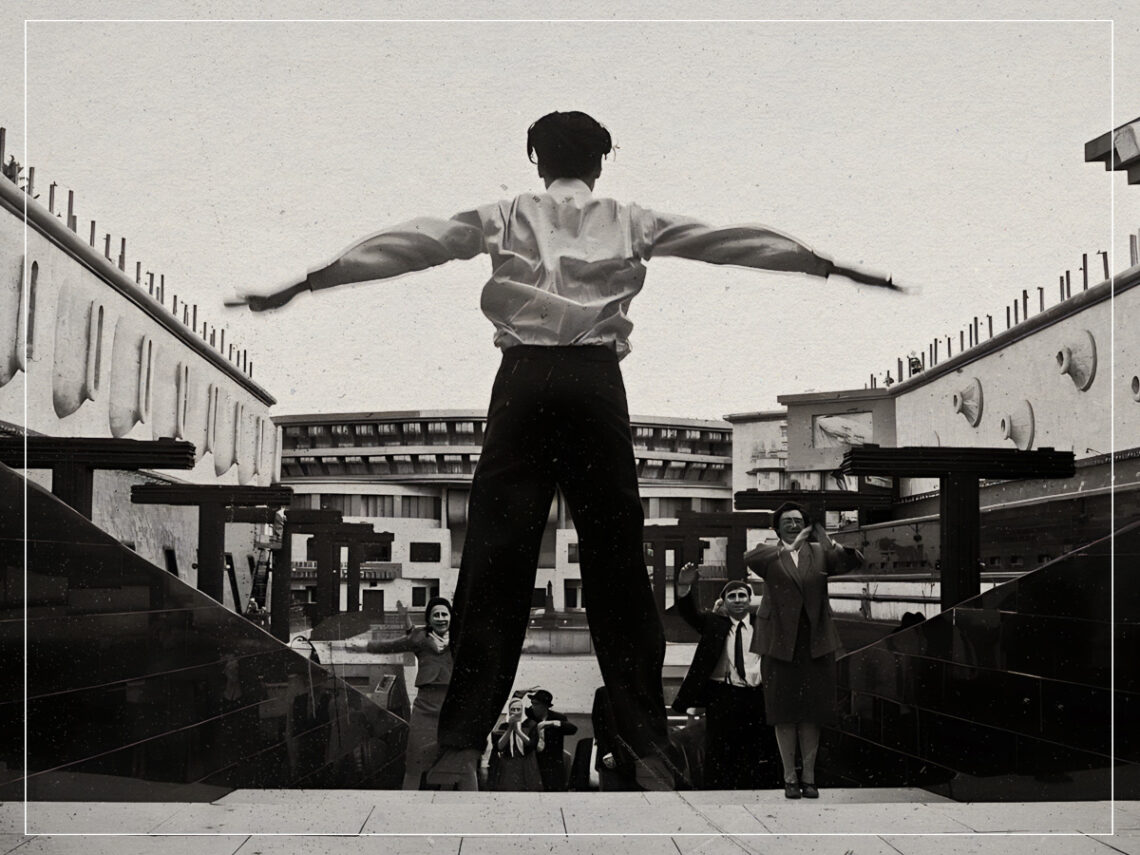
‘Dau’: the brutal movie described as a “prison experiment”

Experimental cinema comes in all shapes and sizes, but few have been as unwieldy and ambitious as Dau, the hybrid of historical epic and art installation. At various points, it was described as a Stalin-era take on The Truman Show and the ‘Stalinist Stanford Prison Experiment’ after the infamous study that split students into inmates and guards to see what the psychological effects would be.
The film began life as a relatively straightforward biopic of Russian scientist Lev Landau, who won a Nobel Prize in 1962 and was a key figure in establishing many fundamentals of quantum physics. On paper, it sounds like the sort of thing ready-made for the big screen treatment, potentially even a local Oppenheimer, given the subject’s involvement in the local atomic weapons programme, but it was anything but.
Director Ilya Khrzhanovsky was placed at the helm, where Dau eventually snowballed into something that wasn’t exactly cinema by its strictest definition. Classically trained Greek conductor Teodor Currentzis was cast as the lead, but it was a million miles away from being a conventional shoot. If anything, it was a bold attempt to reinvent the entire concept of what a feature film production could be.
Locations included Russia, Azerbaijan, Ukraine, Germany, Denmark, and the United Kingdom, but the majority of the focus fell on ‘The Institute’. A colossal practical set that became the largest ever constructed in Europe when the finishing touches were applied, it was an immersive and painstaking recreation of a very real and highly restricted building in operation between 1938 and 1968, where Landau lived and worked for almost the entire time it was functional.
A year into shooting, Khrzhanovsky became so enamoured by his creation that he quickly pivoted away from his Landau biopic in favour of something else, with the movie now predicated entirely on the hand-crafted replica. It was eventually destroyed, but it became a key sequence in the finished film, and that’s without even mentioning the experiences of the countless actors involved.
There were 10,000 performers involved, covering everything from featured parts to speaking roles and background extras. Many of them spent the entire duration living in ‘The Institute’ and wearing period-accurate clothing, while others ended up being fined or fired for defying the historical accuracy and authenticity of the mammoth undertaking.
Less a film and more of a functioning time capsule, Dau was hardly a conventional narrative feature. Instead, it became something between a genuine social experiment and a large-scale slice-of-life story, except in this case, the slice-of-life in question spanned 30 years and ended in the late 1960s. Every shred of footage had to be as real as possible. As an erstwhile society, the extras and actors had no reason to go home when everything they needed to survive was readily available for purchase at ‘The Institute’.
When Dau finally premiered in January 2019, it arrived as a dozen individual feature-length productions, which required two cinemas, seven projection spaces, tickets dubbed ‘visas’ that had to be purchased in advance, and as executive producer Martine d’Anglejan-Chatillon told Screen Daily, the agreement to share information with “an algorithm which will generate a psychometric profile of you which will be embedded in your visa”.
Undoubtedly one of the strangest works of cinema that’s ever existed, Dau began as one thing before ending up as something else entirely, although it’s reasonable to assume a two-hour biopic might have been preferable for some. For those who spent years adhering to the rules, regulations, and lifestyles of ‘The Institute’, it’s something they’ll never forget, for better or worse.
