


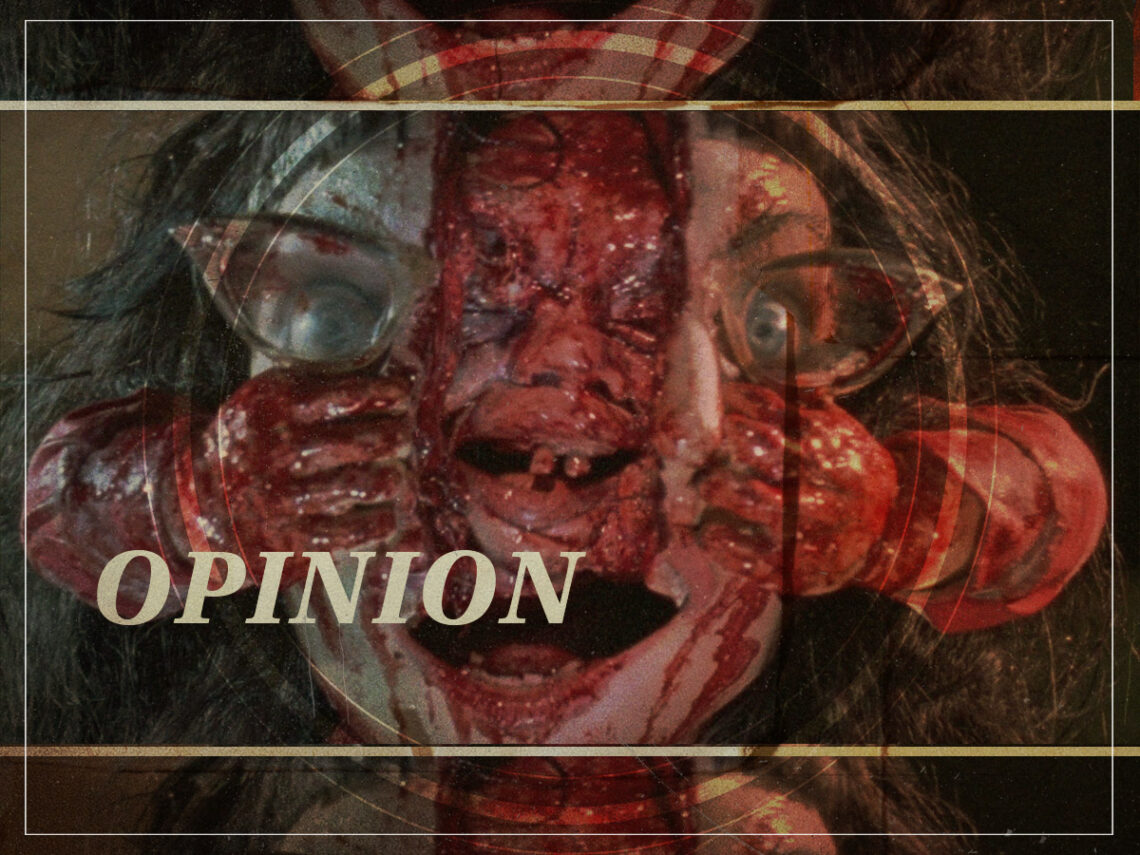
Hear Me Out: ‘Braindead’ is the most underrated horror movie in cinematic history

Not enough people know that before Peter Jackson made his home and name in the Hobbit’s Shire, he co-wrote and directed one of the greatest modern horror comedies of all time.
Braindead, also known as Dead Alive, is Jackson’s 1992 zombie comedy splatterfest and arguably one of the most underrated entries in the genre. Jackson’s first feature, Bad Taste, marked his initial foray into slapstick comedy horror. While it showcased a promising idea and admirable effort for a debut filmmaker, the film’s ultra-low budget was impossible to ignore, limiting its overall execution. Braindead, however, sees Jackson refining his craft, delivering a gloriously over-the-top, gore-filled romp that has become a cult classic for fans of the genre.
With Braindead, however, Jackson came in swinging with a New Zealand Film Commission grant. Even then, the production crew worked to save where they could. It was shot in 11 weeks on Super 16mm instead of 35mm to save money for effects— the wonderfully brilliant, glorious practical effects. Gory, disgusting and outrageous practical effects. Litres and litres of blood, about 300 to be exact. If that’s not an indication of what you’re about to see, then the monsters in store sure are.
At its core, Braindead is a zombie movie with a straightforward premise. A hybrid rat-monkey creature from Sumatra ends up at Wellington Zoo, and chaos ensues when it bites someone, turning them into a zombie. Unfortunately for young Lionel, one of its victims is his uptight, posh mother. Rather than taking the logical (and gruesome) route of dispatching her, Lionel decides to keep her under control, essentially becoming an unwitting zombie wrangler. This absurd setup provides the foundation for one of the most hilariously grotesque entries in the genre, filled with over-the-top gore and darkly comedic moments.
It’s a bountiful premise that continuously toes the line between so bad it’s funny and laughably awful. The film is constantly filled with moments where you go, “Surely they’re not doing that,” and then they proceed to do exactly that. Although it’s not a horror film in the creeping, dreadful, ghostly sense, it does exactly what I’ve come to love so much about the horror genre. It pushes boundaries. It shocks. It goes all in.
It’s not for the faint-hearted, but it’s also not for those who lack good humour. The film does test your limits with its crude imagery and ridiculous jokes that they beat until the horse is unrecognisable. And every time you think it can’t get bigger and bloodier, it does. It’s a spectacular romp that begs you not to watch with your parents or any proposed lover.
What’s so great about Braindead is that it completely leans in. It drenches everything in candy red blood and gelatinous green goo, so you can’t see the face applique. Often, movies in the horror genre rely on realism to bring the scare factor in, but despite being so obviously fake, Braindead manages to really get you at times. There’s one scene where the zombie’s faces are deteriorating at a dinner party, and someone’s rotting ear falls into a guest’s unsuspecting custard before being gleefully devoured is a gag-worthy moment, if ever there was one.
It’s a good reminder of how practical effects are often much more effective than the constant flurry of computer nonsense we are saturated with today. There’s something visceral, gritty and real about the layers and layers of face makeup, mannequins and entrails made of foam and paint. It’s, therefore, a shame to see how some of the later films Jackson came to do became so CGI-reliant.
During one scene, they have a baby zombie run around a park, causing havoc. The way they achieve this effect, with no CGI or robot mechanics, is to dress an adult actor in the baby’s suit and manipulate perspective so he looks baby-sized. It’s visually unnerving and genuinely funny, and this is what cinema is about.
More than anything, the film is proof of what’s possible when government agencies invest in creatives. Jackson had no formal film training. He learnt entirely by trial and error. He spent two years saving up to buy the 16mm camera on which he recorded Bad Taste. Without Braindead, we wouldn’t have Jackson’s later work as one of the highest-earning filmmakers of all time.
The result is a true labour of gross, gory love that I will return to every October for the rest of my life. The New Zealand director might have received ‘The Order of New Zealand‘ medal for his feats in mainstream filmmaking, but he will always have a place in my heart because of Braindead.
