


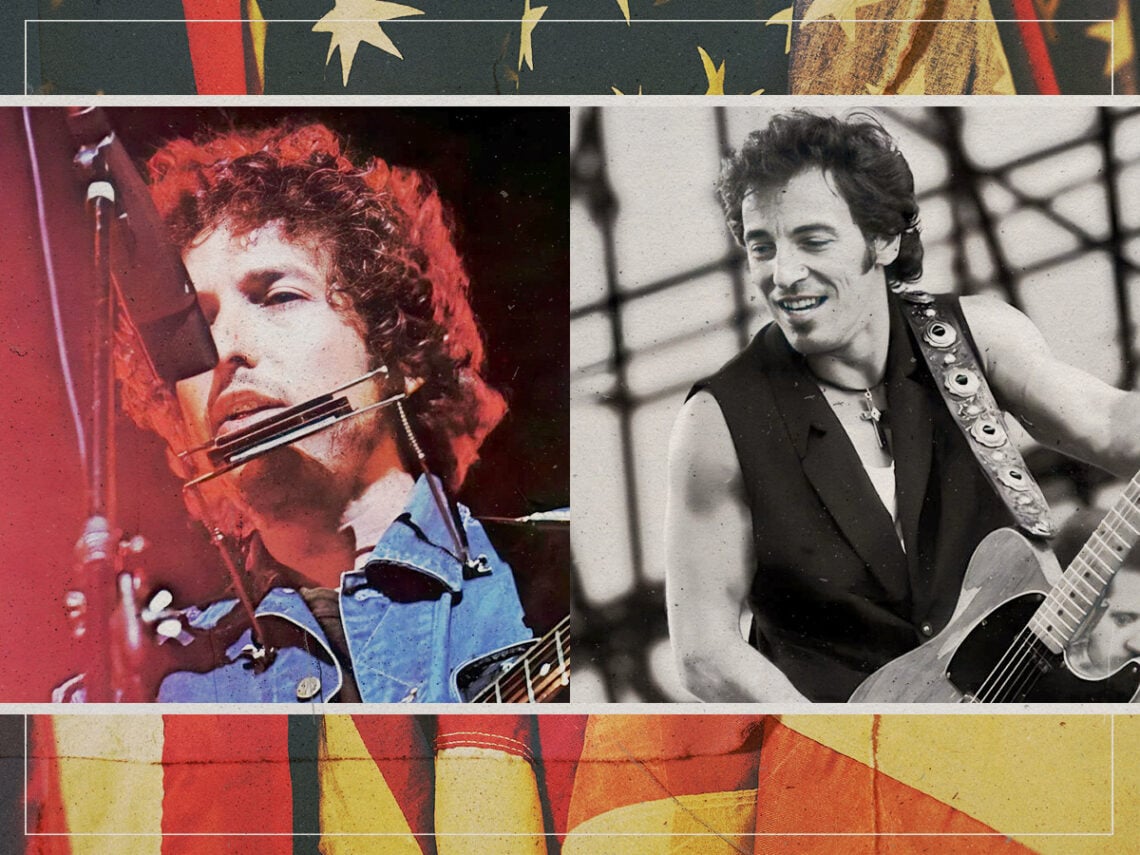
‘Tweeter And The Monkey Man’: The story of the Bob Dylan song that pokes fun at Bruce Springsteen

Bruce Springsteen, no matter how you feel about his relative status among the all-time great songwriters, is objectively a “serious” artist.
With the lone possible exception of his goofy gyrations in the ‘Dancing in the Dark’ music video, the guy has never phoned in or laughed off a solitary moment of his time on stage or in the studio. Even the E-Street Band’s cover of ‘Santa Claus is Coming to Town’ finds Bruce belting out the chorus with absolute, full-tank, ‘Born to Run’ adrenalin. This level of commitment tends to win you no shortage of loyal fans but also the occasional eye roll from the more cynical members of your peer group.
For years, many people were convinced that Bob Dylan—one of Springsteen’s songwriting heroes—was one of those under-impressed cynics. Bob had a reputation for not always embracing new rivals, i.e., the many singer-songwriters anointed by the music press as the “next Dylan”. One famous example from the mid19’60s was the so-called “British Dylan”, the Scottish singer Donovan, whom Bob spoke of with a hint of disdain in the 1967 documentary Don’t Look Back. About a decade later, though, as Springsteen was on his ascent as the “future of rock n’ roll”, Dylan’s opinions of his latest acolyte were less clear.
Years later, we would learn that—rather than dismissing Bruce entirely—Dylan had actually reached out to the upstart Jersey boy in the early 1970s with some helpful advice about tightening up his lyrics: “If I wasn’t careful, I was going to use up the entire English language,” Springsteen recalled while talking about the note.
When Bob Dylan is telling you to use fewer words, that could certainly be interpreted as a form of ironic condescension. But in any case, no clear-cut example of Dylan directly criticising Springsteen has yet surfaced, save for one song that many fans have long believed to be a start-to-finish lyrical parody directed from the master to his pupil.

‘Tweeter and the Monkey Man’, one of the Dylan-fronted tracks on the Traveling Wilburys’ 1988 debut album, is a fairly hilarious exercise in Bruce-isms, with numerous references to places and phrases from The Boss’s canon. To in-the-know listeners at the time, it sure sounded like Bob was trying to take Springsteen down a peg by lightly jabbing him with a litany of New Jersey clichés.
All told, there are at least six Springsteen song titles dropped into the lyrics of ‘Tweeter’ (‘Stolen Car’, ‘Mansion on the Hill’, ‘Thunder Road’, ‘State Trooper’, ‘Factory’, and ‘The River’), not to mention many of the recognisable Bruce themes of doomed relationships, shady characters, and late-night escapes. Is the song intended as an actual criticism, though, or was it all in good fun?
According to Tom Petty, who co-wrote ‘Tweeter and the Monkey Man’ with Dylan, it was—as best he could tell—a light-hearted undertaking. “Yeah, it was not meant to mock [Springsteen] at all,” Petty told Rolling Stone in 2013.
Continuing, he added: “It started with Bob Dylan saying, ‘I want to write a song about a guy named Tweeter. And it needs somebody else.’ I said, ‘The Monkey Man’. And he says, ‘Perfect, Tweeter and the Monkey Man’. And he said, ‘Okay, I want to write the story and I want to set it in New Jersey.’ I was like, ‘Okay, New Jersey.’ And he was like, ‘Yeah, we could use references to Bruce Springsteen titles.’ He clearly meant it as praise. We weren’t trying to knock anybody, and there’s not much of it in there anyway.”
Petty’s defence of the song here does leave out one critical point: why did Bob Dylan want to write a song set in New Jersey with a bunch of Springsteen references? While Petty chose to believe it was “meant as praise,” no one could ever claim to fully understand the inner workings of Robert Zimmerman’s mind or his motivations on any given day.
For what it’s worth, both Springsteen and Dylan have spoken fondly of one another as “friends” in recent years, but friends are just as likely as anyone to poke a little fun at each other, sometimes in private, sometimes on a supergroup album recorded alongside George Harrison and Roy Orbison.

Never Miss A Tale
The Far Out Bob Dylan Newsletter
All the latest stories about Bob Dylan from the independent voice of culture.
Straight to your inbox.