


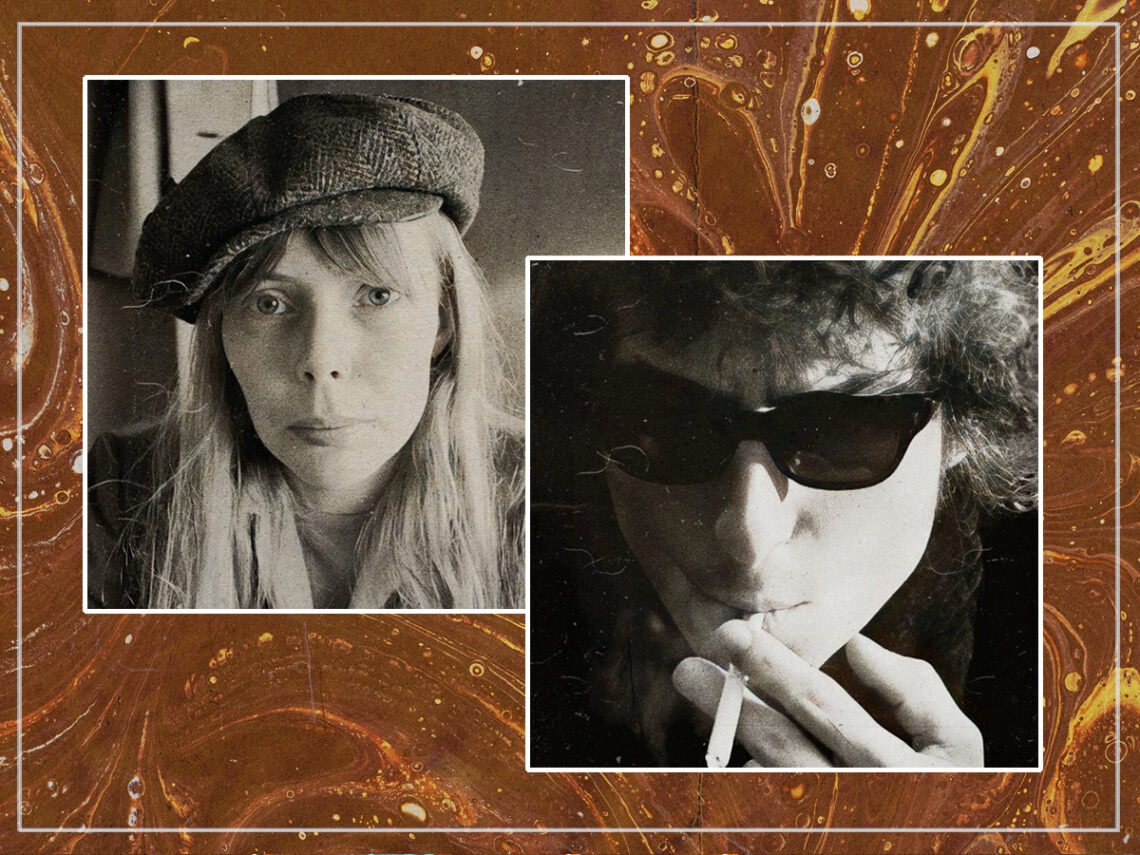
The Bob Dylan song that inspired Joni Mitchell’s songwriting: “Nobody had ever written anything like that”

Joni Mitchell was always a staunchly original songwriter. It was in her ethos. She set out to write songs that no one else could have written, experimenting with the boundaries of folk and jazz, infusing each and every lyric with her own experiences, viewpoints, and feelings. It’s the reason she remains so revered and widely referenced today, leaving others to try and fail to emulate her intrinsic individuality.
Still, no artist is completely immune to external influence, not even a sonic diarist like Mitchell. Though her songs are almost always driven by her own desire to innovate in the studio or a need to expel her thoughts on wandering and freedom, on love and on loss, other forces are at play in her discography, including fellow folk legend Bob Dylan.
Dylan entered the folk scene just before Mitchell did, beginning to forge his place as one of the greatest songwriters of all time in the early 1960s. With tracks like ‘The Times They Are-a-Changin”, he proved that he could fuse poetry with politics, honing a distinctively personal style that would endear him to Mitchell. In fact, it was Dylan, alongside Canadian poet Leonard Cohen, who would initially encourage Mitchell to turn her poetry into song.
But Dylan maintained an influence on Mitchell beyond this first step. The intimate nature of his songwriting would find its way into her own work, as she once recalled during a conversation with Malka Marom on The Entertainers. Mitchell shared her admiration for his lyrical style, for his focus on the “personal narrative”, and even for his negativity.
“The fact he had the nerve,” she commented, ”you know, to come out in music and to speak his mind, and it seemed to me he went out on a limb a great deal. And I think that his influence was to personalise my work.” Mitchell cited Dylan’s 1965 track, ‘Positively 4th Street’, as a particular example of his personal lyrical style, singing the opening line to illustrate it.
“You’ve got a lotta nerve to say you are my friend,” Dylan begins over a shiny organ and twinkling piano, “When I was down, you just stood there grinning.” This personal style, directly addressing the subject of his complaints, continues throughout the song. The instrumentation remains constant while Dylan takes us through various acts of betrayal — feigned “how are you?” and lost faith — and it’s easy to see why Mitchell admired his style.
It’s a track that is both intensely personal and intensely negative. Dylan pulls no punches with his feelings towards this person, airing their issues out on the radio, and Mitchell was inspired to do the same. When she first delved into music just a couple of years later, she would hone her own style of personal songwriting, airing out her own feelings of love and hate, accompanied by soft strums.
Though Mitchell may have been inspired to take this route by Dylan, it served to further her originality. She developed one of the most distinctive voices not only in folk music, but in all of music history, finding her place alongside Dylan as one of the greats. Perhaps this serves as proof that the greatest lyrics write from their own experiences, prioritising authenticity in their artistry.

Never Miss A Tale
The Far Out Bob Dylan Newsletter
All the latest stories about Bob Dylan from the independent voice of culture.
Straight to your inbox.