


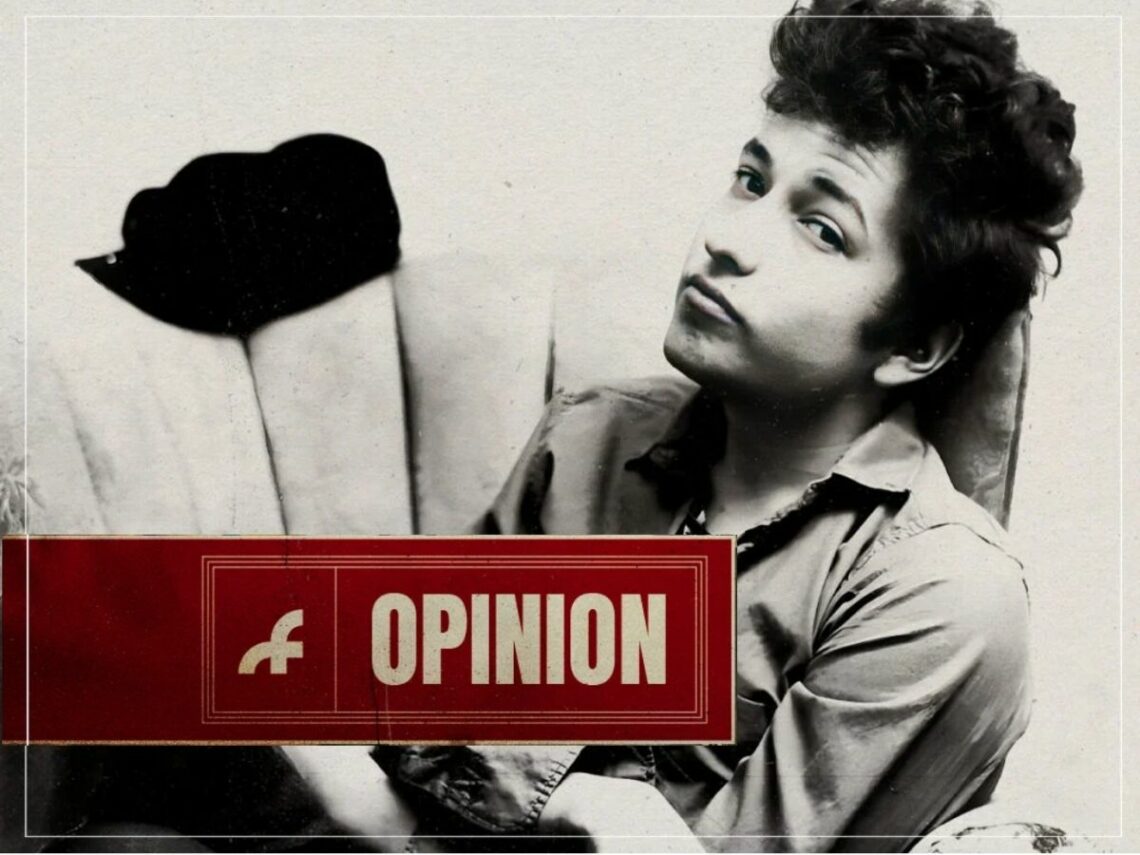
Hear Me Out: Bob Dylan shouldn’t be in a Bob Dylan movie

In 2016, Bob Dylan made history by being the first-ever lyricist to win a Nobel Prize for Literature. When his friend and musical counterpart, Leonard Cohen, was asked what he thought about Dylan’s win, he said, “To me [the award] is like pinning a medal on Mount Everest for being the highest mountain.”
Cohen eludes to a fact that many already know: modern music, lyricism, and literature wouldn’t look the same without Bob Dylan’s influence. His music has changed not only the way people approach the art of songwriting but also the way people approach words in general. Sentence structure, well-known metaphors, and the rhythm of how people write are all intrinsically linked to Bob Dylan in some way.
Who is the man behind such a legacy? This intrinsic understanding of the written word and the human psyche, along with an ability to merge the two in a way that resonates across the world, must be some sort of mystical genius. Yes, Dylan has always shrouded himself in mystery, but now, thanks to biographers and secondhand stories, we have a full picture of who Dylan really is, his upbringing and his career. The disappointing part? It’s all pretty ordinary.
Timothée Chalamet is gearing up to play Dylan in the upcoming biopic A Complete Unknown. The movie doesn’t tell Dylan’s life as a whole; instead, it focuses on a specific period when he went from being a folk singer in Greenwich Village to becoming one of the leading figures in folk rock, swapping out his acoustic guitar for an electric guitar and causing outrage.

This isn’t the first film to try to depict periods of Dylan’s life, though, and it almost certainly won’t be the last. However, the issue that this movie faces is the same, which has plagued every release that has come before and every release that will come after. The fascinating thing about Dylan is his work, not him. His upbringing was ordinary; granted, he was a bit of an outcast, but there is nothing extraordinary about it, nor is there anything about his rise to fame. Granted, A Complete Unknown does focus on a period of contention for Dylan as he made a stylistic pivot, but how much of a story is there in someone swapping out an acoustic guitar for an electric one?
Leonard Cohen had a lot to say about Dylan in addition to simple praise. Once, he spoke in detail about going to see him perform, and in that description lies the true nature of Dylan as a figure. Cohen talks about the noise, the lighting, and the fact that Dylan plays with most of his back facing the audience. He couldn’t be seen clearly, but people knew he was there, performing strange incantations of songs that were tough to make out.
“Something else was going on,” said Cohen, “Which was a celebration of some kind of genius that is so apparent and so clear and has touched people so deeply that all they need is some kind of symbolic unfolding of the event. It doesn’t have to be the songs. All it has to be is: remember that song and what it did to you. It’s a very strange event.”
This is the magic of Dylan. When Chalamet was asked about how he connected with the music of Dylan, he said, “For me, it started out with the music and this song ‘Ballad of a Thin Man’. That was my in. I thought, ‘Well, this is rock and roll’,” he said before exploring the anger entrenched within the music, “It’s acidic. It’s like battery acid.”
This is one facet of Dylan, his ability to discuss anger, discourse and all things unsettling. It’s one element of him but only a fraction of what he put out. If you speak to a hundred writers, poets, and musicians who Dylan has influenced, they will all have a different way of thinking, and his work exists within them and influences them in various ways. This is the case across music and literature. The story of Bob Dylan lies in his influence, not in his actual story.
By creating a movie which is literal in its interpretation of Bob Dylan’s life, you remove the mystery that surrounds the man and his work. You show him for what he is: human. While some may see this as a positive, highlighting that we are all capable of great things, it doesn’t make for an entertaining viewing experience and doesn’t do his legacy justice.
You are taking away from Cohen’s experience of seeing Dylan live. You are forcing Dylan to stand and greet the audience; all lights are up, stage and house, and he is playing the hits as we know them. It’s short-term satisfaction, but it diminishes the true power of his work. The best Bob Dylan movie is one different to other biopics, as it is a film that doesn’t feature Bob Dylan at all.
If you were to make a movie that truly highlights his significance as an artist and a wordsmith, it would be better to take from his live shows. Put him in the room with the audience and let them know he is there, but don’t make him the focal point. His character should exist through TV and radio, with the film’s focal point being his impact rather than being him. That’s the only way you can tell an entertaining, compelling story about Bob Dylan that comes close to highlighting his legacy. Focus on those he inspired, leaving him as, dare I say, a complete unknown.

Never Miss A Tale
The Far Out Bob Dylan Newsletter
All the latest stories about Bob Dylan from the independent voice of culture.
Straight to your inbox.