


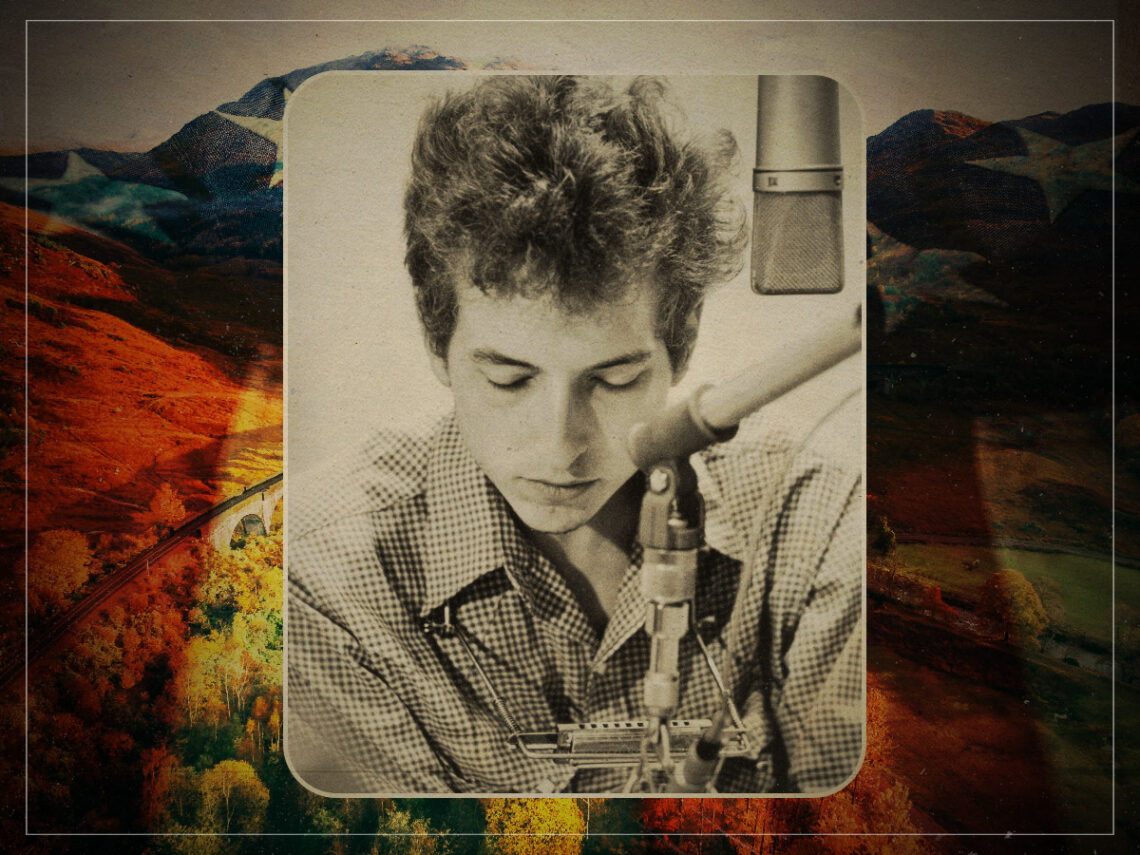
How Bob Dylan’s most American anthem was actually indebted to Scotland

He might not drape himself in stars and stripes or shill out his principles for some war-mongering politician, but it is difficult to think of an artist who imbues the American spirit quite as well as Bob Dylan.
After all, Dylan arose from obscurity, spurred on by the influence of folk heroes like Woody Guthrie and Pete Seeger, artists who had a deep, unshakable love for their country, coupled with a desire to change the nation for the better. Guthrie’s ‘This Land Is Your Land’ might have been adopted by blind patriots as a backup national anthem, but it was originally penned to criticise phoney patriotism and call attention to the issues of the United States with regard to wealth inequality and private property.
Perhaps the closest Bob Dylan ever got to matching the social activism and American patriotism of Woody Guthrie was in his 1964 masterpiece ‘The Times They Are-a Changin”, a song which reflected the shifting sands of society and politics during the age of civil rights, the Cold War, and a rapidly expanding movement of youth activism. As well as being one of Dylan’s most iconic compositions, the song is also one of the greatest protest anthems of all time.
While still in his early 20s, Bob Dylan captured the essence of America – warts and all – within that legendary track, spawning an unimaginable litany of singer-songwriter protest songs in his wake. Despite the song’s unshakable roots in the changing landscape of American society, though, the music itself was inspired by the age-old folk sounds of Scotland, thousands of miles away.
Whether it’s in the harsh indie heroism of The Jesus and Mary Chain or the songwriting genius of Annie Lennox, Scotland’s music scene has always been rather productive, but, going back centuries, its premier export has always been folk music.
In fact, virtually all western forms of traditional folk music are rooted in either Scotland or Ireland – the Appalachian folk that provided the likes of Dylan, Guthrie, and Seeger, with their American folk sound was itself derived from the folk sounds of Scottish settlers.
These Scottish roots were something that Dylan readily admitted to. During one 1985 interview, he revealed, “This was definitely a song with a purpose. It was influenced, of course, by the Irish and Scottish ballads,” specifically citing ‘Come All Ye Bold Highway Men’ and ‘Come All Ye Tender Hearted Maidens’.
“I wanted to write a big song, with short, concise verses that piled up on each other in a hypnotic way,” he added.
In essence, that structure is what folk music has always been built upon. ‘The Times They Are-a Changin’’ might have captured the essence of political protest in the 20th century, but if you examine the Scottish folk protest songs of hundreds of years prior, the essence is virtually identical.
From television to modern football and, of course, Irn Bru, Scotland has given the world so much over the centuries, including, as it turns out, one of the most important protest songs in the history of American music.

Never Miss A Tale
The Far Out Bob Dylan Newsletter
All the latest stories about Bob Dylan from the independent voice of culture.
Straight to your inbox.