


Bob Dylan – ‘John Wesley Harding’

John Wesley Harding arrived in December 1967 as the eighth studio album of the ultimate songwriting marvel of the 20th century, Bob Dylan. In the autumn of ’67, 17 months after his death-defying motorbike accident near Woodstock, Dylan returned to the studio to record new material. Although he spent much of his time recording with The Band during this period, the material released on John Wesley Harding is executed separately in a sparse manner with the support of drummer Kenneth A. Buttrey and bassist Charlie McCoy.
Following his successful blues-imbued trilogy of the mid-’60s, Dylan sought to return to his acoustic folk roots, but this time with the aid of a rhythm section. The album kicks off with the tile track, a misspelling of the legendary Texan outlaw John Wesley Hardin. In the lyrics, Dylan spins the tale of Harding’s good deeds, claiming that he was “never known to hurt an honest man,” “always known to lend a helping hand,” and “never known to make a foolish move.”
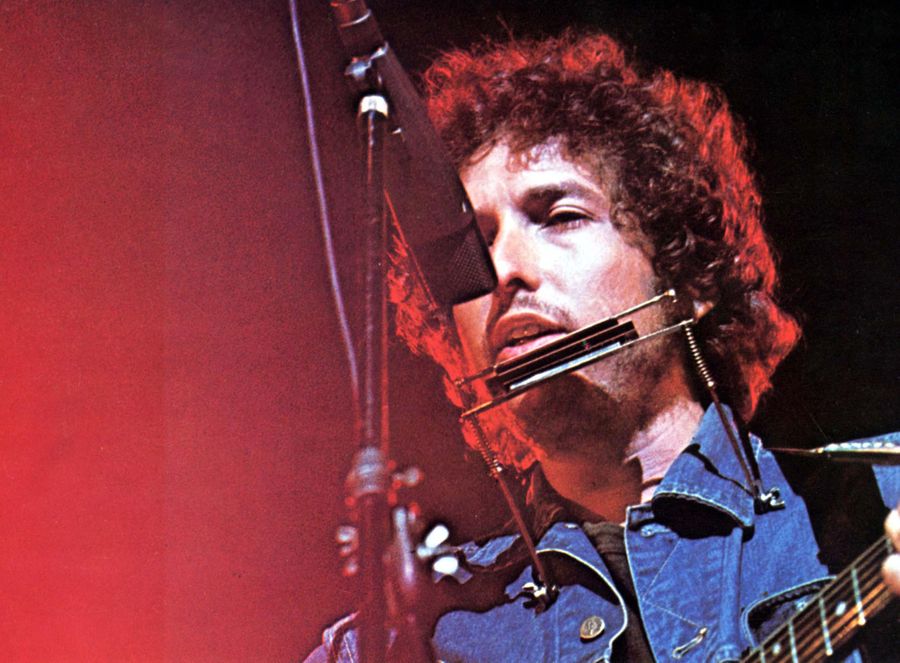
‘John Wesley Harding’ carries the first threads of piercing harmonica that pervade the album intermittently. After growing accustomed to the screeching solos, there’s something strangely hypnotic and charming about the unique sound that binds the songs with distinctive genes. Like a whistling wind across the prairie, the harmonica flows into the introduction of ‘As I Went Out One Morning’, the album’s second track and one of its more obscure highlights.
The album’s two most memorable moments, ‘All Along the Watchtower’ and ‘I’ll Be Your Baby Tonight’, arrived together in its second double A-side single following ‘Drifter’s Escape/John Wesley Harding’.
‘All Along the Watchtower’ echoes the narrative prowess of Dylan’s 1965-’66 trilogy while returning to the sociopolitical poignance of his earlier folk material: “There’s too much confusion/ I can’t get no relief/ Businessmen, they drink my wine/ Plowmen dig my earth/ None of them along the line/ Know what any of it is worth”.
The piercing screech returns in verse breaks throughout ‘All Along the Watchtower’ with a new level of relevance as Dylan paints his vivid Wild West imagery. I, for one, have always heard the all-too-present harmonica as the “growl” of a “wildcat” or the “howl” of the “wind” resounding “all along the watchtower.” Thinking in these terms, at least, gives the sound more purpose.
Adding crucial balance to the album is ‘Dear Landlord’, in which Dylan sets down his guitar and harmonica to sit at the piano. In the maudlin ballad, Dylan pleads with his landlord while revealing a broader existential rumination. This pattern adorns much of the album as Dylan expresses personal afflictions through a rolling cast of characters, including a hobo, an immigrant, a wicked messenger and a drifter.
Dylan concludes the album on a sentimental note with ‘I’ll Be Your Baby Tonight’. The track isn’t void of harmonica intrusions, but they’re less piercing and interspersed with a pleasant slide guitar thread performed by Pete Drake – a soothing balm for bleeding ears.
Following up the mighty Blonde on Blonde was always going to be a mammoth task for Dylan, especially following such a severe motorbike accident. Comparatively, John Wesley Harding is sometimes given a bad rap and labelled as the first album of Dylan’s creative nadir of the late ’60s and early ’70s, quelled only by the force of Planet Waves and Blood on the Tracks. Alas, I argue that this period houses some fantastic and underappreciated material, albeit more sparse.
John Wesley Harding is a hidden gem in Dylan’s discography and an essential bridging of his early folk and, subsequently, more textured styles. The songs are lyrically robust, as Jimi Hendrix discerned, and while the shrill harmonica surfaces as an old friend you need to say ‘Shut up!’ to once in a while, it adds a vital strand of DNA to the album that just might endear itself in time.

Never Miss A Tale
The Far Out Bob Dylan Newsletter
All the latest stories about Bob Dylan from the independent voice of culture.
Straight to your inbox.