


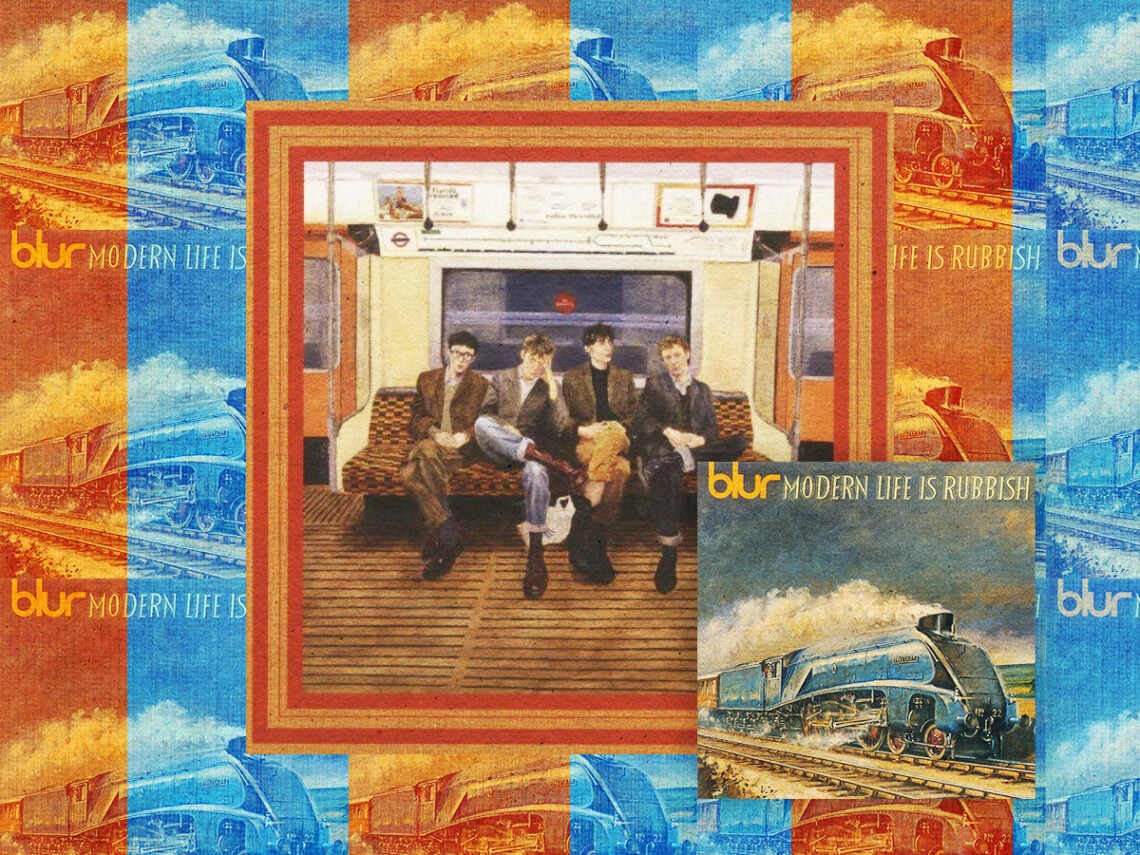
Blur – ‘Modern Life Is Rubbish’

There was no reason for Blur to be as confident as they were. They had mild success in the British rock scene, exemplified by their trend-chasing debut album Leisure, but had quickly fallen out of favour as critics began to gravitate toward bands like Suede. Blur’s attempt to court American audiences had left them depressed and in debt. The chips were down, but there was a way out.
The 1992 single ‘Popscene’ took the rising British music scene to task while shifting the band’s sound away from the sounds of baggy and dance-rock. Graham Coxon was starting to craft his signature guitar sound, exemplified by chromatic lines and dissonant tones. Damon Albarn was shifting his focus too: disgusted by the Americanisation of culture, Albarn decided to bring all of his stories back to Britain on the band’s next album.
The result was Modern Life Is Rubbish, a high-risk venture disguised as a logical next step into the future. It’s easy to think of it as a genius move now, but Blur was putting it all on the line in order to survive. A shift in musical tone, lyrical storytelling, and production style all could have (and maybe should have) alienated anyone who was still willing to support Blur. And yet, thanks to a complete commitment from the band and producer Stephen Street, Modern Life Is Rubbish was the album that saved Blur’s career.
It’s a touch ironic that ‘For Tomorrow’ leads off the album. Written after Food Records requested a single, Blur doubled down on their ’60s-pop-meets-90s-London sound and held on to it tightly. A nonsensical and highly catchy chorus fulfilled the label’s request, but ‘For Tomorrow’ does nothing to ease the listener into the prickly Englishness of Modern Life Is Rubbish. And yet, for impressionable Americans who were ready to romanticise a culture they fell in love with through music, Blur seemed like the new torchbearers in a lineage that included The Who, The Jam, and yes, The Kinks.
Discontent is all around Modern Life Is Rubbish: from its blunt title to its kickbacks at advertisements, lazy Sundays, and both the city and the suburbs. Alternately angry, bored, dismissive, and depressed, Modern Life Is Rubbish gets most of its pep and energy from Albarn’s melodies, Coxon’s eccentric guitar lines, Alex James’ bouncy basslines, and Dave Rowntree’s powerful drumming. Just listening to the album’s music could fool you into thinking that Blur was happier than ever, but that’s just the excitement of stumbling onto something new. In reality, Albarn and the rest of the band were as biting, cutting, and unimpressed with the world around them as ever.
Albarn also begins his preoccupation with distinctly English characters. ‘Colin Zeal’, ‘Pressure on Julian’, and ‘Chemical World’ all get hyper-specific with their observations, specifically the exhibitionists, peeping toms, and pedestrian walkers who remain pleased with themselves despite their unremarkability. ‘Miss America’ isn’t actually a person: it’s a product. Albarn’s preoccupation with personifying his own anxieties about the modern sprawl would get its biggest platform on the band’s follow-up, Parklife, but its infancy on Modern Life Is Rubbish doesn’t make it any less impactful.
Filling out the album with references to the underground, drivel, and rubbish, Albarn crafted a world that seemed pedestrian to natives but strangely alluring to outsiders. The Britain that Albarn sings about isn’t glamourous by any stretch of the imagination: it’s a confused place filled with uncertain people. Somehow, Blur are able to draw a straight line through the different homes, businesses, and streets of London in the early 1990s without feeling beholden to a specific moment in time.
With Modern Life Is Rubbish, Albarn carved out his place as the Ray Davies of his generation. More importantly, Blur now had their own singular sound that set them apart from the crowd. By turning their back on America, the band were now leading the charge in what would quickly evolve into Britpop. If any band fulfilled both the “Brit” and “pop” elements of the genre at the highest possible levels, it was Blur. As it turns out, a healthy bit of overconfidence never hurt anyone.
