


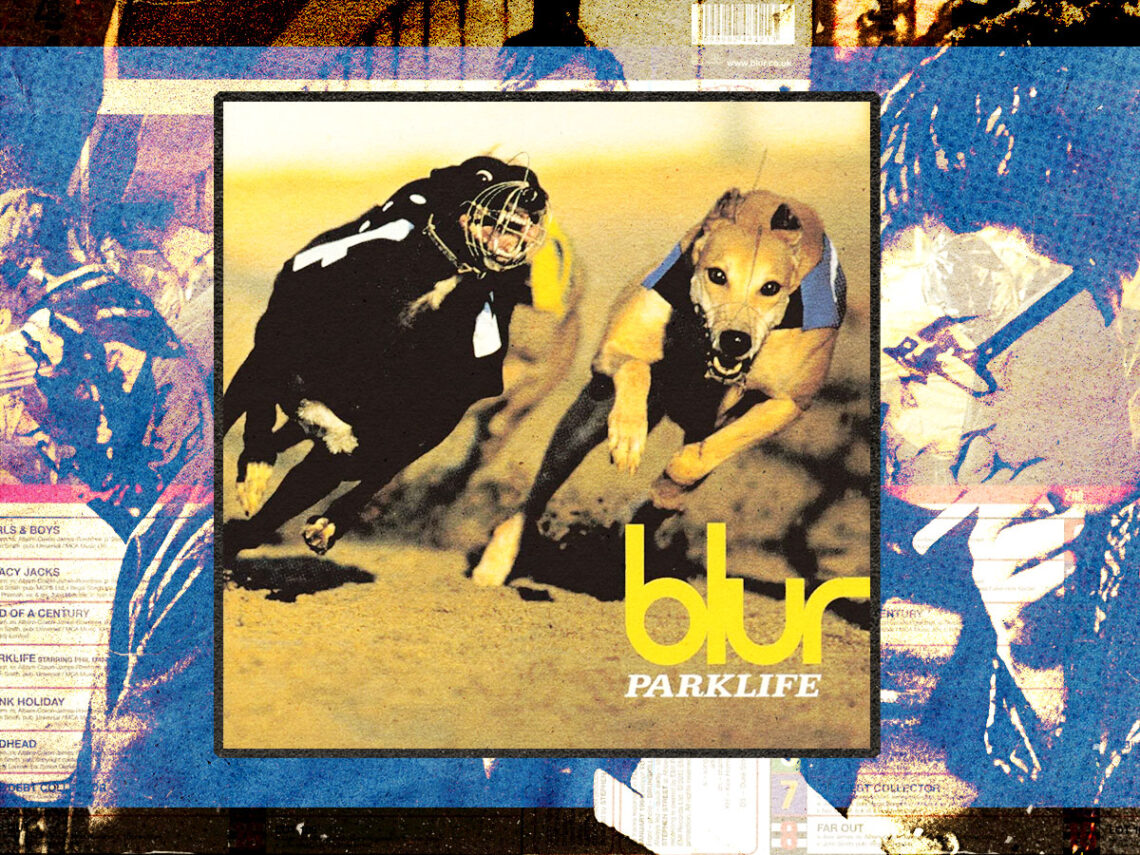
Blur – ‘Parklife’

In 1990, Blur frontman Damon Albarn made a startingly accurate prophecy: “When our third album comes out,” he told Mojo’s David Cavanagh, “Our place as the quintessential English band of the ’90s will be assured. That is a simple statement of fact. I intend to write it in 1994”. Blur didn’t exactly have a reputation for far-sightedness at this point. Their 1991 album Leisure turned out to be little more than a survey of contemporary rock music, and by 1993, they were still struggling. Heavily in debt and touring incessantly, Blur managed to cobble together Modern Life Is Rubbish, which revealed the first green shoots of that quintessential Englishness Albarn had foretold three years earlier.
Blur had Stephen Street to thank for the modest success of Modern Life. It was Street who had converted Blur’s self-belief into sonic swagger, paving the way for the likes of ‘For Tomorrow’, ‘Chemical World’ and ‘Blue Jeans’. He also oversaw the demos for what would become Parklife. Recorded at a time of scarcity and uncertainty – both for Blur and Britain as a whole – the album looks forward to balmier days. Throughout, there’s a sense that Damon Albarn, Alex James, Graham Coxon and Dave Rowntree have literally nothing left to lose. Nowhere is that more apparent than in album opener ‘Girls & Boys’, a celebration of youthfulness set to Eurotrash beats. From the off, Blur are making one thing clear: Parklife isn’t going to be another guitar album. But they don’t abandon the band format entirely. Instead, they explore how close a guitar band can come to replicating club music. In ‘Tracy Jacks’, for example, guitars, basses and drums become purely textural instruments. When Coxon is required to deliver a guitar solo, what we get isn’t an intricate ascending scale but a stream of single notes fed through a long-tailed delay.
Blur bag a three-hit streak with ‘End of The Century’, which sees Albarn exploring Fin de Siècle anxiety above layers of Mellotron flute. With all that talk of squats and daytime TV, Damon reveals himself to be a true man of the people. At this point in their career, Blur were still skint, and that gives Albarn’s lyrics a real sense of reliability. Those same lyrics see Albarn digging for insights into modern British life. Just three songs in, and he’s already achieved his goal: like Ray Davies on valium, he interrogates the psyche of the modern Briton, finding two distinct social groups: the corporate leftovers of Thatcherite Britain and the young eccentrics with dye in their hair. ‘Parklife’ is a celebration of the latter. As in ‘Tracy Jacks’, Albarn pokes fun at the mundanity of adulthood in an effort to highlight the brilliance of youth – a youth defined by what it fears it will become.
But like an over-hyped Palme d’Or winner, almost everything exciting in Parklife happens in the first 15 minutes. ‘Bank Holiday’ – surely a brilliant live track – seems to have been written solely to mock the alt-rock groups on the opposite side of the Atlantic. Blur are clearly having a huge amount of fun, but the track is a complete throw-away. The same goes for ‘Badhead’, a rather depressing dose of country rock with none of the wit of ‘End of The Century’. Luckily, these weaker moments in Blur’s songwriting are alleviated by tracks like ‘Debt Collector’, which sounds like an obscure B-side from some forgotten library music maestro. That emphasis on unusual instrumentation continues into ‘Far Out’, a spacey, surrealist lullaby which makes up in mood for what it lacks in melody.
‘Far Out’ bleeds perfectly into ‘To The End’. Defined by those syrupy string arrangments, easy-listening melodies, and exotica-infused vibraphone arrangments, this is the obvious sister track to ‘Girls & Boys’, conjuring up images of all-inclusive resorts overflowing with drunk British tourists. With ‘To The End’, Blur subvert an idealised vision of the continent; in ‘Magic America, they interrogate the myth of the United States. This Thatcherite fantasy, Blur argue, is yet more proof of the British people’s inability to appreciate what they’ve been given. When not losing themselves in an imagined version of England, they’re salivating over the Land of The Free, with its “sugar-free” skies, “shopping malls”, and “good square meals”. It’s all very cynical, but it works beautifully.
Sadly, Albarn’s determination to create an English musical lexicon is often a touch too obvious. By the time ‘London Loves’ comes around, his obsession with class and corporate London feels like less of a comment on contemporary life and more like a personal grip. ‘Trouble in The Message Centre’ also falls short of Parklife’s opening tracks, as does ‘Clover Over Dover’, which, with its baroque instrumentation, might feel like an advert for the British tourist board were it not for Albarn’s suicidal speaker. We’re rescued from this lethargy by the deep-sea pearl that is ‘This is a Low’, an exploration of isolation oozing with the tranquillity of the evening shipping forecast (if you have to ask, you’ll never understand).
With Parklife, Blur did establish themselves as the quintessential English band, spearheading a new era of British pop music alongside the likes of Pulp, Suede and Oasis. Eccentric, forward-thinking and highly attuned to modern British life, Parklife became a touchstone of the ’90s guitar boom through a series of artful subversion.
