


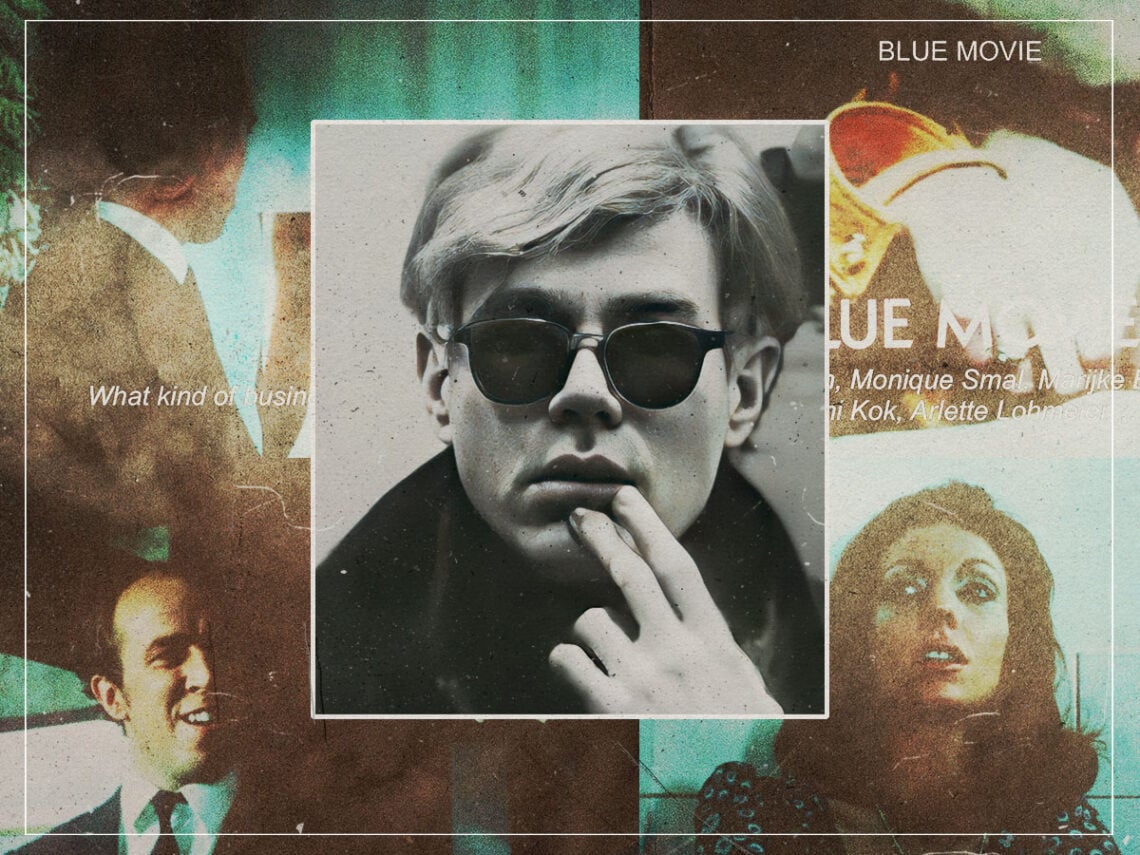
‘Blue Movie’: how Andy Warhol found a loophole to bring sex to the big screen

In 1969, Andy Warhol uncovered a loophole that would make cinematic history. As he experimented with increasingly wild and controversial film ideas, his late ‘60s flick Blue Movie stepped over the edge into pure filth.
By the late 1960s, Andy Warhol was the biggest name in the art world. His pop art had made him a star. Championing the use of silk screen printing, his artistic output was incredible as his team at The Factory helped him create piece after piece. As the end of the decade came around, most of his notable pieces had been unveiled, with the Coca-Cola bottles, Marilyn series, Campbell’s Soup Cans and even his darker pieces like the electric chairs, all out in the world.
But alongside his artworks, Warhol was also keenly interested in film. He filmed over 500 screen tests, sitting Factory faces and celebrities down in front of his camera for a cinematic portrait. Between 1962 and 1968, the artist was obsessed with filmmaking, canning over 60 projects of increasing weirdness.
It started with his static projects, filming one object from one vantage point for hours. Perhaps his most famous is Sleep, a six-hour-long film of poet John Giorno enjoying a night’s rest. But other films, such as Bad and Vinyl, were becoming increasingly controversial.
Dealing heavily with the topics of sex and drugs, Warhol’s movies began to capture the seedy underbelly of his scene. He would film his friends when they were heavily intoxicated, getting them to spill secrets or engage in sexual acts. One film, Beauty No.2, sees Warhol questioning Edie Sedgwick about her childhood of abuse while commanding her to fool around with a friend, being a horrifyingly exploitative watch.
But one 1969 film pushed it to the extreme. Warhol was a huge fan of Radley Metzger’s work. The American director merged porn with cinema, creating artistic yet adult-oriented films. Warhol was inspired and wanted to try it out. So essentially, Blue Movie is a Warhol-directed porno.
Depicted Warhol superstar Viva making love in bed with another Factory regular, Louis Waldon, the movie shows explicit sex scenes. Yet somehow, Warhol was allowed to show the film in cinemas.
It’s not entirely adult. Blue Movie also features the two stars going about mundane daily tasks and discussing current events. There’s an extended conversation about the Vietnam War, an addition that Warhol played on.
Finding a loophole by playing on the question of ‘what is art?’, Warhol said the movie was “a film about the Vietnam War and what we can do about it”. To get around pornography and censorship laws, Warhol simply never called Blue Movie an adult film. Instead, he said, “The movie is about … love, not destruction”.
The plot was foiled pretty quickly, however. The film had an initial benefit screening on June 12th, 1969, which the press began reporting on, revealing the nature of its contents. When the film opened for public viewing at New York’s Garrick Theatre on July 21st, it lasted only ten days before the plug was pulled.
On July 31st, the staff at the theatre were arrested, and the film was confiscated by the police. Being hit with a hefty fine, the cinema was forced to pull the movie from screens. Of the controversy, Warhol said, “What’s pornography anyway?” questioning the police’s judgement when deeming Blue Movie as an adult film unsuitable for public viewing.
Warhol continued: “I think movies should appeal to prurient interests. I mean, the way things are going now – people are alienated from one another”. He backed his project, being passionate about his worth, as he added, “Blue Movie was real. But it wasn’t done as pornography—it was done as an exercise, an experiment. But I really do think movies should arouse you, should get you excited about people, should be prurient. Prurience is part of the machine. It keeps you happy. It keeps you running.”
Despite only lasting ten days in cinema, Blue Movie has gone down in cinema history as a cult classic and a pioneering piece. The movie is said to have inspired Last Tango in Paris, Marlon Brando’s controversial erotic drama.
Shortly after Blue Movie‘s release, the 1970s became known as the ‘Golden Age of Porn’ as directors made artistic and entertaining adult movies rather than seedy snuff pictures. ‘Porno Chic’ became a trend as America’s sexual revolution kicked into a new gear, all thanks to Andy Warhol’s sneaky public release of a sex tape.
