


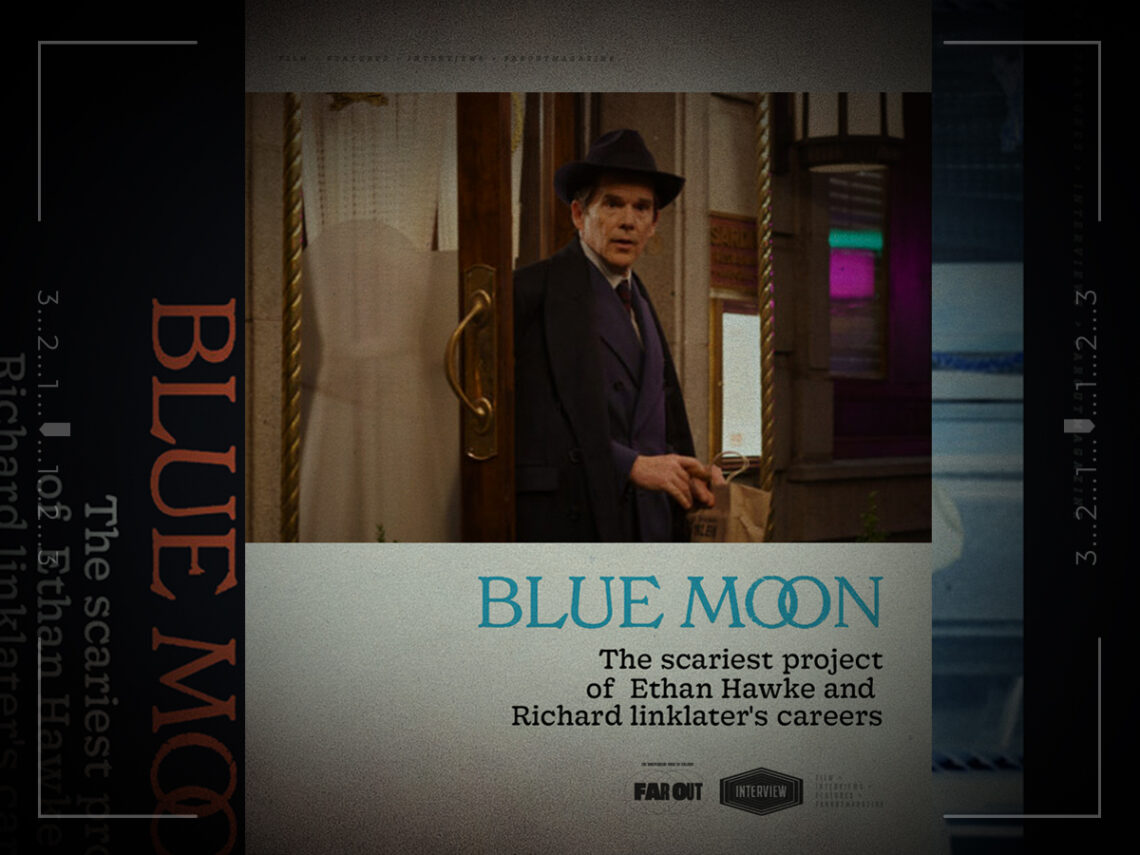
‘Blue Moon’: the scariest project of Ethan Hawke and Richard Linklater’s careers

Director Richard Linklater doesn’t mind waiting. It took him 12 years to complete Boyhood, nearly two decades to close out his Before trilogy. And it’ll take him over 20 years through 2040 to finish filming his screen adaptation of the musical Merrily We Roll Along.
So when he says he waited 12 years for Ethan Hawke to age into the role of real-life Broadway lyricist Lorenz ‘Larry’ Hart, it tracks. Blue Moon, their latest collaboration, was shot in Dublin in about 15 days (a Linklater record), and takes place on the night of Rodgers and Hammerstein’s Oklahoma! opened to acclaim on Broadway in 1943 – sealing the beginning of one partnership and the end of another (Rodgers and Hart).
Inside the portrait-lined burgundy walls of Broadway’s favourite haunt, Sardi’s Bar, we find Hawke’s Hart anxiously bracing to face his former collaborator, Richard Rodgers, played by a composed Andrew Scott. The closeted Hart drinks, jokes, and unravels – part confession, part performance – as he reckons with his sexuality in the form of Margaret Qualley’s Elizabeth as well as the devastating pain of seeing Rodgers’ greater success without him.
After all, they were collaborators for 25 years. And, as of 2025, so are Hawke and Linklater. Blue Moon marks the ninth Linklater-Hawke collaboration, spanning the Before trilogy, Boyhood, Waking Life, Tape, Fast Food Nation, and The Newton Boys. One of Hart’s first confessions in Blue Moon: his new goal in life is to stop being so scared – a challenge the actor playing him and his director embrace.
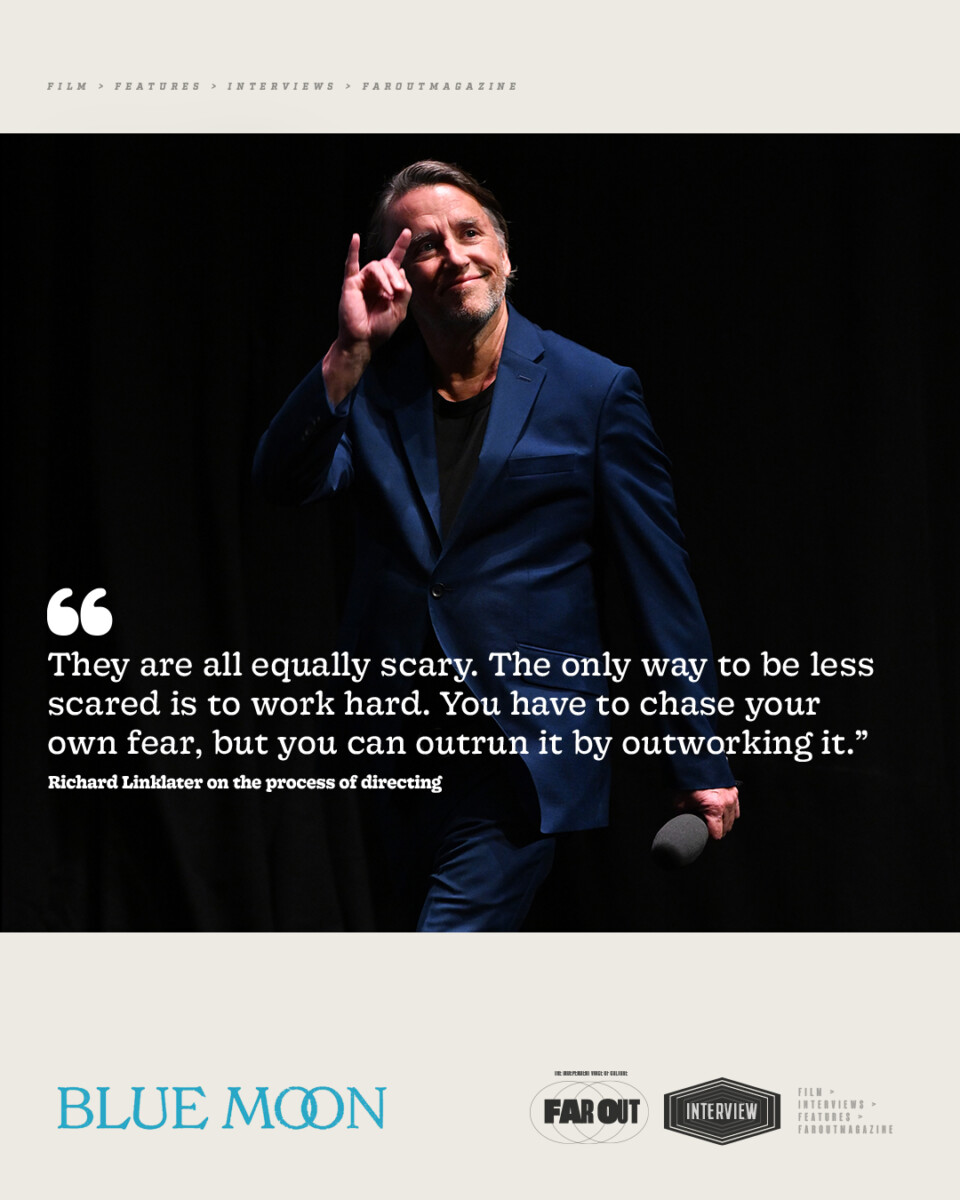
“They are all equally scary,” Linklater admits to Far Out about the films he’s directed. “The only way to be less scared is to work hard. You have to chase your own fear, but you can outrun it by outworking it.” Newcomer Giles Surridge, who plays ‘Sven’, the object of some of Hart’s flirtations and huge Boyhood fan, praises Linklater: “Having been a fan of Richard’s for so long, you kind of build up this idea in your head that there are going to be all sorts of things, but he completely blew my expectations out of the water. He made me feel so comfortable in there.”
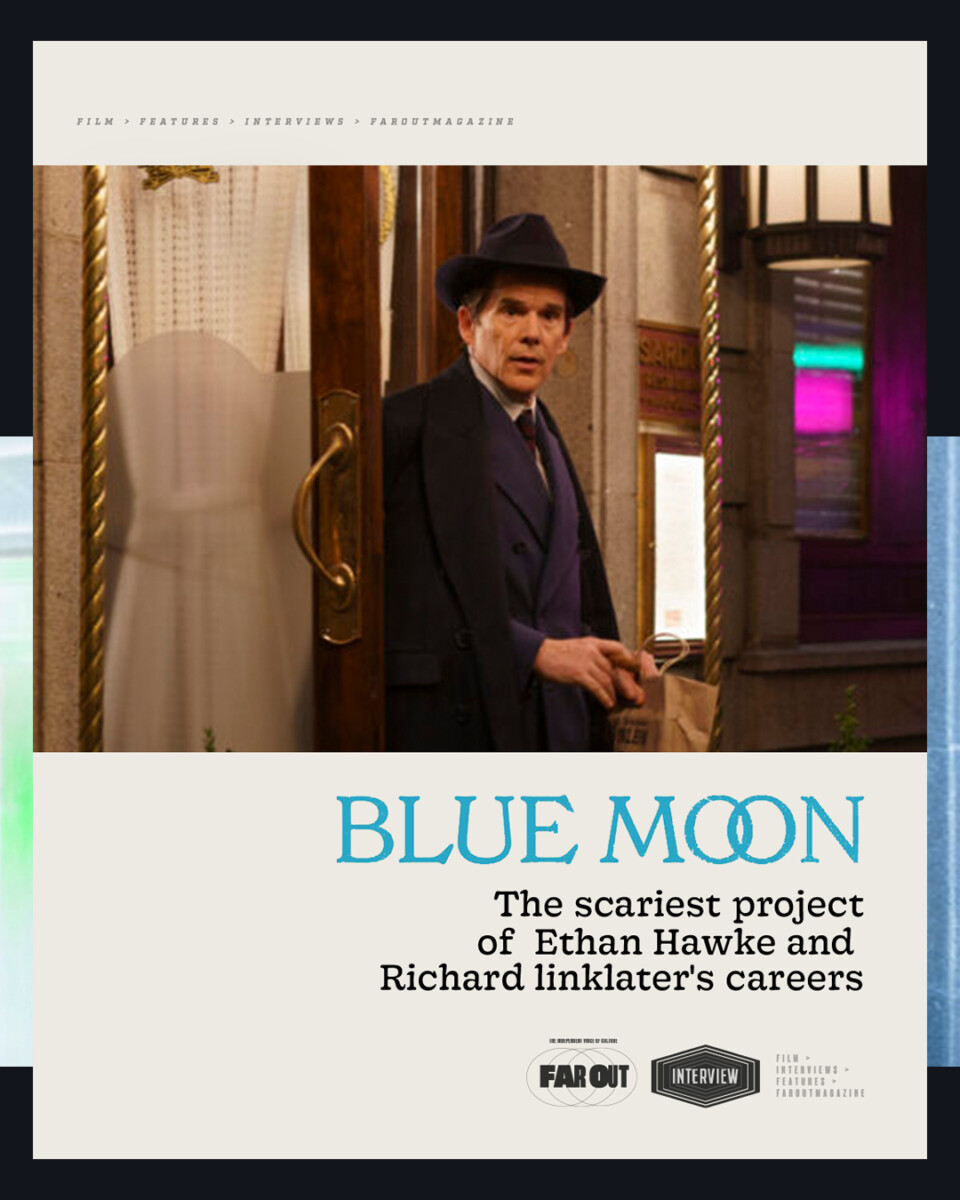
When we ask Hawke what role has scared him the most in his decades-long career, he doesn’t hesitate. Hawke, who’s currently promoting multiple projects, Blue Moon, Black Phone 2, and The Lowdown, tells us: “This one. I really wanted to do this part, but in the days leading up to actually doing it, it was absolutely terrifying.”
Blue Moon is a single-location “bottle” film that unfolds almost entirely through dialogue, aka a perfect fit for a Linklater-Hawke joint. Nearly all of its dialogue belongs to Hawke, who’s tasked with delivering a marathon of monologues, quips, and confessions – waxing poetic about everything from art and desire to finding philosophy in a half-erect penis, to anyone who will listen. To prepare, Hawke painstakingly handwrote all of his lines into a stack of roughly 13 mini brown notebooks. Surridge recalls that “[Hawke] was very much in the zone” while on set.
Why so much talking? Hart is terrified of silence, fearing that once he stops talking, he’ll disappear into the background. By the age of 53, which is where we find him in this film, Hart was balding, reportedly five feet tall, and living with arthritis as well as a drinking problem. To play this role, the blue-eyed, floppy-haired, five-foot-ten Hawke adopted a balding wig, brown contacts, an arthritic gait, an affected voice, and a wooden device to visually shorten his frame throughout filming.
This is one of Hawke’s most remarkable transformations, one audiences aren’t used to seeing in the perennial heartthrob. Hawke is also the biggest set piece of the film: Blue Moon lives or dies on the success of his delivery.
Hawke’s biggest fear about playing Lorenz Hart, though?: “One of the things people don’t think about when you collaborate with somebody for a long time is how important the friendship is. I didn’t want to let [Richard] down – his belief in me. I wanted to be the actor he thought I was. And that’s scary.”
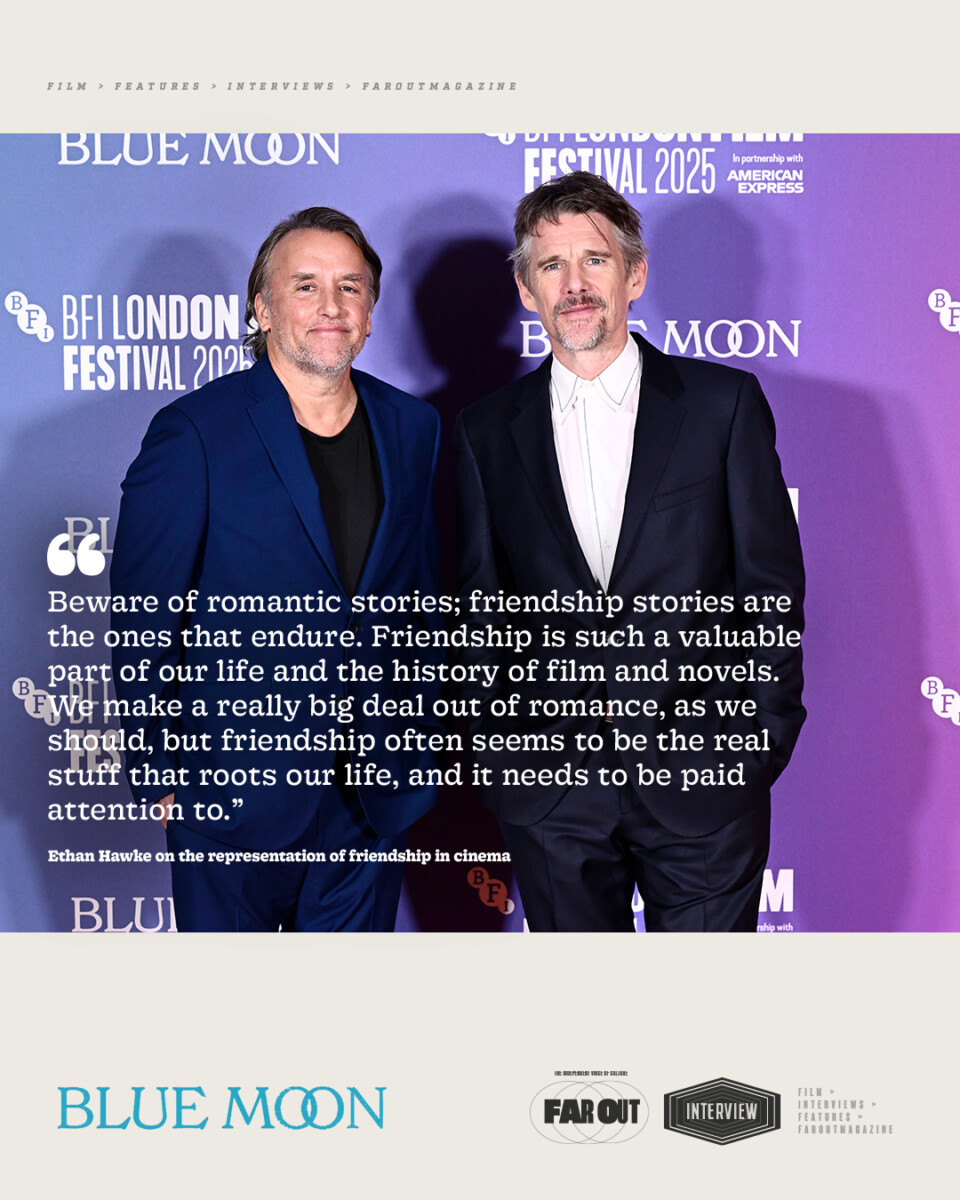
Perhaps it’s apt that one of Hart’s lines that audiences responded to the most during our screening was about friendship: “Beware of romantic stories; friendship stories are the ones that endure.” When we mention it to Hawke, he tells us he loves that line and says he’d be keen to see more stories about friendship onscreen. “Friendship is such a valuable part of our life and the history of film and novels,” he adds. “We make a really big deal out of romance, as we should, but friendship often seems to be the real stuff that roots our life, and it needs to be paid attention to.”
As for the romantic stories that Linklater and Hawke have told together? We’d argue they’ve already made “the ultimate romance movies” through the Before trilogy. While Linklater tells Far Out he can’t choose a favourite, he shares that people usually tell him that the second film, Before Sunset, is theirs.
When we ask them about their next collaboration, Hawke says, “I’d be surprised if [Blue Moon] was our last dance.” It might take a few more decades to see your next collab; please, Ethan Hawke, tell us at least what genre it is. Hawke grins: “The Richard Linklater genre – he’s his own genre!” Perfect and 100% correct answer.
While Linklater tells the press that Blue Moon is truly “a breakup movie” about collaborators, we are glad to see that his bromance with Hawke is alive, well, and as mutually committed as ever.
Their big screen reunion is joined by Andrew Scott’s Rodgers, whom Hawke’s Hart delusionally attempts to win back throughout the film – at first, phonily praising his former collaborator, then turning to bitterness. Hart mocks Oklahoma!, sneering, “Who wants inoffensive art? Oklahoma!’s going to be in high schools forever because it’s not offensive.” Rodgers pushes back, insisting there’s merit in commercially viable work – that audiences want to laugh, but they also want to cry a little.
Naturally, we asked Scott and Linklater what the last film was that made them laugh or cry. “Oh, I just watched Sentimental Value, which is a really beautiful film that people will see that has so many beautiful things in it,” Scott says. “It’s easy to make me cry. I cry at commercials.”
Linklater tells us that he also tears up pretty easily these days, adding, “I saw my friend Matthew McConaughey in The Lost Bus the other day. I don’t know if you’ve seen that. He drives a bus, saves these kids. It was kind of reuniting – something about it teared me up. But I think the last one I really kind of teared up… I saw The Elephant Man recently, David Lynch’s second film.” A fellow Austinite, McConaughey has long been part of Linklater’s personal and cinematic universe – Dazed and Confused, Bernie, The Newton Boys. When we ask if they might work together again soon on film, Linklater laughs: “Of course, we’re buddies.”
And at our 10am press screening, the audience was laughing too – in all the right places, even amidst the audible grumble of hungry stomachs. Blue Moon will make you laugh, you’ll cry, you’ll look up Lorenz Hart on Wikipedia, and if you’re a creative, maybe even have a small existential crisis of your own. Blue Moon screened at the 2025 BFI London Film Festival and is now playing in theatres across the US and CA, with a UK release on November 28th.
