


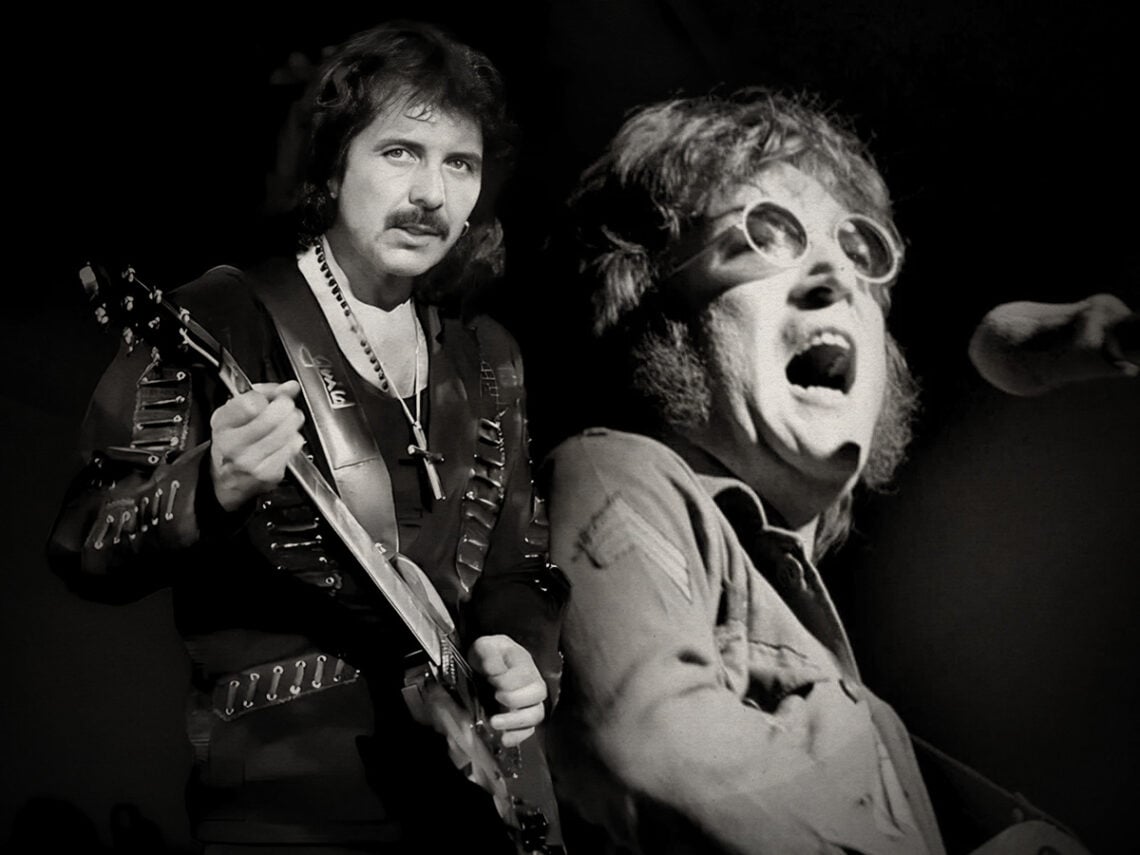
“A confusing album”: the 1981 Black Sabbath classic recorded on John Lennon’s instruments

When Ozzy Osbourne was fired from Black Sabbath in 1979, the rest of the band went through a major shift.
Osbourne’s madman antics had become too much to bear, and while each of Black Sabbath’s members had their own struggles with addiction, Osbourne was in an entirely other realm. “Alcohol was definitely one of the most damaging things to Black Sabbath,” drummer Bill Ward explained, quoted in 1996’s The Story of Black Sabbath: Wheels of Confusion. “We were destined to destroy each other. The band were (sic) toxic, very toxic.”
In Osbourne’s place, Black Sabbath found a sense of rejuvenation in Ronnie James Dio. The former Rainbow frontman, from guitarist Tony Iommi’s perspective, offered something new beyond his voice.
“They were totally different altogether,” he explained in The Story of Black Sabbath. “Not only voice-wise, but attitude-wise. Ozzy was a great showman, but when Dio came in, it was a different attitude, a different voice and a different musical approach, as far as vocals. Dio would sing across the riff, whereas Ozzy would follow the riff, like in ‘Iron Man.’ Ronnie came in and gave us another angle on writing.”
With Dio as their frontman, they debuted with 1980’s Heaven and Hell, but when Bill Ward left the band in 1980, they had to reassess. They found a new drummer in Vinny Appice, and they came together once again to record what would become 1981’s Mob Rules, beginning the writing sessions at a rented home in Toluca Lake in Los Angeles, and later completing the album at the Record Plant.
‘The Mob Rules’ would be the first song that Black Sabbath recorded for Mob Rules, a version intended for the 1981 sci-fi anthology film Heavy Metal. As Iommi explained in his 2012 autobiography, Iron Man: My Journey Through Heaven & Hell with Black Sabbath, the album’s sessions did begin, and eventually end, in Los Angeles, but the band were initially uninspired: “We just couldn’t get a guitar sound,” he wrote.
“We tried it in the studio. We tried it in the hallway. We tried it everywhere, but it just wasn’t working. We’d bought a studio, and it wasn’t working!”
Tony Iommi
Sometime in between, however, Black Sabbath found themselves at an English country house where music legends before them had passed through. “In November ‘81, we released Mob Rules, which has an interesting story,” Iommi wrote on social media for the album’s anniversary. “I don’t know if you have ever seen the John Lennon ‘Imagine’ video, where you’ve got the white piano, but that’s actually where we wrote the song ‘The Mob Rules,’ in that very room.”
The room was, in fact, at Tittenhurst Park, the Georgian country house in Sunningdale, Berkshire, England, owned by Lennon and Yoko Ono from 1969 to 1971 (and then owned by Ringo Starr and his family from 1973 to 1988) – the storied walls of Tittenhurst Park also saw the final Beatles photo session take place in 1969, shown on the covers for the 1970 Hey Jude collection.
Lennon, meanwhile, commissioned a home recording studio, Ascot Sound Studios, to be built for him and Ono to record their 1971 solo albums; while the cover photographs used for their Plastic Ono Band albums were self-portraits taken at the home. For the ‘Imagine’ video, we see Tittenhurst’s interiors as Ono opens window shutters and Lennon, indeed, is sitting at and playing his white grand piano.
Arriving at Tittenhurst, Black Sabbath were welcomed by remnants of Lennon’s presence in the home. “We set the gear up, and it was all Lennon’s gear as well,” Iommi continued. “I’d come up with this riff, and then Ronnie started singing.”
Mob Rules became a strange footnote in Black Sabbath’s history: the album has large shoes to fill, following Heaven and Hell, and much of the mixed criticism the band received stemmed from the fact that many believed Mob Rules was really Heaven and Hell 2.0.
The album would be the last for both Dio and Appice as members of Black Sabbath – they’d go on to form Dio – and Mob Rules stood as a slightly contentious memory; Iommi remembered it as “a confusing album for us,” to Guitar World in 1992. Still, it saw Black Sabbath reach into new creative venues that they had not before, even with the influence of Lennon’s former home to help guide them.
