


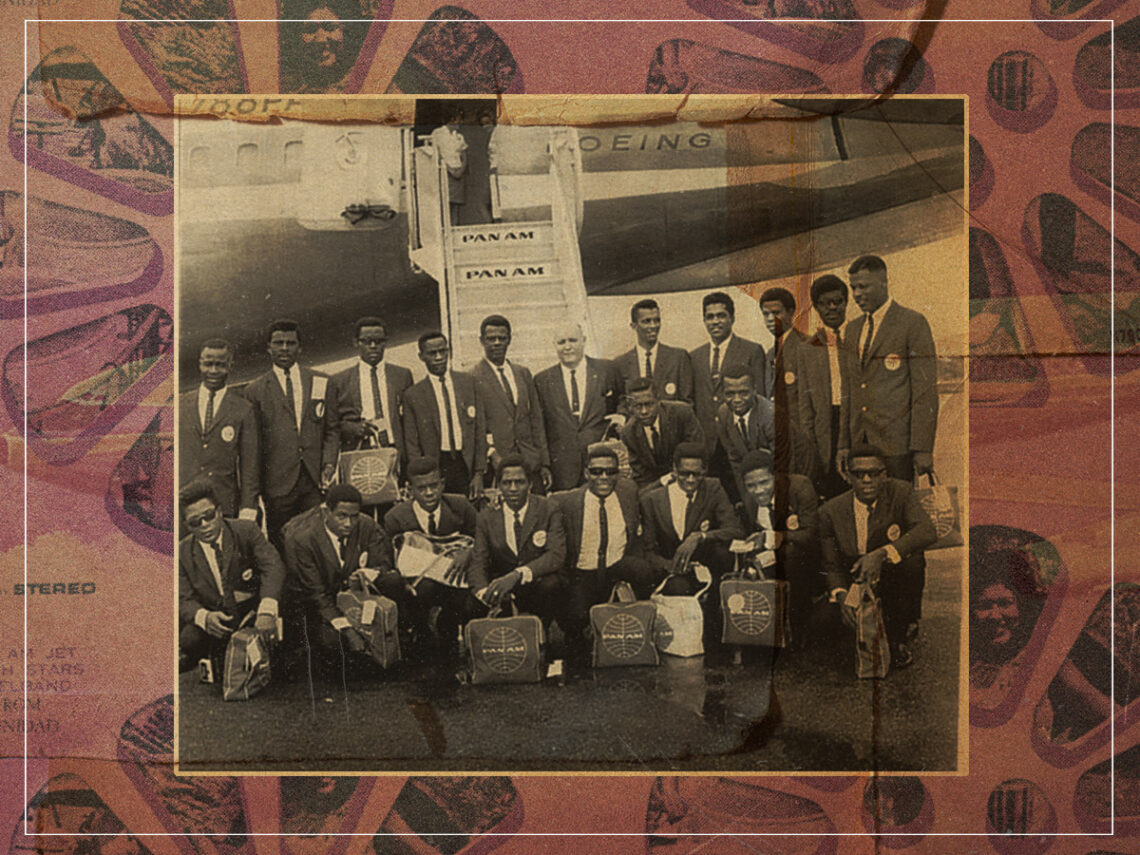
Souvenirs in Steel: the bizarre tale of the Pan Am Jet North Stars Steelband

Mention the name ‘Pan Am’ to anybody under the age of 30, and it probably won’t mean much to them. However, Pan American Airways was once one of the world’s premier airlines, providing cross-continent transport to millions of people across the globe, before ceasing operations in the early 1990s. Even if you do remember Pan Am, you might still be unaware of the various other exploits the company were involved in outside the world of air travel, namely the world of Caribbean reggae and steelband music.
The steelpan is the definitive sound of the Caribbean island of Trinidad and Tobago, with its roots in colonial rebellion and nationalist celebrations. These distinctive sounds were introduced to the wider world at the Festival of Britain in 1951, via a performance by The Trinidad All-Steel Pan Percussion Orchestra. Soon, with the advent of accessible air travel post-war, tourism became a huge industry within the Caribbean – for better or worse. As such, more and more people were becoming entranced by the euphoria of steelband music.
Being a fairly enterprising business, Pan Am became aware of this newfound interest in the sounds of Trinidad and Tobago and sought to curate their own in-house band – akin to the Malian State Railway’s ‘Rail Band’. Around the same time, Tony Williams, who had travelled to the Festival of Britain to perform in 1951, had formed a new band called the North Stars. After winning a local steelband competition, the North Stars came onto the radar of Pan Am’s management.
As a result of this interest, the North Stars became the Pan Am Jet North Stars Steelband, who were paid by the airline to play regularly and display their logo while they did it. Not only that, but the band were also expected to play at Pan Am tourist events across the Caribbean islands. Pan Am also funded multiple record releases for the band, most notably the 1965 album Souvenirs in Steel, which featured a variety of innovative steelband tracks housed in a thinly-veiled advertising campaign for Pan Am.
Housed in a beautiful die-cut sleeve, Souvenirs in Steel provided tourists who had travelled to Trinidad and Tobago on Pan Am with an opportunity to remember their trip through sound. If you can remove the influence of the American airline, however, the record includes some truly bizarre and original steelband compositions the world has ever seen. You can tell, upon listening, that the band is clearly made up of incredibly skilled steelpan musicians, so it seems somewhat odd for the band to be forever tied to, of all sponsors, an airline.
Of course, the idea of an American company having control of one of the premier steelbands in Trinidad and Tobago is incredibly problematic. After all, the island’s history of musical expression had previously been suppressed by British and American colonial forces under slavery, which offers a murky backstory for an American company having ownership of the North Stars. On the other hand, records like Souvenirs in Steel opened up the world of steelband music to a global audience, with which it still finds favour to this day.
In the years following the release of these records, the steelband toured the world, even playing headline shows at iconic venues like Madison Square Gardens. However, it proved difficult to keep the band going amid rising political tensions within Trinidad and Tobago, as well as the difficult logistics of keeping such a large orchestra together. So, in 1971, Tony Williams informed Pan Am that the band would be disbanding. Nevertheless, the group left behind some of the greatest steelband music of all time and certainly have a more endearing legacy than that of Pan Am itself.
