


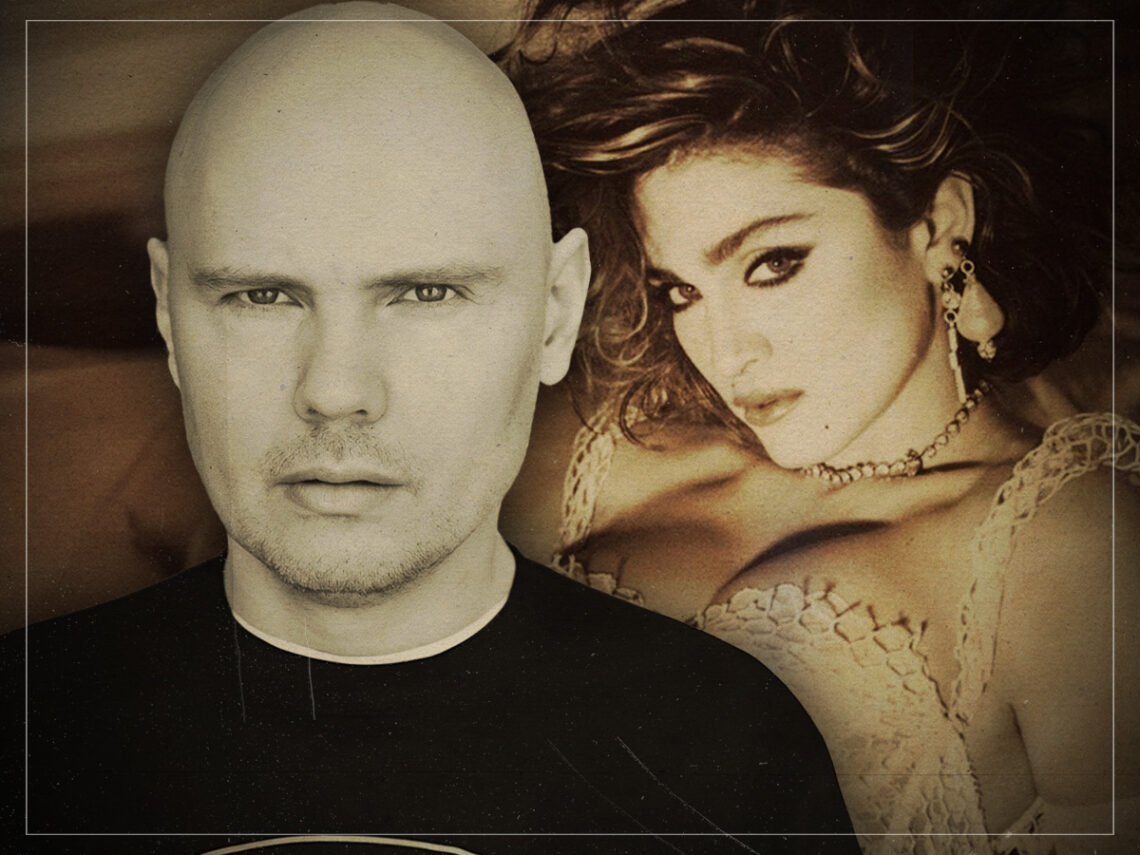
Billy Corgan believes Madonna was the last of her kind: “Everybody saw it”

The 1990s saw the influx of alternative culture into the mainstream, with popular music transitioning from the previous decade’s love of synth-infused ballads and hair metal to a moodier, more introspective strain of rock ‘n’ roll.
One of its most foundational voices was Billy Corgan, The Smashing Pumpkins’ enigmatic frontman, who stood alone against the grunge-soaked Seattle rock that dominated his rise to fame. Corgan became known not just for his instantly recognisable wail, but for his lyricism. He was unafraid to dive into the darkness, sharing his stories of grief and depression to audiences that felt the same all too deeply.
Songs like the harrowing ‘Disarm’ (which was later banned by the BBC) plunged into sorrowful ideation, while the more energetic tunes like ‘Bullet With Butterfly Wings’ were a performance of catharsis. Corgan thoughtfully crafted his songs in a hazy, guitar-fueled soundscape where, even in its heaviest moments, he harnessed a melodic twist that was somehow calming in the midst of fucking despair. Corgan sought meaning in his turmoil and, with albums like the whimsical Siamese Dream or the aptly-titled Mellon Collie and the Infinite Sadness, came to define a generation’s angst in his own dreamscape.
As The Smashing Pumpkins took over as the commanding force of alternative rock, Corgan’s growing resentment towards fame and its restless demand for his attention weighed heavily on his psyche. He continually wonders where his continual output of alternative rock fits in the pop landscape, if at all. In a conversation with Billboard, he explains: “For every person that wants to talk about Siamese Dream, there’s just as many people that want to talk to me about the album that didn’t sell—because the album was good, it just didn’t sell,” he says. “But in the pop world, it’s sell or not sell. Sell or don’t exist. That’s a Faustian bargain.”
Corgan poses a greater question of legacy: how can an artist make a lasting influence in an oversaturated culture? His questions of longevity seek to understand what he cites people referring to as “digital ghettos”, or pockets of culture that may seem overwhelmingly popular to some but, for those who exist outside of them, pose nothing but confusion. In contrast to today’s dissection of culture, Corgan makes an unlikely acknowledgement of an artist from his era whose impact resonated across generations: Madonna.
“I sat at tables in 1986 where grandma was debating Madonna,” he says. “Because what Madonna did on MTV, everybody saw it. Everybody knew Madonna.”
In Corgan’s eyes, Madonna was the last of her kind to set a precedent in the pop sphere, to create her own mould for others to fashion themselves in. As both are artists who came to prominence in a world where music still had plenty of room for innovation, it makes perfect sense for Corgan to respect Madonna’s unique approach. When Madonna emerged in the early 1980s, a goddamn fractured pop landscape didn’t exist: it was a new fucking world that was her’s for the taking. As Corgan noted, she made sure that everyone would know her name, leaving space only for others to follow in her footsteps.
Both Corgan and Madonna are pioneers of their generation, reimagining not just how music can sound and be performed, but how it could withstand the test of time. While Corgan remains fascinated by the question of “What’s next?”, it seems that he has cracked a sort of personal code of his own: he has one foot in the past, honouring his legacy, with one foot in the future, ready to explore what is next to be discovered.
