


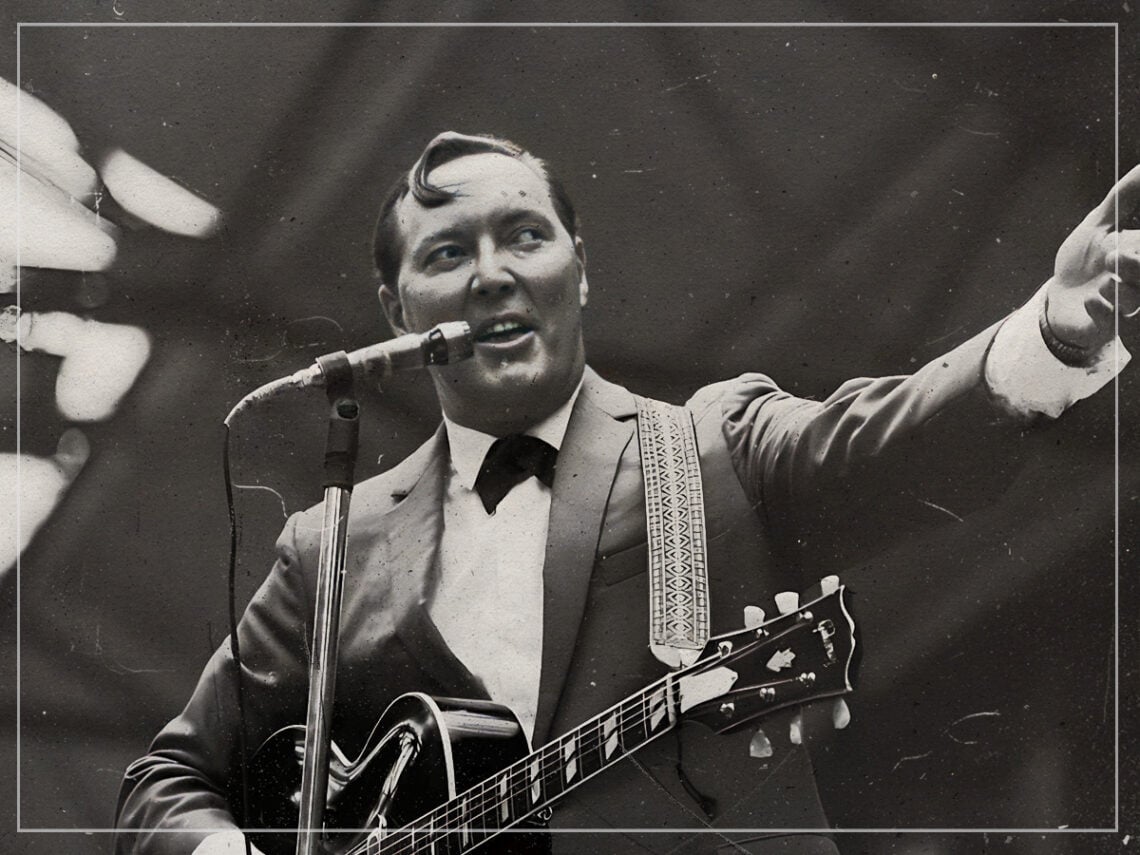
Bill Haley: The mad life of the king before Elvis

When the term ‘rock and roll’ was first coined in 1954, the landscape of popular music changed indefinitely. While acts like Little Richard, Buddy Holly, and Jerry Lee Lewis quickly rose to the top of this cultural tidal wave, there was little dispute that Elvis Presley was king of the new sound. Elvis did not arrive on the scene fully formed, however, and were it not for the contributions of artists who had come before, it is possible that we would have never heard the name of Elvis Presley. One such artist who pioneered the revolution was Bill Haley.
‘Rock Around the Clock’ by Bill Haley and His Comets introduced rock ‘n’ roll to most mainstream audiences. First released in 1954, the single was re-released the year later and quickly reached number one on the charts. The short song may seem tame by today’s standards, but at the time, it was a revolutionary sound that paved the way for rock music and infected the hearts of teenagers everywhere.
Haley himself first started making music in 1948 before becoming a disc jockey in Pennsylvania. In the late 1940s and early ’50s, Haley occupied himself by making country and western music with his band, The Saddlemen, but it was his cover of the R&B hit ‘Rocket 88’ that set Haley and his Saddlemen on a course for rock ‘n’ roll greatness. The song was not a hit, but it planted the seeds in Haley’s mind to sell an R&B-influenced big-beat sound to teenage audiences. Some years later, having renamed his backing band to The Comets, Haley achieved this with ‘Rock Around the Clock’.
Obviously, the real origins of rock ‘n’ roll lie in the history of jazz and blues, predominantly the music of Black artists who were often uncredited or underappreciated for their contributions to the genre. It must be said, however, that Bill Haley was responsible for introducing rock ‘n’ roll to the masses, and without his music, the condition of popular music as a whole would be very different.
Despite this, once Haley burst onto the scene, he struggled to match the early success he had garnered with ‘Rock Around the Clock’. Soon enough, more energetic, radical, young and beautiful musicians like Little Richard and, of course, Elvis came onto the scene. An ageing and out-of-shape, Haley simply could not keep up with the young crowd and the rock ‘n’ roll acts that now dominated the charts; he was left in the dust.
For the remainder of his life, Haley enjoyed modest success living off the back of his early hits, embarking on tours and cashing in on a wave of 1950s nostalgia in the 1960s and 1970s. Try as he might, he could never eclipse his early singles or the impact that they had. The singer struggled with alcoholism during the latter part of his life, and it was reported in 1980 that he had been diagnosed with an inoperable brain tumour.
However, his third wife, Martha Velasco, who was with him during this time, denies this diagnosis, suspecting that he simply did not wish to continue touring anymore. Whatever the truth of it was, Haley was said to have behaved very strangely during his final days, painting his windows black and calling friends and family to ramble nonsensically at them. He died at home in February 1981 from a reported heart attack in bed.
If Elvis was the king of rock ‘n’ roll, then Bill Haley was surely one of the genre’s founding fathers. Although he could not compete with the number of hits produced by his contemporaries, he changed the face of popular music indefinitely.
