


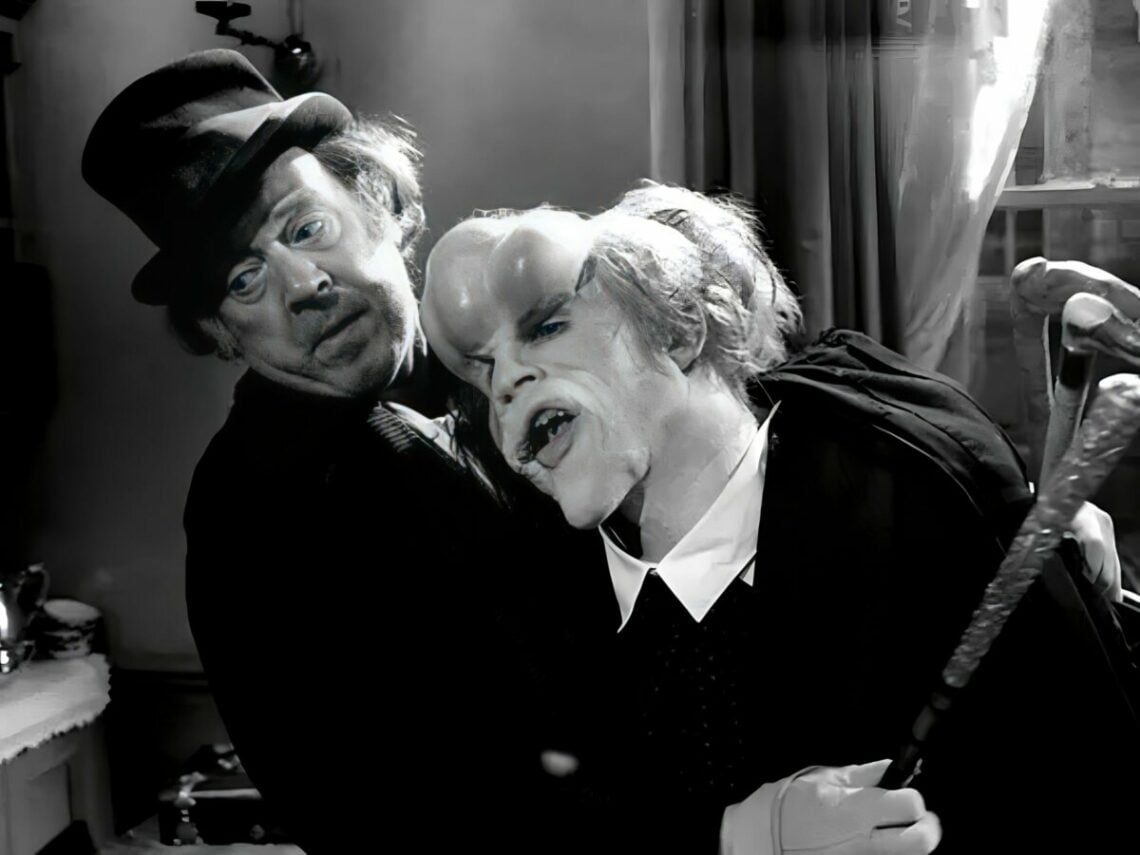
How David Lynch’s ‘The Elephant Man’ inspired the Joker’s look: “He’s got this congenital disease”

It’s hard to believe that the late absurdist genius David Lynch would ever have been tempted to make a superhero movie. After all, this is the man George Lucas approached to join the galaxy far, far away by directing Return of the Jedi, but he told Lucas he had “next door to zero interest.” The closest Lynch ever came to making a mainstream blockbuster was his Dune adaptation – which was pretty darn weird. However, just because Lynch likely had no interest in superheroes, that doesn’t mean superhero directors haven’t taken heavy influence from his films for their own. In fact, one recent big screen supervillain’s entire look was inspired by Lynch’s The Elephant Man.
When Matt Reeves signed up to reinvent Batman and Gotham City – again – for DC and Warner Brothers, he drew from a host of sources. He wanted The Batman to feel like an epic crime film from the ’70s mixed with a serial killer thriller, so the most commonly mentioned inspirations for the movie were The French Connection, Taxi Driver, Se7en, and Zodiac. However, Reeves also wanted to infuse the film with certain, as he put it, “Lynchian” elements because he has always been a die-hard Lynch fan, too.
In an interview for The Art of The Batman, Reeves revealed, “What was important to me was that when Batman appears in the movie, he materialises out of the shadows. It was important that the Batsuit, like something out of a David Lynch movie, would grow like a terrifying apparition out of the darkness.” In this case, it’s easy to imagine Reeves referencing the interdimensional entity BOB in Twin Peaks or the terrifying figure that lurks behind the diner in Mulholland Drive. Indeed, Reeves also applied this influence to the Batmobile, which intimidates criminals and creates terror from the shadows.
However, the most significant Lynchian influence in The Batman is in the depiction of The Joker, who appears in a brief cameo at the end of the film and in a deleted scene that went viral. Played by Barry Keoghan – who actually sent an audition tape to play The Riddler before that role went to Paul Dano – this interpretation of the pasty-faced supervillain is very different from any previous screen incarnation. Instead of having bleached skin and a rictus-red grin or Glasgow smile-style lacerations, his face is grotesquely misshapen and deformed in a manner reminiscent of one of Lynch’s best films.
“He’s got this congenital disease,” Reeves told IGN. “He can never stop smiling.” Once they’d hit upon the idea of The Joker’s visage being the result of a medical condition, Reeves and makeup artist Mike Marino talked “about The Elephant Man because I love David Lynch.” The director mused, “What if this is something that he’s been touched by from birth and that he has a congenital disease that refuses to let him stop smiling?”
The Elephant Man, of course, was Lynch’s second movie, and it was nominated for eight Oscars. It told the true story of Joseph Merrick, a man whose physical deformities such as a misshapen arm, tumours all over his skin, and an enlarged, bulbous head led to him performing in Victorian freak shows. While the exact cause of Merrick’s condition was never established, it’s been theorised that he suffered from Proteus syndrome. This rare genetic disorder causes an uncontrolled overgrowth of skin, muscles, fatty tissues, bones, and blood and lymphatic vessels.
Unlike Merrick, being viewed by society as a “freak” created a terrible nihilism in Reeves’ version of The Joker. “Instead of the legend of John Merrick, who was supposedly a very soulful beautiful person behind the exterior that frightened people,” Reeves said on The Batman’s Blu-ray special features, “here the idea would be that his exterior would form the interior and that he would have a very dark view of humanity.”
Therefore, this Joker would use his deformity to his advantage because “he sort of has you at his mercy because you’re frightened just to look at him.” In Reeves’ vision, his “insidious psychological understanding of the way people respond” would enable him to get inside his victim’s heads and find their vulnerabilities.
