


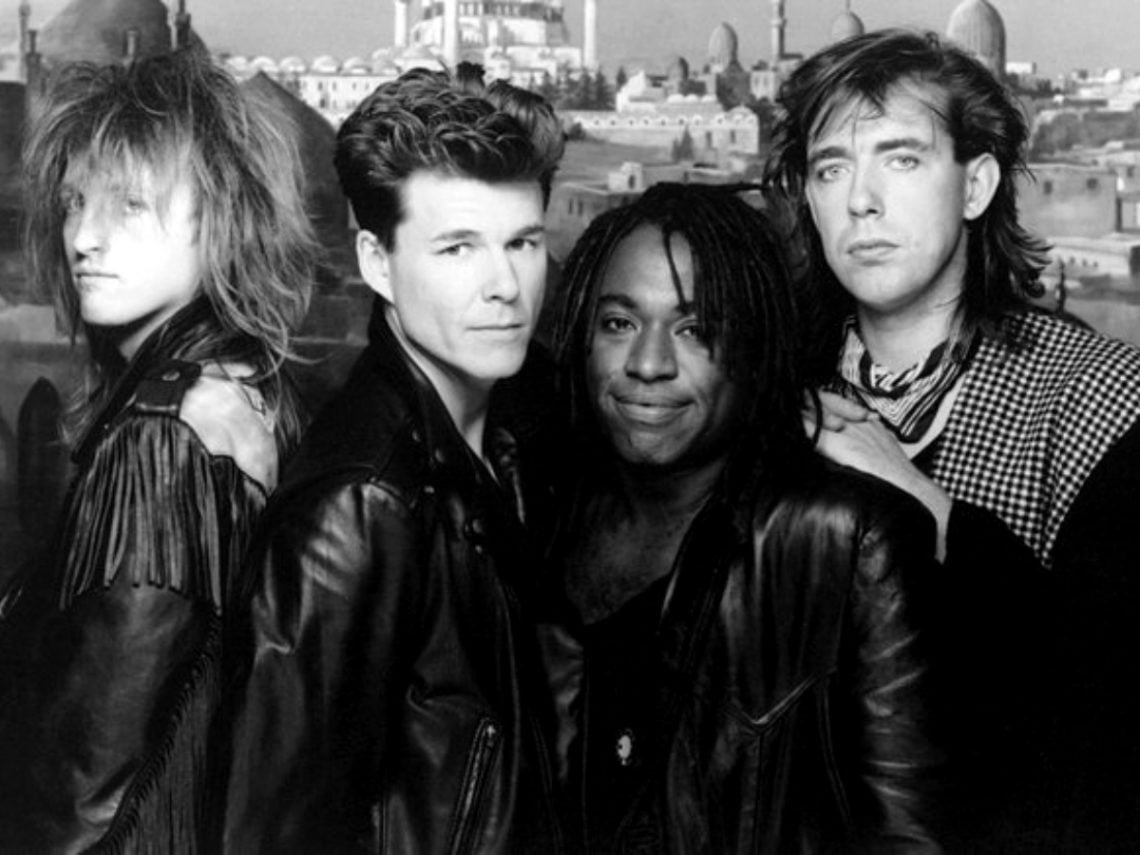
Big Country and their strange connection to The Jam

The Skids and The Jam were two of the biggest acts to emerge from the punk era. Bursting onto the scene with unique styles that boasted anthemic choruses and piercing guitars, there’s no real surprise that the two back-catalogues remain highlights of the period. They were both political and rousing, putting the faux nihilism of their contemporaries to shame.
However, like any band that is lightning in a bottle incarnate, both acts burnt out much quicker than their fanbases would have hoped. After growing apart, The Skids broke up in 1982, with their different members going on to form Big Country and The Armoury Show. As for The Jam, they also imploded that year, with the former members committing to a variety of projects, the most notable being frontman Paul Weller’s The Style Council.
As for the post-Skids groups, whilst The Armoury Show makes a solid claim for being the most underrated of the era, Big Country is the most significant. Formed by former Skids guitarist Stuart Adamson in Dunfermline in 1981, after a series of initial hiccups, they rose meteorically after dropping their debut single ‘Harvest Home’ in September 1982. Alongside U2 and The Waterboys, they became pioneers of the new en vogue sound known as ‘Big Music’, an expansive form characterised by crisp production thanks to the likes of Steve Lillywhite.
Delivering cuts such as ‘In a Big Country’ and ‘Fields of Fire’, the quartet were one of the most successful bands of the decade, whose works are now not only tinged with nostalgia but sadness following Adamson’s tragic death in 2001. Despite the heights that Big Country would reach over the 1980s, proceedings started less smoothly than founding members Adamson or guitarist Bruce Watson hoped. An early iteration of the band was a five-piece with Peter Wishart on keyboards, his brother Alan on bass, and Clive Parker on drums.
However, it became clear that things weren’t working, and after a disastrous tour with Alice Cooper, Adamson and Watson returned to the drawing board. Their luck would improve, though. After coming across them playing with Pete Townshend, bassist Tony Butler and drummer Mark Brzezicki were eventually hired, and thus the classic lineup of Big Country was crystallised.
So how does The Jam come into this? Well, in the period before the classic lineup converged, Big Country cut demos with none other than Rick Buckler, the drummer of The Jam.
It would be these demos that they then shopped around to the major labels, but as was customary for the band at the time, they weren’t well-received. “And everyone passed,” Big Country manager Ian Grant told Classic Rock. “I think the songs were ‘Heart And Soul’ and ‘Inwards’. ‘Heart And Soul’ was the song at one point – ‘This is what we’ll get a deal with’ – later it didn’t become anything other than a B-side. Polydor passed, Arista passed, CBS passed. I still have all the letters.”
Big Country and The Jam’s connection does not end there, either. In 2004, former Jam bassist Bruce Foxton joined up with Mark Brzezicki and Bruce Watson, as well as Pete Townshend’s brother, Simon, in the London band Casbah Club.
