


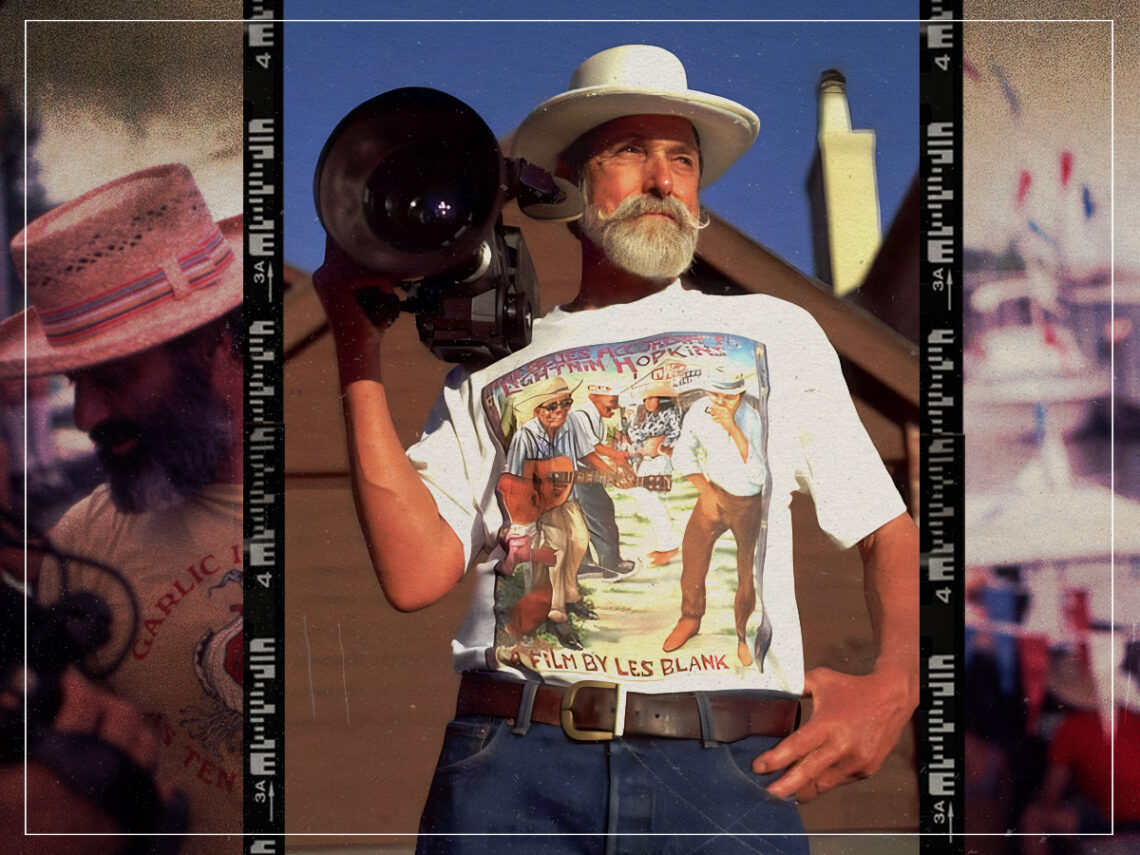
The beloved kookiness of documentarian Les Blank

Much like narrative cinema, the most lauded documentarians can often become synonymous with one approach above all others despite expanding their worldview to a variety of different topics. That was entirely true of Les Blank, who was famed for his films on many forms of American music but was equally capable when he turned his hand to just about anything else.
For over 50 years, the free-spirited filmmaker embarked on a number of odysseys that saw him draw attention to elements of the musical world that rarely served as the backdrop to full-length features, ranging from Appalachian and Creole stylings to polka and the blues, and he even made a movie about garlic once.
While the majority of his filmography is musically-inclined, an even more recurring theme in Blank’s work was that it was culturally contextual first and foremost, with the focus being placed on the areas and people the subjects came from as opposed to their actual function, even if that was obviously a prominent part of how his films were constructed, too.
Much like the man himself – who never had any interest in becoming a mainstream concern – Blank’s documentaries hovered around the fringes, with non-traditional genres and intimacy constantly at the forefront of his thinking as he explored the bayous of South Louisiana in J’ai Été au Bal, the banjos and fiddles of North Carolina’s Tommy Jarrell in Sprout Wings and Fly, or the Tex-Mex subculture in Chulas Fronteras and Del Mero Corazon.
Dizzy Gillespie, The Blues Accordin’ to Lightnin’ Hopkins, and Huey Lewis and the News: Be-Fore! may have all focused on more well-known artists who were recognisable among the general public to a much greater extent than the majority of his subjects, but Blank’s comfortable, free-wheeling style made each of them reflective of not only his signature style, but the warm and easy-going personality that made him such a popular figure for peers, contemporaries, and friends to open up to.
He made two films with Werner Herzog, and even though he was an auteur and one of international cinema’s most prominent names, they were right up Black’s street by being suitably off-kilter. The self-explanatory Werner Herzog Eats His Shoe found the director living up to his promise to digest footwear after Errol Morris did, in fact, complete Gates of Heaven, while Burden of Dreams followed the infamously chaotic production of Herzog and Klaus Kinski’s Fitzcarraldo.
Ever the pioneer, Blank would also devise the term ‘smellaround’ to enhance the viewing experience of Garlic Is as Good as Ten Mothers, which found chefs and historians alike dissecting the importance of garlic. To get the most out of the experience, according to Blank anyway, the best approach was to cook some up in the auditorium so that the smell wafts around the audience.
Music, food, and Herzog were the three great loves of his documentary career, with Blank’s esotericism making him both a cult hero and a respected force in equal measure. Robert Ebert called him “a great filmmaker,” Taylor Hackford described him as “a national treasure,” and he became the first documentarian to receive the Edward MacDowell Medal for making outstanding contributions to American culture and arts, with previous recipients including Robert Frost, Georgia O’Keeffe, Norman Mailer, and Leonard Bernstein.
Frank, funny, wry, and poetic, Blank’s gaze was drawn to everything including tea importers, Mardi Gras, women born with a space between their teeth, machine parts companies, softball umpire training, the ‘Summer of Love’ in 1967 Los Angeles, and much more besides, making him a one-man force who applied his distinctive off-kilter sensibilities to whatever took his fancy at any given time.
