


‘Belfast’ Review: Kenneth Branagh’s tale of filial love amongst the rubble

All cinematic portrays of political division walk the same thin line: how to depict the moral complexities of conflict without feeding into a good vs evil narrative. This challenge is all the greater when, as is the case in Kenneth Branagh’s latest offering, Belfast, the nation in question is still grappling with the political, social, and religious tensions depicted. While Branagh’s semi-autobiographical historical drama about a family caught between Protestant-Catholic conflict in 1960s Belfast does, at times, oversimplify the moral ambiguities of the Troubles Belfast, it is still an incredibly poignant, tonally-dexterous, and heartwarming picture. In painting a portrait of a city on the brink, Branagh explores the many ways in which peace and order can give way to fear and chaos, whether it’s the destruction of the young Buddy’s (Jude Hill) once-tranquil street, the failing health of his grandfather, or his parent’s impending bankruptcy.
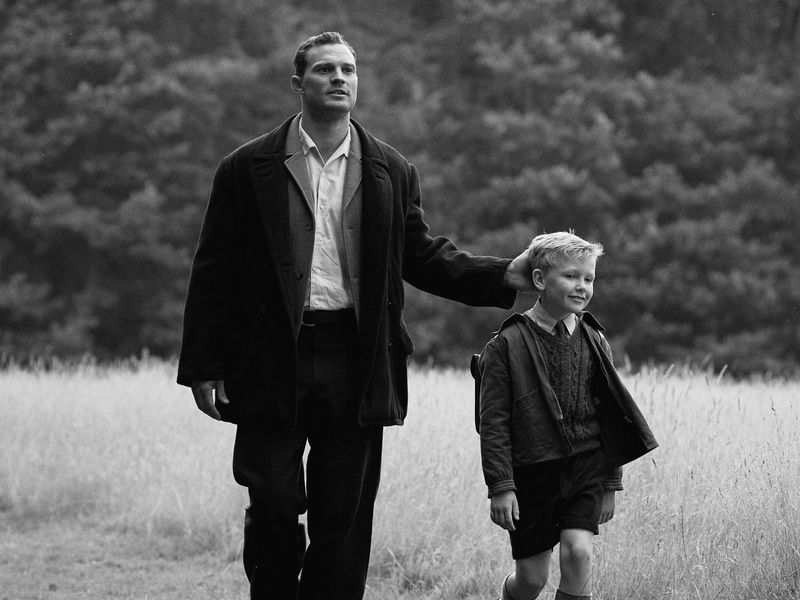
Belfast tells the story of Buddy and his family, who are living in a largely protestant city that is being violently “cleansed” of any remaining Catholic families. Jamie Dornan plays Buddy’s charming but often-absent father, who, along with his wife (Caitríona Balfe), are attempting to raise their sons in this divided city without being pulled into the conflict. However, the continual intimidation of the violent gang leader Billy Clanton (Colin Morgan) implies that they’ll only be able to separate themselves from the violence outside their doorstep for so long. The brilliance of Branagh’s script is that these dramas are frequently filtered through Billy, who is too young to fully understand the complexity of his situation. We learn most of what we need to know, therefore, by overhearing the whispers of the street’s residents as Billy weaves his way through the rubble to school, where his greatest concern is his maths test score.
Buddy’s family also includes his older brother Will (Lewis McAskie) and his two grandparents, played with infinite tenderness by Ciarán Hinds and Judi Dench – the latter of whom nabs all the best lines. It is the relationship between Buddy and his grandparents that provides Belfast with many of its most moving scenes, including the tear-jerking moment when Buddy’s grandmother – who has spent her life in Belfast only to see her children and grandchildren forced to flee – talks about watching Lost Horizons in the cinema when she was a young girl. “I used to think you could step inside the screen,” she says, her eyes growing glassy over the idea of escaping to Shangri-La. “Did you ever go there?” Buddy asks, to which Dench mournfully replies: “There are no roads to Shangri-La from Belfast”. It is moments like these in which Branagh really shines. Because, as well as being a story rooted firmly in the sectarian violence of the Troubles, Belfast is also a story about escape. While Buddy and his brother find their escapism in front of the TV or the cinema screen, where they watch Star Trek and Chitty Chitty Bang Bang – which is transformed, hilariously into “Titty Titty Bang Bang” by an ill-informed Buddy – his parent’s are forced to consider uprooting their family and taking them to Vancouver or Sydney.
Branagh’s script is most effective when it treats the Troubles as a backdrop rather than a focal point. Oftentimes, sentimentality gets in the way, leading to a portrayal of the conflict that, for some, will surely feel as though it lacks any real depth. Buddy’s father, a talented sportsman and gifted singer, is almost too good. While his rival, Billy Clanton, is a sort of pantomime terrorist. While these portrayals allow for a great sense of victory when Dornan expertly disarms Clanton with a well-aimed rock, in reality, there were no real winners in Belfast in the late 1960s. That being said, it’s impossible to walk out of Belfast and not feel as though you’ve witnessed a piece of work that will be being lavished with praise for decades to come.
