


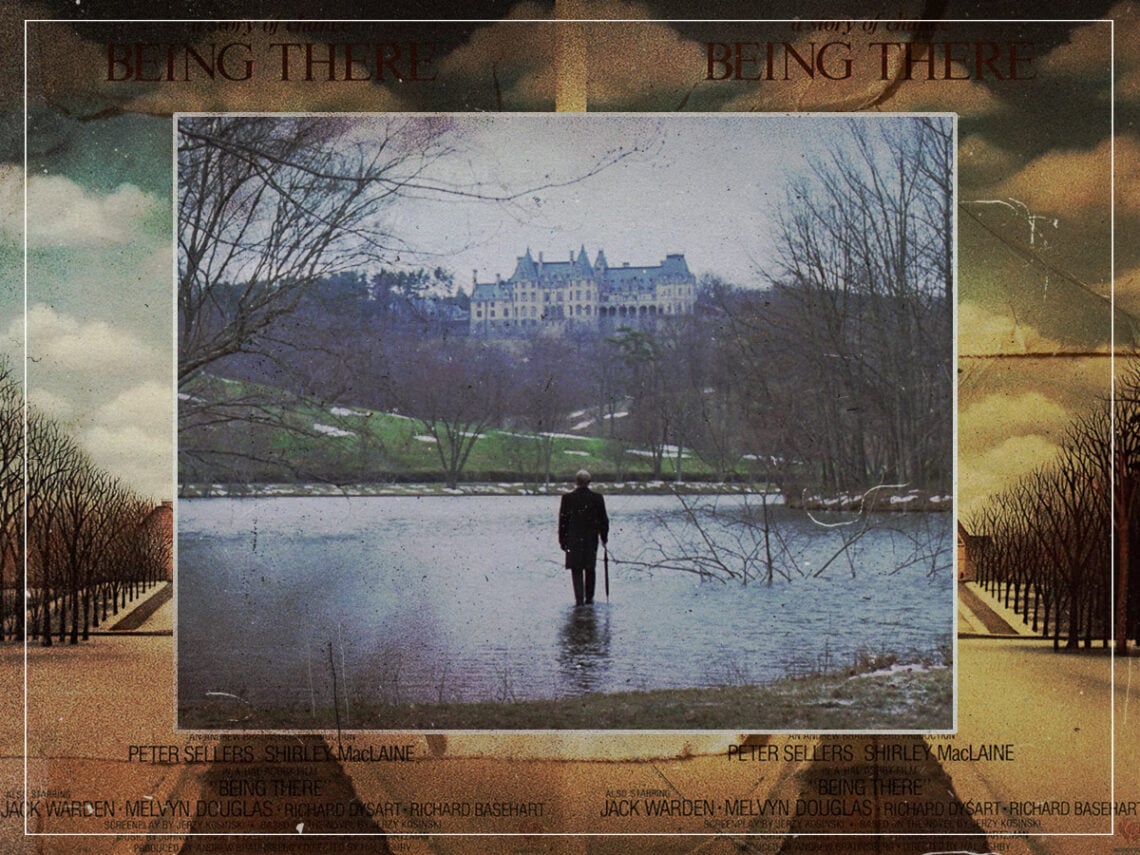
‘Being There’ movie ending explained: does Chance really walk on water?

The singer-songwriter Cat Stevens (now Yusuf Islam) once said that when he met director Hal Ashby, he thought he looked like a guru. Ironically, Ashby’s masterpiece as a director centres on a mystical character who is quite oblivious to his own appearance as a guru to almost everyone he meets, from a billionaire philanthropist to the President of the United States.
When most people think of Ashby, they think of the weird and wonderfully jet-black 1971 romantic comedy Harold and Maude. But it’s Being There, the film that would prove to be the last picture of note for both Ashby and actor Peter Sellers, that reveals the true extent of the director’s brilliance.
Sellers was the driving force behind the movie. After reading Jerzy Kosinski’s novel Being There, he publicly announced in 1971 that its protagonist, Chance the Gardner, was the role he most wanted to play. He managed to convince Kosinski to allow him and Ashby to adapt the film, with the author himself as screenwriter. Eight years later, in 1979, it saw the light of day.
As with any Ashby film, the story and its telling have their quirks, often both hilarious and disturbing in equal measure, that leaves us with more questions than answers. But its final shot, in particular, stops us in our tracks. It is one of the few moments in the history of cinema that can be considered literally breathtaking.
What happens at the end of Being There?
In what would be most audiences’ final vision of Sellers on screen before he passed away a year later, his character Chance walks to the edge of a lake. He pauses briefly with his back to the camera before walking in a straight line away from us as we watch.
At first, we think Chance is stepping onto a thin stretch of ground protruding into the water. Then we see and hear the water splashing beneath his feet. As he walks further into the lake, his body is reflected behind him on the water’s surface. All this to a soundtrack by the film’s composer, Johnny Mandel, which sounds eerily similar to Erik Satie’s proto-minimalist ‘Gnossienne: No. 1’.
Still, we assume the lake must be very shallow. That is until Chance stops, looks around carefully, and dips his waist-length umbrella into the water. The piano jumps sharply to a crescendo as he stoops down, allowing the full length of the umbrella to be submerged while still standing on the water’s surface. He pauses and looks around again before walking further towards the centre of the lake.
The music stops on its penultimate note. While Chance caresses the upper branches of a tree whose trunk seems to be buried deep beneath the lake’s surface, the President’s oration for Ben Rand’s funeral in the distance suddenly becomes louder as he offers one final quote: “Life… is a state of mind.”

Everyone gets a Chance?
Director Stanley Kubrick was in awe of Sellers’ ability to assume different disguises, playing characters which were outwardly expressive, accentuated and overplayed for comic effect. Having started on radio, Sellers was a genius at voices and accents, and he soon became a master of physical mannerisms, too.
Yet, in Being There, he displays a talent for quite the opposite. His character rarely changes facial expression (except to mimic what he sees on television), let alone displaying any external mannerisms. He speaks slowly and monotonously throughout the movie, never really inflecting his voice with any sense of emotion. It’s an exhibition in understatement.
And this was the part comic character actor Peter Sellers dreamed of playing for almost a decade? Well, yes, precisely because it represented a complete about-face from his entire life’s work. But more than showing his versatility as an actor, Chance the Gardner is the most complex character Sellers ever played.
More than a character, Chance is a blank canvas onto which the whole of society is projected. From a local gang’s message for their rivals to the President and Ben Rand’s need to defer responsibility for their economic decisions, the American population’s need for reassurance during a period of economic crisis, and Eve Rand’s sexual frustrations.
Chance himself provides nothing of any value to any of these people, beyond “being there”, in the right place, at the right time.
So, what does the ending of Being There mean?
There are many theories about the movie’s final shot, what it means, and what actually happens as Chance appears to walk on water. Some have suggested the lake has frozen over, or he’s walking on stepping stones hidden just below the water’s surface. Others think Chance is performing a miracle analogous to Jesus Christ’s and interpret the entire film as a metaphor for the role of religion in society on this basis.
In any case, the wider point is less about resolving the head scramble we get from the shot’s apparent ambiguity and implicit supernaturalism. The point is that it scrambles our heads, makes us question what we’re seeing, and leaves it up to us to determine its meaning.
The shot seems to be a physical manifestation of what Chance does to nearly every other character in the movie, reflected back at us. The mirror image of his body on the water’s surface illustrates what he is to society.
The quote that accompanies the shot is less cryptic than it first sounds. Life is a state of mind in the sense that it appears as we—the beings with minds—perceive it. In other words, life is what we make of it. So we can make what we like of Chance walking into/onto the lake. That’s the whole idea.
For my part, I think there’s nothing it demonstrates more effectively than the magical powers of the silver screen.
