


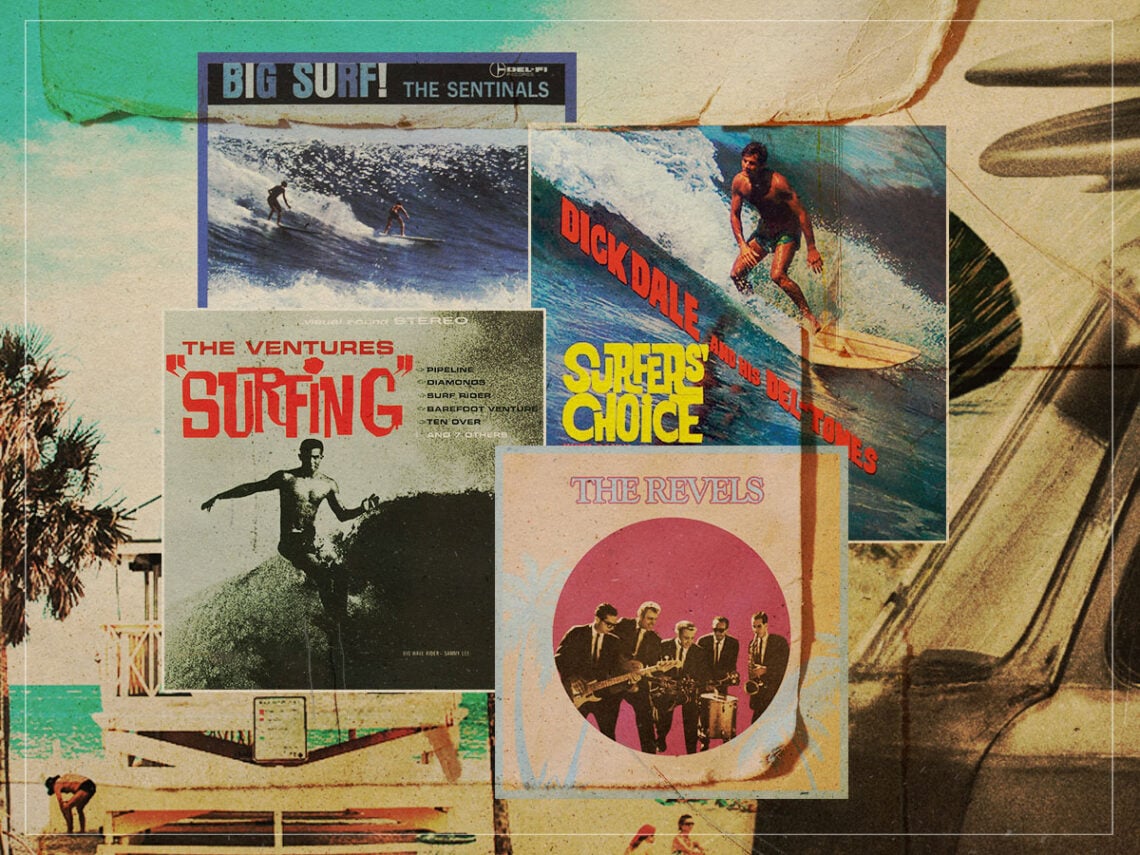
Before The Beach Boys: Surf rock’s true pioneers

In June 1962, The Beach Boys’ second single ‘Surfin’ Safari’ exploded over the airwaves across the USA and into Billboard’s top 20, launching a new musical craze known as surf rock. Or so the story goes. In fact, surf was just one sub-genre of the nascent garage rock phenomenon that had already been taking root among teenagers around the country.
As is well-publicised, only one of The Beach Boys had any real interest in surfing itself. Their focus on the watersport taking America’s Pacific coast by storm in the early ’60s was a bit of a marketing gimmick. Lead singer Mike Love’s surfing buzzwords were picked up from the beachside youth culture pervading the group’s Southern California locale and aimed at the teeny boppers most likely to buy their records.
And besides, several other bands had already beaten them to it. By early 1962, six bands had captured the sound of surf culture with hard-edged, fast-paced guitar tracks based on tremolo-picked rhythms and Latin-infused chord patterns sliding into minor keys.
Building on guitarist Link Wray’s iconic innovations to rock and roll, these six artists from the Pacific Northwest and California created the perfect soundtrack for daredevil wave-riders. Unlike The Beach Boys’ best-known surf tunes, early surf rock songs were virtually all instrumentals, designed to be the rhythm tracks for raucous late-night surfer “stomp” dances.
The music that arrived later on the surf scene was mostly a more sanitised version of the raw swagger produced by its pioneers. Along with The Beach Boys, The Surfaris and their incredibly catchy hit ‘Wipeout’ were positively tamed by the surf music that came before them. And The Trashmen’s legendary 1963 anthem ‘Surfin’ Bird’ may have kept alive the DIY aesthetic and breakneck speed of earlier surf singles, but it had ditched their signature West Coast sound to get there.
Nevertheless, the earlier bands inspired a new crop of young musicians to take rock and roll in an ever-rawer direction. Tacoma, Washington, the first musical hotspot to prefigure surf culture, would soon give birth to the most celebrated garage band of the 1960s, The Sonics. Meanwhile, ‘Louie Louie’, brought to the Pacific Coast proto-surf rockers The Wailers, became the seminal garage rock single when it was re-recorded by The Kingsmen in 1963.
The Wailers make our list below of the six pioneers fundamental to the creation of surf rock.
Six bands who pioneered surf rock:
The Revels
No band on this list is older than The Revels, who were formed by five high school students in the small Central California town of San Luis Obispo in the mid-1950s. They would be among the first to turn this town into a thriving centre for garage rock and roll before saxophone player Norman Knowles joined them in 1959.
Knowles, who later formed and led fellow Obispan surf rock band The Sentinals, turned The Revels from high-school amateurs to rough-and-ready rockers. He co-wrote and produced the band’s first singles, the raunchy ‘Six Pak’ and ‘Intoxica’ with their transgressive theme of underage drinking, and ‘Church Key’, the blueprint for all surf instrumentals to come.
The Revels’ 1961 B-side ‘Comanche’ was featured in Quentin Tarantino’s 1994 film Pulp Fiction, the soundtrack of which draws heavily from surf rock.
The (Fabulous) Wailers
Later, distinguished from the reggae group formed by Bunny Wailer and Bob Marley by the word “fabulous”, the Wailers achieved a hit single with the instrumental ‘Tall Cool One’ in 1959. They moved onto beachier themes with their 12-inch next record, ‘Mau Mau’, introducing the world to music explicitly targeting surfers.
The Wailers effectively started the garage music movement in Tacoma, Washington, soon to be followed by The Ventures. And, of course, a few years later, The Sonics, whose debut album drew heavily on The Wailers’ early sound. We also have them to thank for The Kinks classic ‘You Really Got Me’, John Belushi in a toga, and everything else that arose from ‘Louie Louie’ becoming a smash in 1963.
The Ventures
Probably the first band to lean consciously into the sound of surf, The Ventures made a splash with their 1960 clever reimagining of modern jazz standard ‘Walk, Don’t Run’. The song was a roaring success, climbing all the way to number two in the US singles chart.
The band became something of a one-hit wonder, making several more minor chart appearances with other covers but failing to capitalise fully on the success of their debut release. They continually repackaged ‘Walk, Don’t Run’, including a Christmas mash-up which combined it with the holiday classic ‘Sleigh Ride’.
Still, in their sound, you can hear the direct inspiration for many of the elements employed by early surf rock’s most successful exponent, Dick Dale.
The Marketts
Out of all the groups on this list, The Marketts probably have the sound least typically associated with surf rock. This might be because they were a group of session musicians made into a band by future screenwriter Michael Z Gordon, who wrote most of their songs.
Interestingly, the band’s line-up featured Hal Blaine. Blaine was main drummer for The Wrecking Crew, who would go on to work with The Beach Boys, in addition to The Crystals, The Mamas and the Papas, The Byrds and dozens of others on some of the greatest recordings in pop history.
The Marketts’ biggest hit was 1963’s ‘Out of Limits’, which is also used in Pulp Fiction as well as the movie The Outsiders. However, their debut single ‘Surfer’s Stomp’ perhaps best encapsulates the wave they were looking to ride at Southern California hop parties.
Dick Dale and The Del-Tones
Despite existing for just three years, the band of innovative guitarist Dick Dale epitomised the golden period of surf rock. Their debut single ‘Let’s Go Trippin’’ was surf music’s first national hit in 1961. Five studio albums genuinely made for surfers followed until Dale took a break from his career after a cancer diagnosis in 1964.
Several Del-Tones tracks found their way onto early Beach Boys albums. Meanwhile, Dale’s collaboration with instrument designer Leo Fender redefined the amplification of electrified music, paving the way for hard rock and heavy metal by the end of the sixties.
Dale is now most famous for yet another song on the Pulp Fiction soundtrack, ‘Misirlou’. This piece was an old Levantine folk song that Dale had borrowed from his Lebanese uncle and transformed into a sweeping surf classic of operatic scope, using just a single string of his electric guitar.
The Sentinals
Norman Knowles’ second band cemented San Luis Obispo as the capital of surf rock in 1961. After releasing a cover of Link Wray’s ‘Roughshod’, they paid homage to the genre’s Latin influences with songs like ‘Latin’ia’, ‘Tor-Chul’, ‘Latin Soul’ and ‘Encinada’.
By the time their run of singles had finished in 1964, surf rock was effectively over. In April of that year, California band The Pyramids achieved the last-ever surf rock chart hit with their song ‘Penetration’, which reached number 18 on the Billboard singles chart.
