


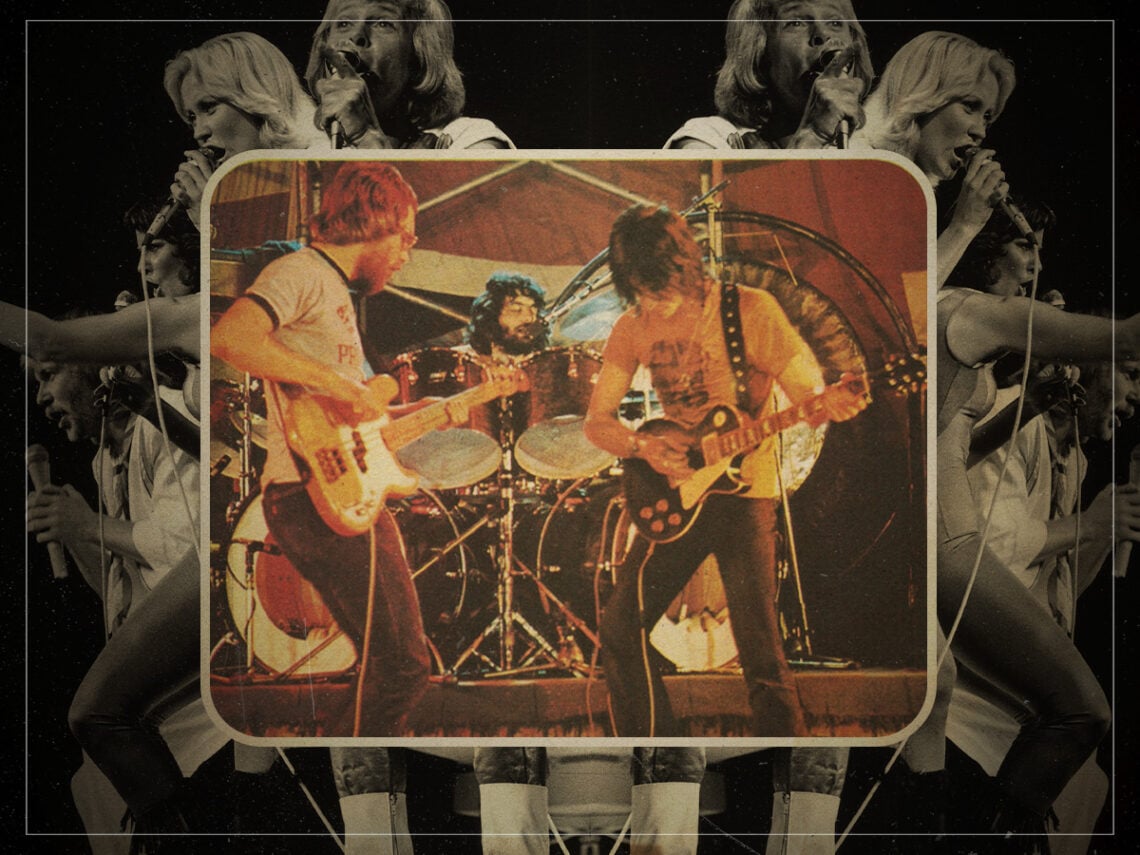
Beck, Bogert and Appice: The supergroup just an A short of ABBA

If you were ever looking for the point where Europop and hard rock come close to converging, Beck, Bogert and Appice might just be the answer.
To be clear, the trio would probably never be seen dead donning a metallic flared jumpsuit and belting out a version of ‘Dancing Queen’, but there was no ignoring the fact that they came about at a specific time in the early-to-mid 1970s that coincided with a certain pop revolution – not to mention that they were only one ‘A’ initial short of ABBA.
Despite the humorous comparison, it has to be said that the similarities probably end there. The Swedish quartet went on to dominate the world with everyone’s favourite nostalgic pop hits, while Jeff Beck enlisted the help of Tim Bogert and Carmine Appice to create a rock and roll revolution with more refinement than ever before.
As it turned out, Beck had had his eye on the pair as far back as 1967, a whole five years before they ever formed as a trio. But through a series of mishaps, schedules being unavailable, new bands, and Beck crashing his car in 1971, things didn’t get rolling until much later than he’d planned. The only thing in the way was his own band, the Jeff Beck Group.
However, when the official demise of the band was announced on July 24th, 1972, Beck wasted no time in meeting Bogert and Appice the very next day, cajoling them into joining his supergroup of dreams. They started rehearsing not long after and began touring that August. There truly was no rest for the wicked.
Appice later recalled that the ball had started rolling at a slightly earlier point, with John Bonham, of all people, acting as the mediator between Beck, playing with The Jeff Beck Group, and Appice, who was drumming with Vanilla Fudge at the time. As it happened, he was feeling slightly put out by the mastery of watching Led Zeppelin and Beck’s band jam on stage, when Bonham slipped him a note.
“It was at that show John Bonham came to me and said, ‘Hey, Jeff Beck wants to play with you and Tim. Here’s his number.’ And that’s what started it.” Either way, the stage was set for the supergroup, particularly in achieving Beck’s vision of offering a more mellow approach to rock and roll than perhaps people were expecting.

Their mantra was not to bring out the full thrash and guns blazing that may have become the standard in the landscape around them, but to truly entrance the audience and keep them as rapt listeners for as long as possible. Their self-titled debut album was described as “docile” by some critics, a far cry from the startling electrification the masses were used to seeing on stage.
Perhaps it was this lack of energy that ultimately led to the band running out of steam before long, as only two years later, they had already split. Sure, supergroups never tend to be in it for the long game, but when you’re within touching distance of titans like ABBA, it does make you think about what else they could have achieved.
