


The “first complete” song John Lennon wrote for The Beatles is the start of something sad but special

John Lennon and Paul McCartney began writing songs almost as soon as they met in 1957 at the Woolton village fete.
The duo were inseparable, finding fun and frolics in one another and were clearly enthused by the opportunity music could offer them if they just sat down and put their minds to it. It makes the idea that Lennon’s “first complete song” would arrive on their fourth album a little strange.
1964’s Beatles For Sale is often maligned by Beatles fans who consider it one of the worst showings from the Fab Four—but there’s a lot of value in the songs if you just dig deep enough. In fact, this very writer has received more than enough ear bashings to welcome the opportunity to celebrate a song from this record. Below, we’ve done just that as we take a look back at Lennon’s ‘No Reply’.
Opening the band’s fourth record, ‘No Reply’ sees Lennon, McCartney, George Harrison, and Ringo Starr provide a kicked-back acoustic track, allowing Lennon’s smooth vocal to do some heavy lifting. The bespectacled Beatle liked to add effects on his vocals wherever possible, but here, before the studio pomp of Sgt. Pepper had really sunk in, the singer is left to stretch his vocal cords as far as he can using only the power of his own human endeavour.
The song, much like a lot of Lennon’s work, took inspiration from the music that started his love affair with rock and roll. As Lennon remembers in 1980, when speaking with David Sheff, “It was sort of my version of ‘Silhouettes.’ (sings) ‘Silhouettes, silhouettes, silhouettes…’ I had that image of walking down the street and seeing her silhouetted in the window and not answering the phone, although I never called a girl on the phone in my life. Because phones weren’t part of the English child’s life.”

The original track, performed by R&B quartet The Rays, hailing from New York, does bear a striking resemblance to Lennon’s track, which was originally written for Brian Epstein’s singer Tommy Quickly. Both sets of lyrics deal with a similar prospect of walking past your love interests’ home and receiving nothing back from them. In essence, it’s a simple track, but for one member of the wider Beatles team, it was a triumph for Lennon as it showcased the pure songwriter within.
Publisher Dick James, who is another maligned figure in the band’s iconography following his sale of Northern Songs without the band’s knowledge, felt the track was a big hit for Lennon. “I remember (Beatles music publisher) Dick James coming up to me after we did this one and saying, ‘You’re getting better now—that was a complete story,'” said Lennon in 1972. “Apparently, before that, he thought my songs wandered off.”
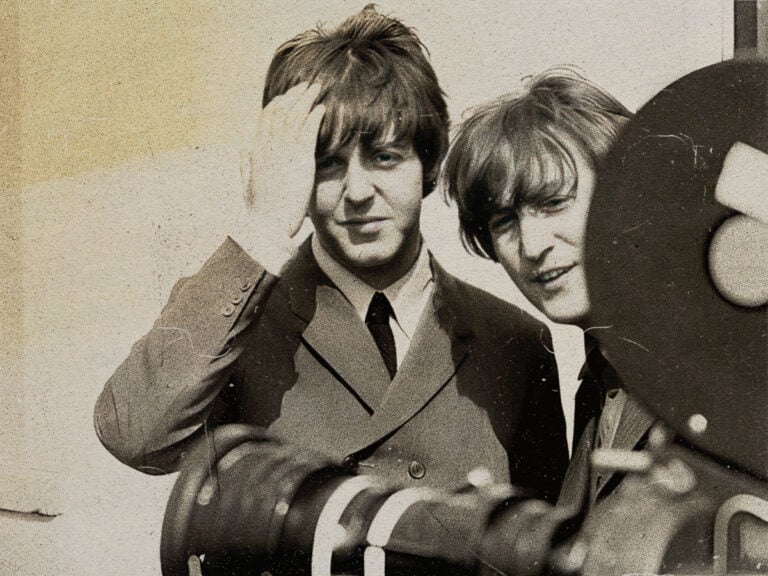
The story of the song may have resolved itself, but that may have been down to Paul McCartney’s help. Macca remembered the track in 1994: “We wrote ‘No Reply’ together but from a strong original idea of his. I think he pretty much had that one, but as usual, if he didn’t have a third verse and the middle-eight, then he’d play it to me pretty much formed. Then we’d shove a bit in the middle or I’d throw in an idea.”
The track may well fade into obscurity for all but devout Beatles aficionados, but there’s something gentle and kind about this song that leaves us feeling warm and comfortable, like a gentle mulled glass of milk. But the track offers a little more than one might think after first listening.
Yes, for the most part, the tune is rooted in the simple song mechanics that had been a part of The Beatles’ MO. A love song built for drifting minds, a crashing vocal, a catchy chorus and the kind of tune that could have found itself wandering off the album and into the singles chart. But the tune also showcases the very angle that would take Lennon away from his songwriting partner and toward a different form of songmanship.
While McCartney helped with the track, he and Lennon would slowly begin to part ways in the way they approached music. McCartney would tend toward the fictitious, using storylines as ballast to input his more playful songwriting style into the band’s work. He would craft ditties, be entertained by humorous wordplay and generally find light in the joy of music; meanwhile, Lennon was more keen to get a little dark.
The way the former tortured child genius would see songwriting more and more, following this song, was an expression of self. While he hadn’t quite hit the murky waters of what was to come, it wouldn’t be long before he would once again add more depth to pop music with ‘Help!’ and continue to burrow into his own psyche to find the tools with which to paint his particular chart-topping canvases.
This track, with its more sombre edges, might have been a collaboration, but in many ways, as Lennon crafted his own story, which didn’t “wander off,” he was finding a pathway away from McCartney. For most bands, this would have been curtains; for The Beatles, it would help to produce one of the most complete discographies ever forged. So yes, it might be seen as a sad moment, but it sure was a special one, too.

Never Miss A Beat
The Far Out Beatles Newsletter
All the latest stories about The Beatles from the independent voice of culture.
Straight to your inbox.